"Status of Inflation Target Management" Briefing
Lee Changyong, Governor of the Bank of Korea, predicted that the consumer price inflation rate, which has risen to the mid-2% range since October, will gradually decline to around 2%. However, he emphasized that, as the elevated exchange rate could, with a time lag, drive up prices for various items, the Bank will remain vigilant and closely monitor the situation.
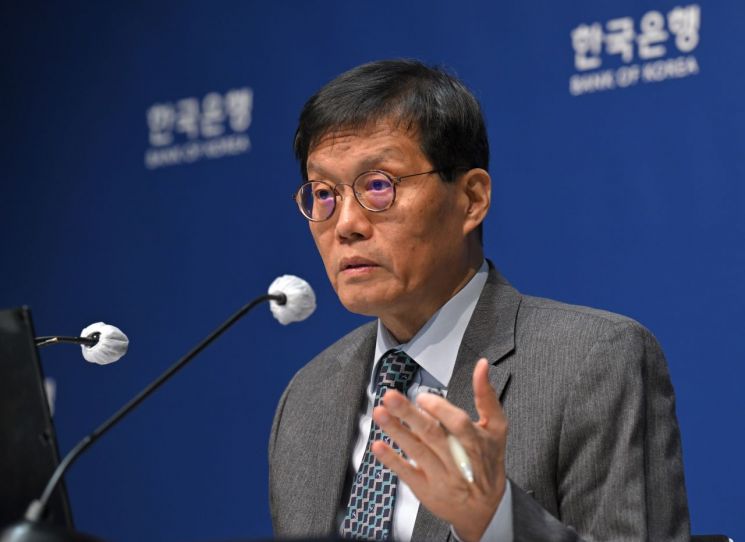
At the 'Price Stability Target Management Status Briefing' held at the Bank of Korea in Jung-gu, Seoul on the 17th, Governor Lee stated, "Next year, we expect the consumer price inflation rate to remain at 2.1%, the same as this year, as supply-side pressures ease despite a recovery in domestic demand." He added, "However, if the won-dollar exchange rate remains at its current high level, there is a possibility that the inflation rate could persist, so we must be cautious." Governor Lee also noted, "We take very seriously the concern that additional increases in the cost of living could further burden the public in these challenging times," and reiterated, "We will stay vigilant and monitor the situation closely."
According to the Bank of Korea, the consumer price inflation rate from January to November this year was 2.1% year-on-year, a slowdown compared to the same period last year. However, it rose to 2.4% in both October and November, reaching the mid-2% range recently. This increase has been attributed to a temporary rise in travel-related service prices, higher prices for agricultural, livestock, and fisheries products due to adverse weather conditions, and an increase in petroleum prices resulting from the high exchange rate.
The core inflation rate, which excludes food and energy, hovered around 2% in the first half of the year. In August, service prices were affected by a temporary discount on telecommunications fees, serving as a downward factor, while in October, a surge in travel demand acted as an upward factor. Recently, the core inflation rate has fallen back to 2.0%, and other underlying inflation indicators have generally remained stable, with the average of these indicators staying around 2% (2.0% in November).
The outlook for next year's consumer price inflation rate is that it will remain stable around 2%, in line with the November forecast. However, there are still potential risks related to the prices of agricultural, livestock, and fisheries products, as well as exchange rate trends. Factors such as a global oversupply of crude oil and the government's strengthened price stabilization measures have been cited as downward risks.
© The Asia Business Daily(www.asiae.co.kr). All rights reserved.
![Clutching a Stolen Dior Bag, Saying "I Hate Being Poor but Real"... The Grotesque Con of a "Human Knockoff" [Slate]](https://cwcontent.asiae.co.kr/asiaresize/183/2026021902243444107_1771435474.jpg)















