An Ultra-Rare Disease Affecting 5 in a Million
Advanced Reconstructive Surgery:
Repositioning the Heart into the Chest Cavity and Covering with Cultured Skin
First Successful Treatment of a Newborn with Ectopia Cordis in Korea
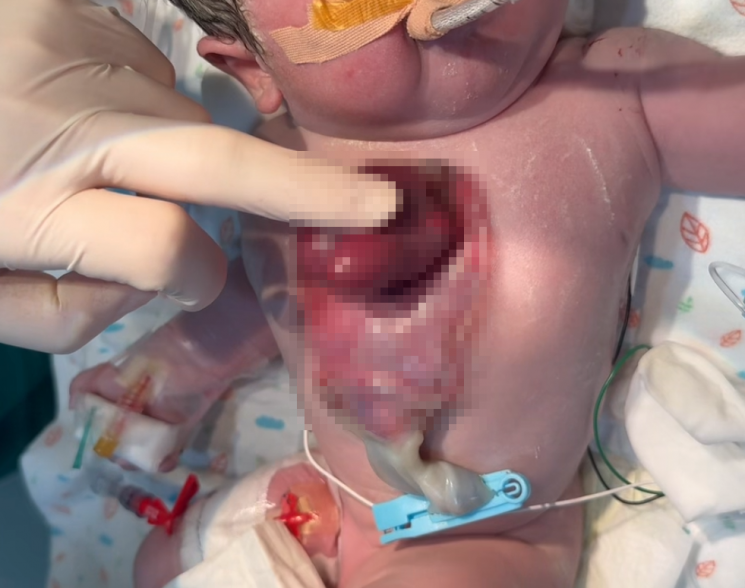
On April 10, 2024, in the delivery room of the new building at Asan Medical Center in Seoul, the heart of a newborn baby, delivered at 38 weeks, was beating completely exposed outside her body. She was born without a sternum to protect her heart, and the skin tissue of her chest and abdomen was not properly formed, leaving her chest open. Whenever the baby cried and strained, parts of her heart and lungs would protrude outside her body, and her lung function was so severely compromised that survival was impossible through spontaneous breathing alone.
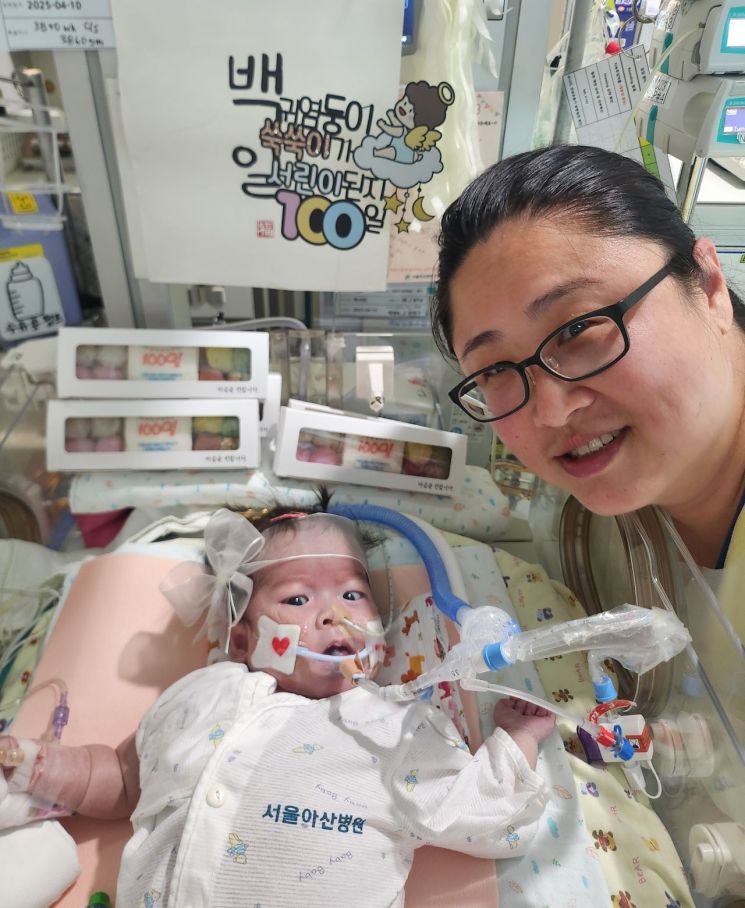 On July 19 this year, Seorin was photographed with her mother to commemorate her 100th day since birth in the Neonatal Intensive Care Unit at Asan Medical Center in Seoul. Photo by Asan Medical Center
Seorin, Born with Ectopia Cordis, Successfully Treated with Advanced Reconstructive Surgery
Park Seorin, an 8-month-old girl, was born with ectopia cordis-a rare and unexplained congenital condition in which the heart is located outside the thoracic cavity. It occurs in only 5 to 8 out of every 1 million births, and over 90% of patients die before birth or do not survive beyond 72 hours after delivery, making it a highly fatal condition.
However, Seorin's small heart continued to beat powerfully outside her body, demonstrating remarkable vitality. In Korea, there had never been a reported case of a newborn with ectopia cordis surviving, and even international literature on the subject was extremely limited. Despite this, the medical team at Asan Medical Center did not give up and remained determined to find a way to increase her chances of survival.
Asan Medical Center recently announced that, through a multidisciplinary collaboration involving experts from the Departments of Pediatric Cardiology, Cardiovascular and Thoracic Surgery, Plastic Surgery, Pediatric Cardiac Surgery, Obstetrics and Gynecology, and Convergence Medicine, they succeeded for the first time in Korea in performing a highly complex reconstructive surgery. This involved repositioning the heart of a newborn with ectopia cordis into the chest cavity and covering the chest area with cultured skin.
For her parents, who had struggled with infertility after their first child, Seorin was more precious than anything. They endured three years of hardship, undergoing 14 rounds of in vitro fertilization, facing repeated cycles of despair and hope, until finally, in 2024, the long-awaited baby arrived. However, their joy was short-lived. At 12 weeks into the pregnancy, they received devastating news: the first detailed fetal ultrasound on November 1, 2024, revealed that the baby's heart was outside her body, diagnosing her with ectopia cordis.
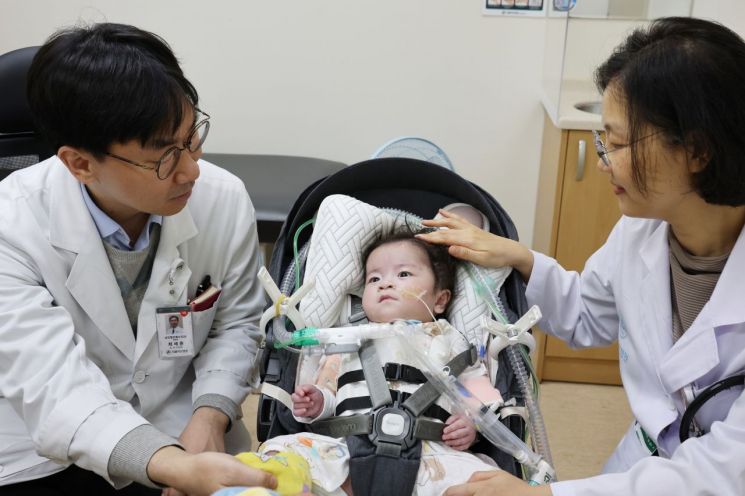 Seoul Asan Medical Center has succeeded for the first time in Korea in treating a newborn with ectopia cordis, a condition where the heart is born outside the body. On the 12th of this month, Professor Choi Sehun of the Department of Cardiovascular and Thoracic Surgery (left in the photo), Seorin Lee, and Professor Paek Jaesook of the Department of Pediatric Cardiology at Seoul Asan Medical Center took a commemorative photo. Seoul Asan Medical Center Photo by Seoul Asan Medical Center
At the first hospital where they received care, the doctors delivered a grim prognosis, saying survival was extremely unlikely. They were told that it would be difficult for the baby to be born alive, and even if she was, she would not survive more than three days, so the parents should prepare themselves. However, Seorin's mother and father kept telling themselves and their doctor, "We waited 14 times to meet Seorin-how could we give up now?" Clinging to their last hope, they turned to Asan Medical Center.
At Asan Medical Center's Fetal Therapy Center, Professor Lee Miyoung from the Department of Obstetrics and Gynecology conducted thorough and detailed ultrasound examinations at every visit, continuously monitoring the heart's structure and the fetus's overall health. Professor Paek Jaesook from Pediatric Cardiology and Professor Choi Eunseok from Pediatric Cardiac Surgery searched through all available research literature to inform the treatment plan. They encouraged the parents, saying, "The fetal heart structure is normal. We will stay with you until the end, so please do not give up."
From Pregnancy to Surgery After Birth
With the unwavering belief of the Asan Medical Center team that "she can be saved," and the desperate hope of her parents, Seorin endured 38 weeks in the womb. On April 10, she finally entered the world. But from the moment she was born, the real battle began. She was missing her entire sternum, and the skin and soft tissue of her chest and abdomen were absent, leaving her entire heart beating outside her body. This was the first such case reported in Korea, and even globally, it is extremely rare. The situation was even more severe than what had been detected on ultrasound.
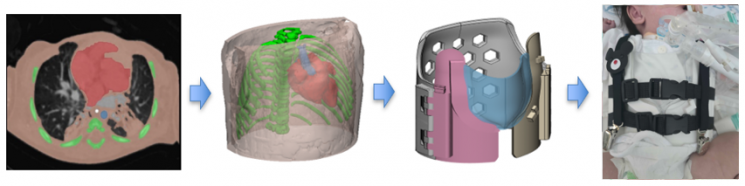 Images of the custom-made chest protector production process based on CT scans and 3D modeling. Asan Medical Center, Seoul
Once again, the medical team at Asan Medical Center did not give up. Experts from Pediatric Cardiology, Cardiovascular and Thoracic Surgery, Plastic Surgery, Pediatric Cardiac Surgery, Obstetrics and Gynecology, and Convergence Medicine united as one. After numerous discussions and meetings to determine the best course of action for Seorin's survival, they decided on a step-by-step approach: first, securing space within the chest cavity to accommodate the heart, and then covering it with cultured skin to reconstruct the chest wall.
The immediate priority was to protect the exposed heart from trauma, infection, and drying, while maintaining respiration and body temperature. The team immediately initiated ventilator support and sterile dressings. On April 11, the day after birth, Professor Kim Eunki from Plastic Surgery performed a temporary operation to cover the open chest and exposed heart with artificial skin.
Professor Choi Sehun from Cardiovascular and Thoracic Surgery performed three surgeries-on May 7, May 14, and May 22-to gradually reposition the heart into the chest cavity. This highly complex surgery required creating space for the heart without damaging surrounding organs, all while maintaining blood pressure. Professor Choi gently pushed the heart inward while lowering the liver, and by the third surgery, the entire heart was finally positioned inside the chest cavity. On June 10, Professor Kim Eunki successfully transplanted autologous cultured skin, grown from a small sample of Seorin's own skin, onto her chest.
Although the heart was finally in place two months after birth, her chest was still covered only by skin, without any bony structure, leaving her vulnerable to external trauma. To address this, Professor Kim Namguk from Convergence Medicine used 3D printing technology to create a custom chest protector that held both sides of the rib cage together to prevent the chest wall from separating. In addition, the rehabilitation medicine team provided therapy so that Seorin could grow up like other children her age.
After Rehabilitation, Seorin Smiled at Her Parents for the First Time
Afterwards, Seorin gradually recovered her health and was able to move to a general ward. Around her 100th day of life, she smiled at her parents for the first time. The little heart that once beat outside her body was now beating strongly in its proper place. Seorin was recently discharged and is now growing up healthy, attending regular outpatient check-ups. For final correction, reconstructive surgery using a firm artificial structure for the anterior chest wall and covering it with her own muscle and skin tissue will be performed after she grows older, likely after the age of three.
Seorin's mother said, "I could not give up on the precious child we met after 14 rounds of IVF. Even in such a desperate situation, with so little information or precedent for treating ectopia cordis, the entire medical team at Asan Medical Center never gave up and found a way to treat her, giving us hope. I am grateful to the team for helping us bring Seorin home."
Professor Paek Jaesook of Pediatric Cardiology at Asan Medical Center said, "At every stage of treatment, we faced unexpected difficulties, but the small changes Seorin showed gave us clear hope, and that hope became the foundation for each next step. I hope our message-that taking even a single step forward can create new possibilities and paths-will inspire other children and families facing rare diseases."
Professor Choi Sehun of Cardiovascular and Thoracic Surgery at Asan Medical Center said, "Saving a baby with such an extremely rare congenital condition as ectopia cordis is not something one doctor can do alone. Experts from various fields with extensive clinical experience came together, sharing their assessments and treatment plans from different perspectives. Thanks to this close collaboration, we were able to save Seorin."
© The Asia Business Daily(www.asiae.co.kr). All rights reserved.
![Clutching a Stolen Dior Bag, Saying "I Hate Being Poor but Real"... The Grotesque Con of a "Human Knockoff" [Slate]](https://cwcontent.asiae.co.kr/asiaresize/183/2026021902243444107_1771435474.jpg)

















