US House Judiciary Committee Holds Antitrust Hearing
$500 Billion Economic Loss Projected for the US Over 10 Years
Concerns Over Formation of a Global Regime of Non-Tariff Trade Barriers
"If Korea's interventionist antitrust policies are combined with ex-ante regulations, it could cost the US economy more than $500 billion (approximately 700 trillion won) over the next decade and lead to trade issues between the two countries," said Shanker Singham, CEO of the Competere Foundation.
On the 16th (local time), the US House Judiciary Committee held a hearing under the theme "Anti-American Antitrust: Foreign Governments' Targeting Strategies Against US Companies."
According to the written testimonies released by the committee, there was a flood of opinions that foreign regulations-including Korea's Online Platform Act (Onple Act), modeled after the European Union's Digital Markets Act (DMA), as well as regulations in Brazil, Australia, and Japan-are harming the US economy and restricting innovation.
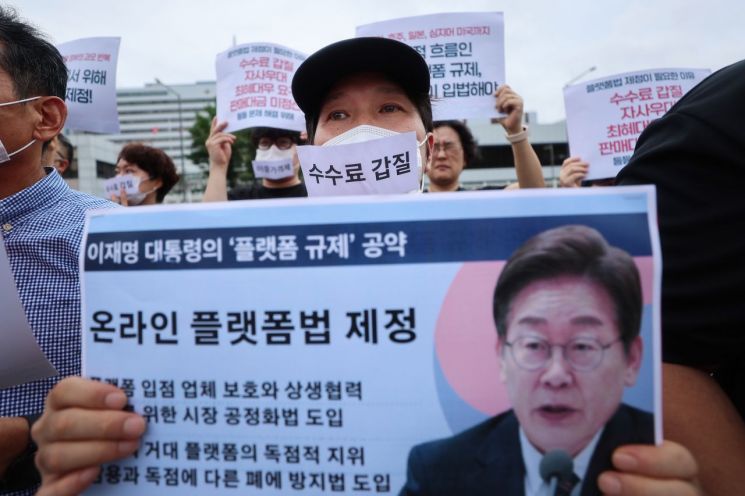
The Onple Act, also known as the "Platform Gapjil Prohibition Act," is intended to protect marketplace sellers from unfair practices and promote fair competition. It was a presidential campaign pledge by President Lee Jaemyung, and the ruling Democratic Party of Korea is accelerating its legislative efforts.
However, both global major information technology companies (big tech) and large domestic platform operators have expressed opposition, arguing that excessive regulation could stifle the development of new services and technological innovation.
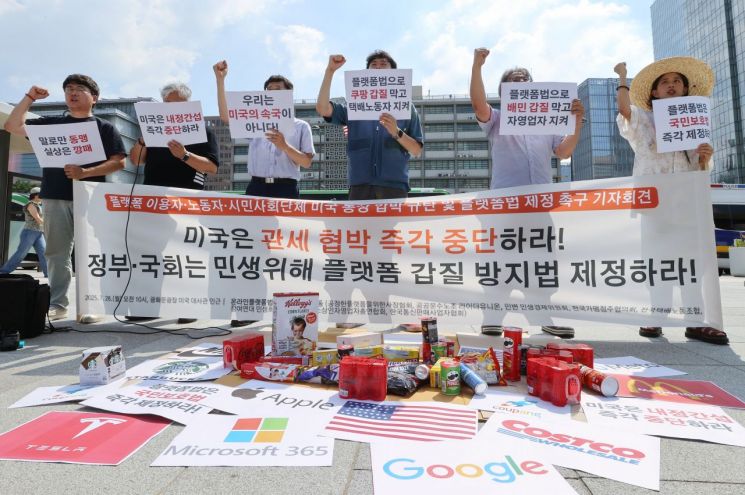
At the US House hearing, the Korean Fair Trade Commission's move to regulate platforms was characterized as a "trade barrier targeting the United States," with claims that it would infringe upon the interests of US big tech companies such as Google and Apple and harm the economies of both South Korea and the United States.
The Competere Foundation, a US nonprofit policy research organization, uses a model called "Anti-Competitive Market Distortion (ACMD)" to quantify the negative impact of government regulations on GDP and economic growth.
Shanker Singham, CEO of Competere, who appeared as a witness, stated, "Korea's discriminatory competition policies weaken the ability of US companies to do business in Korea," and projected that this would result in losses of about $500 billion for the US over the next decade.
Specifically, he estimated that Korea's interventionist antitrust regulations applied across US big tech would cause $300 billion in losses, and ex-ante regulations such as the Onple Act would add another $128 billion, totaling $428 billion in economic losses. He further estimated that, by adding an additional 15-20% to account for social costs, the total damage could reach $500 billion to $525 billion.
Dirk Auer, Director of Competition Policy at the International Center for Law & Economics, stated in his written testimony, "The EU's interventionist regulatory model has spread to Japan, Korea, Brazil, and Australia," adding, "Other countries are likely to follow suit, which will create a global regime of non-tariff trade barriers."
Republican Congressman Scott Fitzgerald pointed out that overseas platform regulatory movements "specifically target US companies, restrict consumer-friendly practices, and grant broad authority to regulatory agencies and bureaucrats without real accountability or due process."
He further criticized, "These are industrial policies designed to give domestic companies a geopolitical edge. After copying US innovation, they drive the very companies that created that innovation out of the market with fines and regulations."
Congressman Scott Fitzgerald, who chairs the Antitrust Subcommittee, sent a letter to Chairman Han Ki-jung of the Korea Fair Trade Commission last July, expressing concerns about the Onple Act and officially requesting an explanation regarding the legislative direction.
© The Asia Business Daily(www.asiae.co.kr). All rights reserved.


















