Metropolitan Residents Show Low Transition Rates to Marriage and Childbirth
Clear Gaps by Birth Year and Employment Status
The so-called "metropolitan area penalty," referring to lower rates of marriage and childbirth among residents of the Seoul metropolitan area, has been confirmed by official statistics. Residents of the metropolitan area showed higher rates of remaining unmarried and childless compared to those in other regions, and the rate at which they eventually transitioned to marriage and childbirth over time was also lower.

On December 16, the National Data Processing Center released, for the first time, the "2015-2023 Population Dynamics Panel Statistics," which tracked changes in the lives of cohorts born between 1983 and 1995. The analysis revealed that both men and women living in the metropolitan area had higher rates of remaining unmarried and childless than those in other regions, and the rate of transitioning to marriage and childbirth after three years was also relatively lower.
For men born in 1983, as of 2015, the proportion who remained unmarried in the metropolitan area was 58.6%, the highest among the five regions nationwide, and the rate of remaining childless was also the highest at 75.2%. During the same period, women born in 1984 in the metropolitan area had the highest rate of remaining unmarried at 46.5%, and the rate of remaining childless was also among the highest at 65.5%.
Similarly, for men born in 1988, as of 2020, the unmarried rate in the metropolitan area was 69.1% and the childless rate was 84.5%, both higher than in other regions. During the same period, women born in 1989 in the metropolitan area also had the highest rate of remaining unmarried at 58.0%, and the rate of remaining childless was 77.0%. The rate of transitioning to marriage and childbirth after three years was also the lowest among metropolitan area residents.
Marriage and Childbirth Gaps Widen by Year of Birth
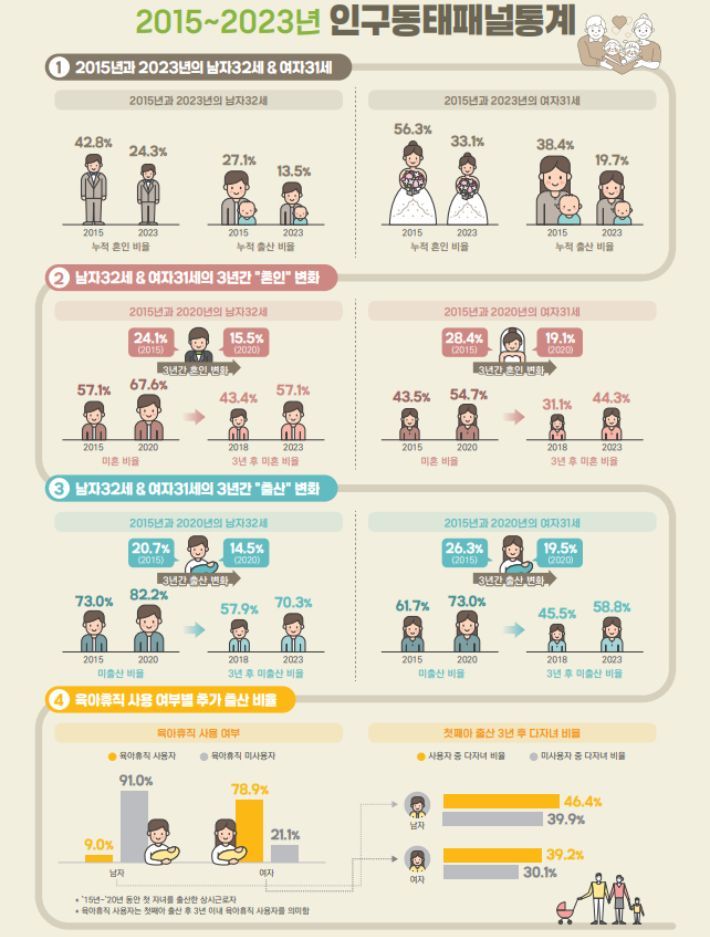
It was also confirmed that those born in earlier years not only had higher marriage and childbirth rates in the reference year compared to those born more recently, but also had higher "change rates," meaning the proportion who transitioned from being unmarried and childless to marrying and having children within three years.
At age 32, for example, 42.8% of men born in 1983 were married, whereas only 24.3% of men born in 1991 were married. The age at which marriage rates peaked also shifted upward over time, from 31 to 32 for men and from 29 to 31 for women.
Differences persisted in three-year transitions as well. Among men, 24.1% of those born in 1983 chose marriage and 20.7% chose childbirth within three years, compared to 15.5% and 14.5%, respectively, for those born in 1988. Among women, 28.4% of those born in 1984 chose marriage and 26.3% chose childbirth, while only 19.1% and 19.5%, respectively, did so among those born in 1989.
Differences were also observed in employment status and income. For men, those who were not regular employees or who had below-average income in the reference year had higher rates of remaining unmarried and childless. For women, the rates of remaining unmarried and childless were higher among regular employees and those with above-average income. However, the rate of transitioning to marriage and childbirth after three years was higher for both men and women who were regular employees and had above-average income. The likelihood of marriage and childbirth was also relatively higher among those who owned a home.
Kim Jieun, Director of Social Statistics Planning at the National Data Processing Center, stated, "The phenomenon previously referred to as the 'metropolitan area penalty' in demographic circles has clearly appeared in these longitudinal statistics tracking fixed cohorts," adding, "When comparing after three years, the regional differences are quite pronounced."
© The Asia Business Daily(www.asiae.co.kr). All rights reserved.
![Clutching a Stolen Dior Bag, Saying "I Hate Being Poor but Real"... The Grotesque Con of a "Human Knockoff" [Slate]](https://cwcontent.asiae.co.kr/asiaresize/183/2026021902243444107_1771435474.jpg)

















