KDCA Shifts Focus from "Blocking Infectious Diseases" to "Managing Travelers' Health"
24 Key Quarantine Management Areas to Be Designated in Q1 2026... Mpox to Be Removed from Quarantine List
The government will completely overhaul its quarantine system, shifting the focus from "blocking the entry of infectious diseases" to "managing travelers' health." It plans to establish a platform that provides integrated travel health information and to introduce artificial intelligence (AI) quarantine officers at airports and seaports.
The Korea Disease Control and Prevention Agency (KDCA) announced the "Plan for Establishing a Traveler Health-Centered Quarantine System" on December 17. This initiative serves as a roadmap to implement the Yoon Suk-yeol administration's national agenda of "improving the infectious disease crisis response system," and was finalized after a review by the Quarantine Expert Committee on December 12.
The KDCA explained that, since international movement is one of the key factors in the emergence of pandemics, it will maintain quarantine capabilities for rapid response during crises, while operating a prevention- and information-centered quarantine system during normal times.
To this end, by next year, the agency will launch the "Travel Health Notification e" platform, which will provide travelers with integrated health information. Drawing on overseas examples such as the U.S. Centers for Disease Control and Prevention's Travelers' Health and the UK's UK Health Security Agency's Travel Health Pro, the platform will allow users to access all necessary information for before, during, and after travel in one place. The platform will enhance search functions and offer traveler consultation features to improve user convenience.
Starting in the second half of next year, guidance messages, which were previously sent only to incoming travelers, will also be sent to departing travelers via KakaoTalk. In addition, the pilot "respiratory testing service" will be expanded to 13 quarantine stations nationwide, allowing travelers with symptoms to receive free test results for three diseases-avian influenza, COVID-19, and influenza-upon request.
The adoption of advanced technology will also accelerate. Quarantine inspection counters equipped with AIoT technology and multilingual symptom reporting screens will allow foreign entrants to conveniently report their health status. This system is scheduled to begin pilot testing at Gimhae Airport in the second half of 2026.
To prevent the spread of infectious diseases through unsanitary transport environments, hygiene management for ships and aircraft will be strengthened. The issuance process for Ship Sanitation Certificates (SSC) will be standardized in accordance with World Health Organization (WHO) guidelines, and inspection fees-which have remained virtually unchanged for 50 years-will be increased by about three times to ensure fairness with international standards. The government also plans to amend the "Quarantine Act" to enable health and hygiene inspections for aircraft, with measures to manage aircraft hygiene and block disease vectors to be established by 2027.
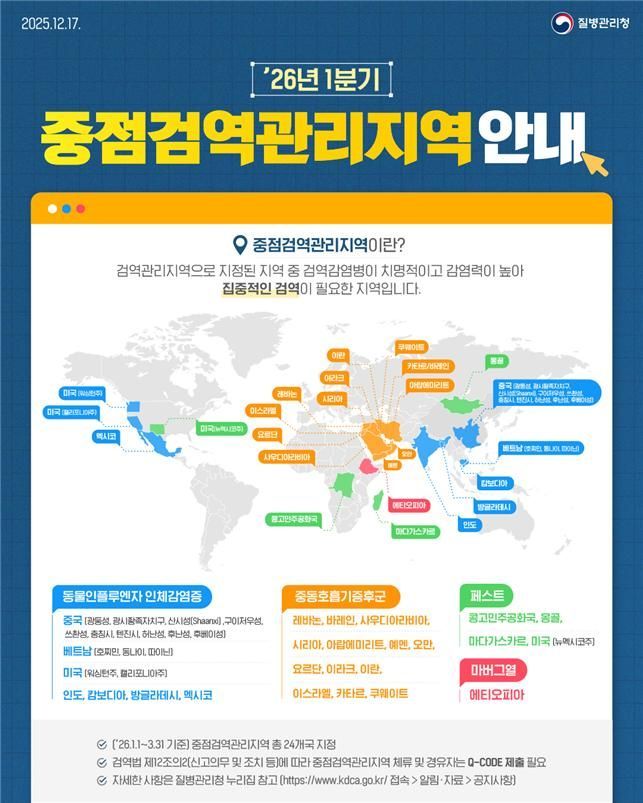
Meanwhile, the KDCA will designate a total of 24 countries as key quarantine management areas in the first quarter of next year, including Ethiopia, where Marburg fever is currently prevalent, as well as certain regions of the United States, China, and Vietnam. Following the end of the World Health Organization's Public Health Emergency of International Concern (PHEIC), Mpox will be excluded from quarantine requirements starting January 1 next year. However, key management of countries where plague is present, such as the Democratic Republic of the Congo, will continue.
Im Seungkwan, Commissioner of the KDCA, stated, "This initiative aims to expand the focus of quarantine from inbound travelers to travelers' health in response to changes in the international travel environment. We will steadily implement major tasks such as building the Travel Health Notification e platform, expanding information provision, and strengthening hygiene management of transportation to establish a safe and robust quarantine system."
© The Asia Business Daily(www.asiae.co.kr). All rights reserved.

















