President Lee: "Sinan County Officials Are Exceptionally Smart, You Should Hire Them"
Sinan County Sees Population Growth for Consecutive Years Thanks to Solar and Wind Pensions
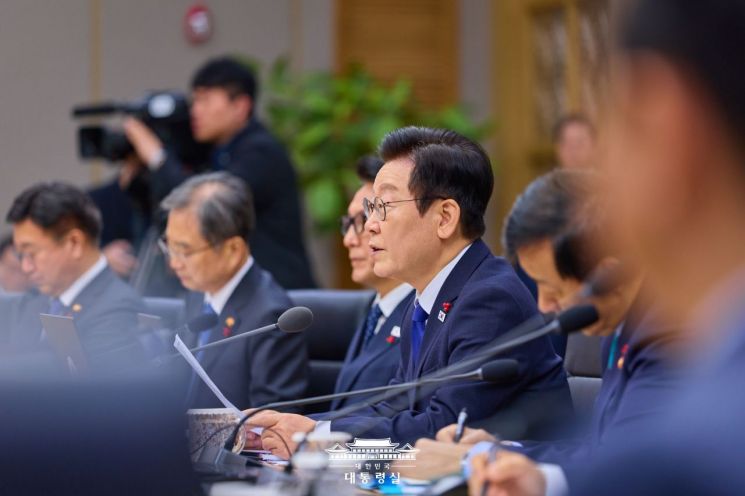 On the 16th, President Lee Jae-myung evaluated the renewable energy policy of Sinan County as a very exemplary model during the Cabinet meeting. Photo by the Presidential Office
The resident-participation renewable energy policy that Sinan County, South Jeolla Province, has been pursuing for several years has been officially recognized as a model case at the highest level of government, bringing renewed attention to the county’s achievements.
On December 16, President Lee Jae-myung mentioned Sinan County’s renewable energy policy while receiving a report on the social solidarity economy from the Ministry of Climate, Energy and Environment at the Cabinet meeting held at the Government Complex Sejong. He evaluated it as “a very exemplary model.”
From the outset, Sinan County institutionalized resident participation in renewable energy projects and took the lead in introducing a profit-sharing model, often referred to as the “solar pension” and “wind pension.” In particular, the county designed a structure in which about 30 percent of the shares from large-scale solar and wind projects are mandatorily allocated to local residents. This system has minimized development-related conflicts and ensured that profits are returned to the local community.
President Lee stated, “Sinan County has systematically promoted large-scale renewable energy projects, and because the share for residents is clearly defined, the policy was established without resistance. This structure should be expanded nationwide.”
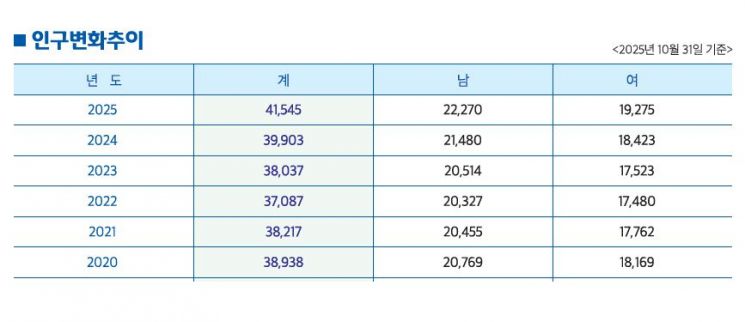
He further noted, “While most county-level regions across the country face the risk of population decline, Sinan County has seen its population increase for several consecutive years thanks to the solar pension,” specifically highlighting the policy’s effectiveness.
President Lee also highly praised the administrative capacity that has designed and implemented Sinan County’s renewable energy policy, stating, “The director in charge is doing an excellent and highly professional job.” This comment is seen as recognition at the national level of the county’s overall policy planning and execution capabilities.
The county’s renewable energy policy is cited as a case that has simultaneously addressed four major issues: generating income for residents, responding to population decline, minimizing local conflicts, and advancing the energy transition.
Observers inside and outside the region note that this is the result of the county’s long-term strategy based on the principle that “energy is a public asset of the community.”
President Lee also emphasized, “Sunlight and wind are infinite resources, and by utilizing public lands and idle sites, we can fully resolve energy shortages,” calling for an accelerated expansion of renewable energy. This aligns closely with the policy direction that Sinan County has already demonstrated in practice.
Additionally, regarding the construction of transmission systems, President Lee proposed a citizen participation fund model, clarifying, “This is not privatization, but complete public ownership in which everyone can participate.”
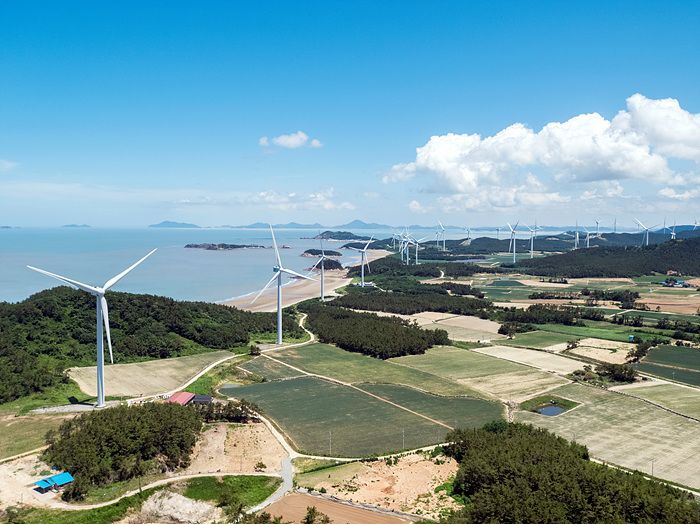
There is also an interpretation that the county’s method of returning power generation profits to residents is now expanding into a discussion about national energy infrastructure policy.
Sinan County continues to expand its local income model based on the sharing of renewable energy profits.
With the remarks made at this Cabinet meeting, Sinan County’s renewable energy policy is now being recognized not just as a local government case, but as a standard model for Korea’s energy transition and population decline response policies.
© The Asia Business Daily(www.asiae.co.kr). All rights reserved.
![Clutching a Stolen Dior Bag, Saying "I Hate Being Poor but Real"... The Grotesque Con of a "Human Knockoff" [Slate]](https://cwcontent.asiae.co.kr/asiaresize/183/2026021902243444107_1771435474.jpg)

















