Targeting $120 Billion in Exports by 2035
Calls for a Presidential Control Tower and Establishment of an AI Semiconductor Technology Institute
The National Academy of Engineering of Korea has called for an all-out national response to secure sovereignty in artificial intelligence (AI) semiconductors, presenting ten key policy guidelines. Amid intensifying global competition for dominance in AI semiconductors, the Academy warned that "now is the golden time."
On the morning of December 17, the National Academy of Engineering of Korea announced that it held a Semiconductor Special Committee Forum at the Chosun Hotel in Seoul under the theme "Guidelines for Becoming a Leading AI Semiconductor Nation." The forum was organized by the Academy's Semiconductor Special Committee, co-chaired by Ahn Hyun, President of SK Hynix, and Lee Hyukjae, Professor at Seoul National University.
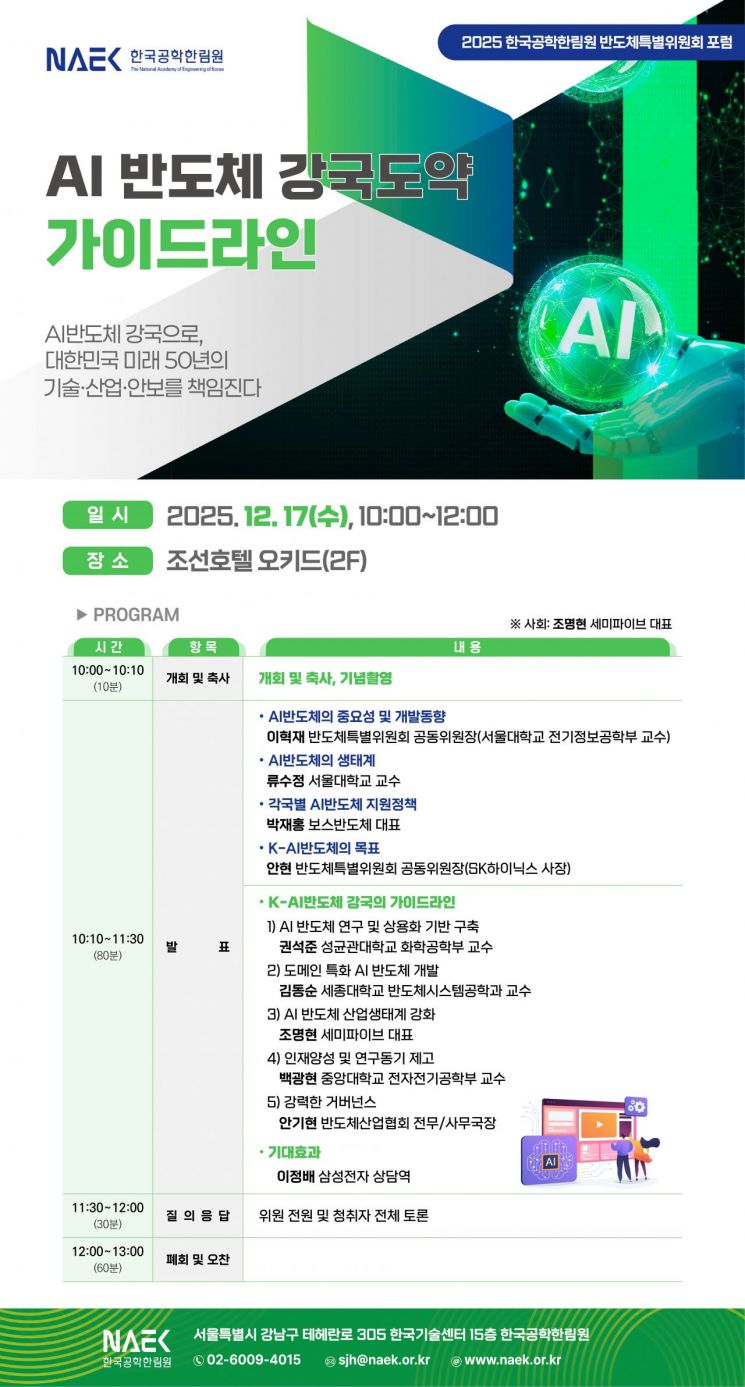
During the forum, participants reached a consensus on the need for a "K-AI Full Stack" strategy, encompassing everything from design to manufacturing and software, with the goal of achieving $120 billion in AI semiconductor exports by 2035. A key weakness identified was the absence of a control tower to coordinate fragmented policies. Experts urgently recommended establishing a Presidential Committee for AI Semiconductor Development and an AI Semiconductor Technology Institute.
In the first presentation, Committee Chair Lee Hyukjae stated, "AI semiconductors are not just simple components, but strategic assets that will determine the future of industry and national security." He projected that the global AI semiconductor market would grow to $775 billion by 2035, about nine times its size in 2024. He assessed that, aside from memory, Korea's commercialization experience and ecosystem infrastructure are still at an early stage, while the United States leads the market and China is rapidly catching up.
Next, Professor Ryu Sujeong of Seoul National University, in her presentation on the AI semiconductor ecosystem, emphasized, "While Korea is strong in memory such as HBM, it lacks integrated capabilities across processors, systems, software, and foundation models." She stressed the need for strategies to build the ecosystem, such as expanding the use of domestic NPUs, particularly in the public sector. Park Jaehong, CEO of BOS Semiconductor, explained that major countries-including the United States (CHIPS Act), China, Taiwan, and Japan (Rapidus)-are implementing comprehensive policies that go beyond R&D funding to foster the entire industrial ecosystem.
Committee Chair Ahn Hyun, in announcing the "K-AI Semiconductor" objectives, identified building the industrial ecosystem and realizing a "sovereign AI platform" as core tasks. He stated, "We must build a national-level 'virtual big tech' ecosystem to secure independent AI technology competitiveness in key security sectors such as defense, energy, and healthcare."
In the highlight of the day-the guideline session-experts including Ahn Kiheon, Executive Director of the Korea Semiconductor Industry Association, proposed ten key tasks across five areas. These included operating a Presidential Committee for AI Semiconductor Development, establishing an AI Semiconductor Technology Institute, introducing a specialized "Doctor of Chip (DoC)" degree, strengthening researcher incentives and expanding military service exemptions, and creating an integrated ecosystem linking design, manufacturing, and services. Proposals also called for fostering domestic materials, components, and equipment, as well as overlapping support, to enable Level 4 autonomous driving commercialization.
Lee Jeongbae, Advisor at Samsung Electronics, who presented on the expected outcomes, predicted, "If these guidelines are implemented, annual AI semiconductor exports could exceed $120 billion by 2035, simultaneously strengthening technological sovereignty and national security."
In his opening remarks, President Yoon Euijoon stressed, "AI semiconductors are the core engine that will safeguard Korea's technological and industrial security for the next 50 years," and emphasized that "government, industry, and academia must form a united front to seize this golden opportunity." The event was attended by over 100 people, including Academy members, National Assembly representatives, government officials, and related organizations.
© The Asia Business Daily(www.asiae.co.kr). All rights reserved.
![Clutching a Stolen Dior Bag, Saying "I Hate Being Poor but Real"... The Grotesque Con of a "Human Knockoff" [Slate]](https://cwcontent.asiae.co.kr/asiaresize/183/2026021902243444107_1771435474.jpg)
















