Mayor Kim Kyungil: "Complex Cultural Space to Be Created by 2028 After Closure of Sex Trade District"
Paju City Declares "Vision for Transforming the Sex Trade District ? Yeonpung Reborn"
From a Place of Violence and Exploitation to an Open Space Blending Welfare and Culture
Paju City announced on December 17 that it held a "Declaration Ceremony for the Vision of Transforming the Sex Trade District Space" at the Paju Citizens' Hall Grand Auditorium on the 16th, and revealed plans to create the former sex trade district as an open space for citizens.
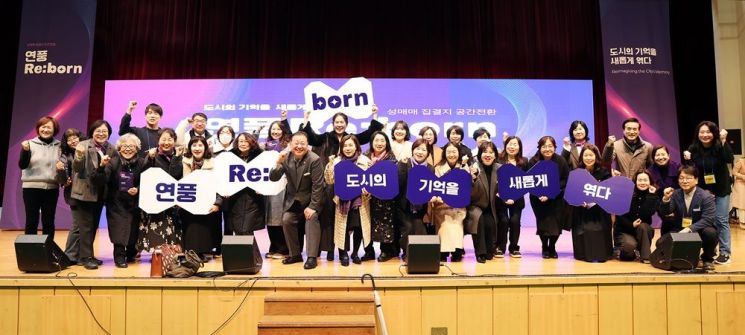 Paju City held a declaration ceremony for the vision of transforming the sex trade district space, "Yeonpung Reborn," on the 16th. Provided by Paju City
Under the main theme of "Yeonpung Reborn - Weaving the City's Memories Anew," the event reflected with citizens on the history of the sex trade district, which had been a site of violence, exploitation, and illegality for over 70 years. It also served as an official declaration of Paju City's commitment to transforming the area, after its closure, into an open urban space where welfare and culture coexist.
Attended by more than 500 people, including Paju Mayor Kim Kyungil, local leaders, officials from related organizations, and citizens, the event began with an introductory video highlighting the need for change in the sex trade district and the process of citizen participation. This was followed by awards presented to ten individuals and organizations who contributed to protecting women's rights and promoting the anti-sex trade culture, and the recitation of essays by six citizens.
Those who took the stage for the readings appealed for citizen participation with statements such as "Silence is consent, and indifference is complicity" and "Now is the time for citizens to participate," conveying the voices of Paju citizens that "The sex trade district must be closed."
Next, Paju City presented its vision video, outlining the step-by-step direction for the spatial transformation project in the sex trade district area.
According to the plan, by 2028, the city will establish social welfare and cultural facilities such as a family center, gender equality plaza, healing garden, and "Rakivium" (a complex cultural space combining a library, archives, and museum). In the mid- to long-term, the city will also sequentially build a municipal nursing home, a health promotion clinic, a park golf course, a public parking lot, and a public library, transforming the Yeonpung-ri area into an open, integrated space where all citizens can gather, blending welfare and culture.
The grand finale of the "Vision Declaration Ceremony" was a citizen participation "vision performance," in which attendees used their mobile phones to access a QR code and share, in a single sentence, their vision for the future of Yeonpung-ri and Paju.
On the large screen at the center of the venue, sentences such as "A road where anyone can walk safely," "A space for human rights education that remembers the past," and "A house of rest and recovery for the vulnerable" were displayed in real time, offering a glimpse into the diverse opinions of citizens regarding the spatial transformation project to be pursued after the closure of the sex trade district.
Paju Mayor Kim Kyungil stated, "'Yeonpung Reborn' is about transforming a space long associated with violence, exploitation, and illegality into an open space where all 540,000 Paju citizens can visit with peace of mind. With this declaration ceremony as a starting point, Paju City will continue to promote a citizen-centered spatial transformation project to create an urban environment where everyone is respected."
© The Asia Business Daily(www.asiae.co.kr). All rights reserved.
![Clutching a Stolen Dior Bag, Saying "I Hate Being Poor but Real"... The Grotesque Con of a "Human Knockoff" [Slate]](https://cwcontent.asiae.co.kr/asiaresize/183/2026021902243444107_1771435474.jpg)















