Hyundai Robotics Lab and DeepX Unveil New Robot
Equipped with DeepX NPU... Expanded AI Model Validation
Hyundai Motor Group’s Large-Scale Investment Raises Hopes for Domestic Ecosystem
Hyundai Motor Company is partnering with local artificial intelligence (AI) semiconductor company DeepX to begin mass production of industrial AI robots next year. Following the development of service robots through Hyundai Motor Group’s Robotics Lab, the company is now expanding its robot mass production to the industrial sector. Hyundai Motor Group previously announced plans to invest 50 trillion won in building robot foundries and related infrastructure, leading to expectations that this move will serve as a catalyst for the full-scale expansion of its AI platform for robotics.
According to the robotics and semiconductor industries on December 17, Hyundai Robotics Lab plans to begin mass production of industrial robots equipped with factory automation functions next year. While specific details have not been disclosed, industry sources mention AI-powered autonomous mobile robots (AMR) based on vision AI, as well as AI inspection and monitoring robots used in smart factories. These robots will be equipped with the M1 neural processing unit (NPU) developed by DeepX, a domestic on-device AI semiconductor company.
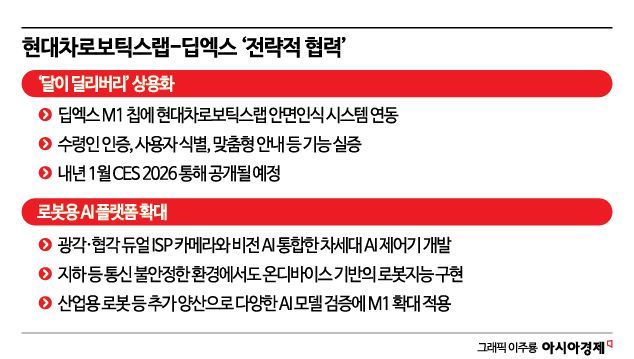
The collaboration between Hyundai Robotics Lab and DeepX began in earnest in 2023. Typically, the development of AI robots involves the use of graphics processing units (GPU) known for their general-purpose computing performance. However, GPUs present significant design challenges due to high power consumption and heat generation. In environments such as factory automation or mobile robots, which require 24-hour operation, power efficiency and thermal management are critical factors. Hyundai Robotics Lab sought alternatives to overcome these limitations and decided to collaborate with DeepX to utilize its M1 chip, which specializes in ultra-low power and on-device AI. The first result of this partnership was the service robot 'DAL-e Delivery,' unveiled earlier this month.
The mass production of industrial robots signifies an expanded application of the M1 chip, allowing for the validation of various AI models. The M1 is considered more power-efficient and cost-effective compared to GPUs.
The next-generation on-device AI controller, jointly developed by the two companies, integrates a wide-angle and telephoto dual image signal processor (ISP) camera and vision AI technology based on the M1 chip. The project has now entered the proof-of-concept (PoC) stage, and the application of the M1 in robot control platforms is reportedly being expanded. Since it can operate without relying on network connectivity even in environments with unstable communication, such as underground locations, it is considered well-suited for the commercialization of AI robots.
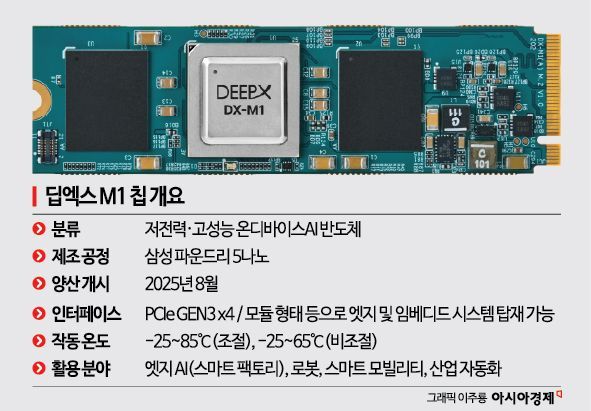
Previously, Hyundai Motor Group announced its plan to invest over 50 trillion won in robotics by 2030. The company aims to build fully automated unmanned processes, known as 'dark factories,' based on physical AI technology. The fact that DeepX’s chips are being manufactured by Samsung Electronics also raises expectations for the expansion of the domestic ecosystem. The M1 is produced using a 5nm foundry process (1nm = one billionth of a meter), and the next-generation M2 will be mass-produced using a 2nm process.
Industry observers see Hyundai Motor Group’s expansion of robot mass production based on on-device AI semiconductors as a signal accelerating the structural transformation of the robotics industry. It means that the domestic industry now has a foundation to implement the shift from hardware-centric robotics to AI-based robotics on its own.
An industry insider commented, "Globally, aside from China, Tesla is virtually the only company with its own robot mass production capabilities. Hyundai Motor Group’s move to expand robot mass production by partnering with DeepX, which has built up technological expertise in physical AI, following its collaboration with Nvidia, will have a significant impact on the domestic industry."
A Hyundai Motor Group representative stated, "At this time, we have nothing further to disclose."
© The Asia Business Daily(www.asiae.co.kr). All rights reserved.
![Clutching a Stolen Dior Bag, Saying "I Hate Being Poor but Real"... The Grotesque Con of a "Human Knockoff" [Slate]](https://cwcontent.asiae.co.kr/asiaresize/183/2026021902243444107_1771435474.jpg)

















