Australia Granted Exception Under Section 91 of the Atomic Energy Act
Follow-up Procedures Needed for Uranium Enrichment and Spent Nuclear Fuel Reprocessing
Inter-Korean Dialogue Expected to Be Discussed
On the 16th (local time), National Security Advisor Wi Sunglak stated that South Korea could explore the option of signing a separate agreement with the United States to build nuclear-powered submarines.
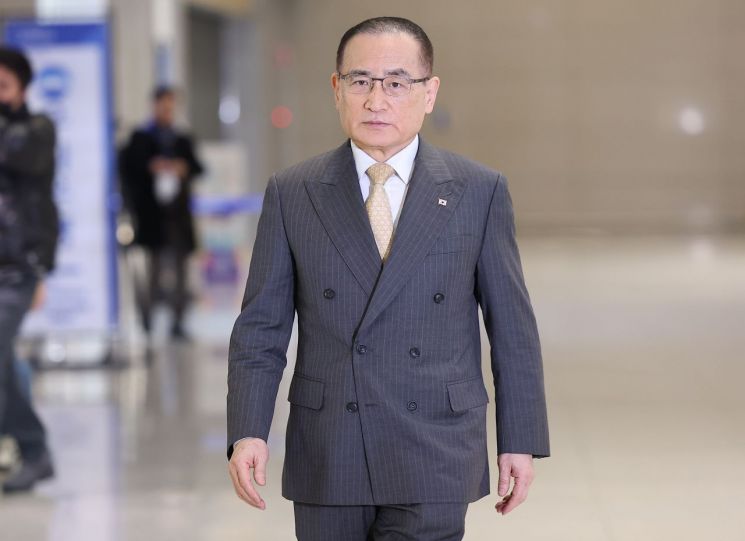
Upon arriving at Dulles International Airport near Washington, D.C., Wi told reporters, "In the case of Australia, which received approval to acquire nuclear-powered submarines, the United States granted an exception under Section 91 of the U.S. Atomic Energy Act, and a separate bilateral agreement was required for that. Since we may also need something similar, I will discuss the possibility."
Australia, a member of AUKUS (the security alliance between the United States, the United Kingdom, and Australia) established during the Biden administration, is receiving support from the United States and the United Kingdom to acquire nuclear-powered submarines.
The Section 91 of the U.S. Atomic Energy Act mentioned by Wi allows the U.S. President to authorize the transfer of military nuclear material. Australia entered into a separate agreement based on this provision.
Wi's remarks are interpreted as suggesting that South Korea and the United States could pursue similar cooperation as in the Australian case. The current U.S.-South Korea nuclear agreement prohibits the military use of nuclear materials.
Regarding the U.S.-South Korea consultative body for building nuclear-powered submarines, Wi said, "We are preparing on our side, and I will assess the U.S. preparations as well," adding, "I will look for ways to facilitate consultations."
Wi will remain in Washington, D.C. until the 18th, where he will meet with Secretary of State and White House National Security Advisor Marco Rubio, Secretary of Energy Chris Wright, who oversees the nuclear sector, as well as working-level officials from the White House and the State Department, before returning to Korea via New York.
During this visit to the United States, Wi plans to discuss with the U.S. side ways to swiftly implement the items included in the U.S.-South Korea summit joint fact sheet, such as uranium enrichment, spent nuclear fuel reprocessing, and the construction of nuclear-powered submarines.
Wi stated, "For the implementation of the U.S.-South Korea summit agreements to carry political weight, it is better to have high-level dialogue, and for security matters, involvement from the Presidential Office and the White House accelerates progress."
Regarding uranium enrichment and spent nuclear fuel reprocessing, he explained, "Since a broad agreement has been reached, follow-up procedures are needed. We need to determine how to proceed with these procedures, and if necessary, adjust or revise the relevant regulations."
When asked whether inter-Korean or North Korea-U.S. dialogue would be discussed during this visit, he replied, "I intend to exchange opinions on the overall issue and also plan to reach out to the United Nations."
He added, "It is true that a favorable atmosphere has developed in the U.S.-South Korea alliance among the various U.S. alliances. If this is an opportunity, we should make the most of it. Within this atmosphere, we must also manage relations with North Korea well, and to do so, coordination and cooperation between South Korea and the United States are crucial."
In response to concerns that the North Korea issue may have been pushed down the list of U.S. priorities, he said, "I don't necessarily think it has been pushed aside. Our main focus has been to stabilize relations with major neighboring countries around the Korean Peninsula, and there has been some progress in that area. In comparison, inter-Korean relations have not advanced sufficiently, so we intend to make progress on that front as well."
Regarding recent conflicts between the Ministry of Foreign Affairs and the Ministry of Unification over leadership in North Korea policy, he said, "There can be some differences of opinion within the government on diplomatic and security issues. These are constructive disagreements, but they are always coordinated and resolved through the National Security Council (NSC)."
Wi stated, "Even in this case, the U.S.-South Korea consultations were discussed at the NSC. There was a very lengthy discussion and the matter was settled after much debate."
He added, "There is some regret that things would have been better if the agreed plan had been implemented as decided." However, when asked if this meant that the Ministry of Unification had been out of step, he replied, "I will not comment on specifics. Discussions took place, and coordination was achieved."
© The Asia Business Daily(www.asiae.co.kr). All rights reserved.

















