First-Year Performance Sharing Meeting Held for the 'No-Code Manufacturing Technology Innovation Ecosystem' Project
No-Code Technology Applied to Eight Companies
Lead Time Reduced and Quality Improvement Confirmed
A new era has begun in which manufacturing processes can be improved without professional developers.
On December 16, Pohang City held the first-year performance sharing meeting of the "No-Code Manufacturing Technology Innovation Ecosystem Construction Project" at Changeup Ground Pohang, sharing the progress made so far in driving digital transformation at local manufacturing sites.
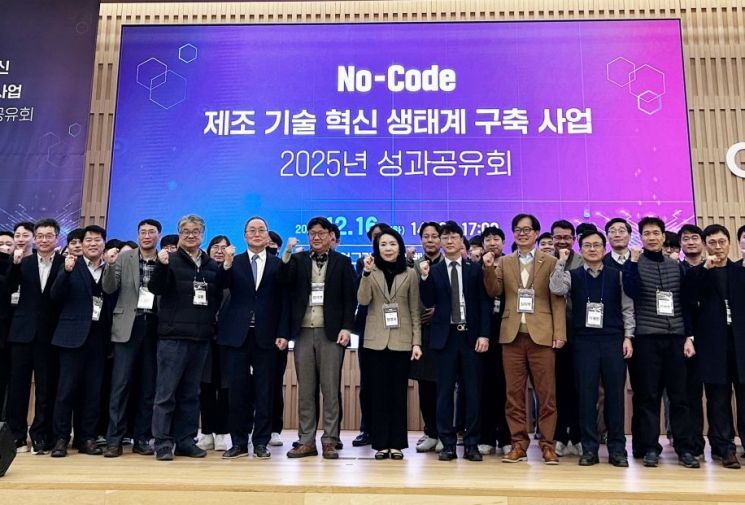 Pohang City held the first-year performance sharing meeting of the "No-Code Manufacturing Technology Innovation Ecosystem Construction Project" on the 16th at Changeup Ground Pohang. Photo by Pohang City
Approximately 80 participants attended the event, including representatives from the Korea Institute for Advancement of Technology (KIAT), Pohang University of Science and Technology (POSTECH), Pohang Materials Industry Promotion Agency (POMIA), Gyeongbuk ICT Convergence Industry Promotion Association, as well as stakeholders from academia, research, government, and both supplier and demand-side companies. They reviewed the achievements of the first-year project and discussed strategies for further expansion.
The performance sharing meeting featured presentations of case studies from demand-side companies, as well as the sharing of demonstration models accumulated during the project and strategies for future expansion. In addition, case exhibitions and demo booths were operated so that company representatives could directly observe and exchange results, which was met with positive feedback from participating companies.
'No-Code' refers to technology that allows users without coding expertise to implement programs using pre-developed templates and graphic-based functions through drag-and-drop methods.
This project is a public contest project led by the Ministry of Trade, Industry and Energy, with a total budget of 24.5 billion won (15 billion won from the national government and 9.5 billion won from local governments) to be invested over five years from 2025 to 2029. The project supports small and medium-sized manufacturing companies in the region, whose digital capabilities are relatively lacking, so that they can improve and operate digital solutions needed at manufacturing sites without developers.
The goal is to rapidly apply and advance solutions tailored to on-site conditions by spreading a system for building and utilizing No-Code-based manufacturing solutions.
Through the first-year project, No-Code-based software development and on-site application were completed for eight local manufacturing companies in various fields, including: ▲Manufacturing Execution System (MES), ▲Digital Twin and Simulation, ▲Predictive Maintenance for Equipment, and ▲PLC-based Equipment Control.
As a result, improvements were seen in areas such as reduced process lead times, lower operating costs, and enhanced quality and equipment responsiveness. All supplier companies that participated in the support achieved outcomes such as applying for GS certification, signing adoption contracts, and filing patent applications.
In particular, with the implementation of digital process twins, automatic analysis and alarms, and AI-based quality and equipment prediction functions, the technology has reached a level of completeness that goes beyond simple proof-of-concept (PoC) and is actually usable in real manufacturing sites.
For the second-year project, plans are in place to promote the practical establishment of the No-Code manufacturing technology innovation ecosystem by expanding application fields, providing customized advancement support for companies, strengthening on-site workforce capabilities, and reinforcing the spread of results and the self-sustaining private-sector-centered cooperation network.
Kim Jeongpyo, Director of the Job and Economy Bureau of Pohang City, stated, "No-Code technology is a key tool for lowering the barriers to digital transformation in manufacturing sites and accelerating its spread. In the second year, we will strengthen standardized application models and expansion systems and spare no effort to provide multifaceted support so that more companies can experience tangible results."
© The Asia Business Daily(www.asiae.co.kr). All rights reserved.
![Clutching a Stolen Dior Bag, Saying "I Hate Being Poor but Real"... The Grotesque Con of a "Human Knockoff" [Slate]](https://cwcontent.asiae.co.kr/asiaresize/183/2026021902243444107_1771435474.jpg)















