KDCA Outlines Response to the "Next Pandemic" in Policy Briefing
Domestic Vaccine Coverage for National Immunization Program to Reach 36% by 2030
The Korea Disease Control and Prevention Agency (KDCA) is developing a rapid-response platform capable of producing domestically developed vaccines within 200 days and is pursuing self-sufficiency in infectious disease vaccines and therapeutics.
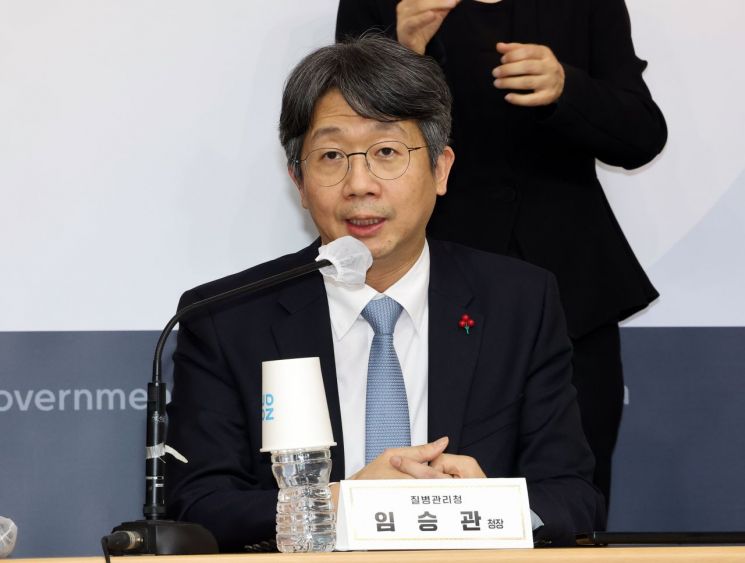 Seungkwan Lim, Commissioner of the Korea Disease Control and Prevention Agency, is explaining the major policy implementation plans for 2026 at the Ministry of Health and Welfare briefing room in the Government Complex Sejong on the 16th. Photo by Yonhap News
On December 16, during a presidential work report held at the Government Sejong Convention Center, the KDCA presented its future policy vision as "Healthy People, Safe Society." The agency announced that it will: ▲ prepare for new infectious disease disasters, ▲ protect the healthy daily lives of citizens, and ▲ proactively respond to future changes such as climate change.
The KDCA will first focus on supporting the development of a COVID-19 messenger RNA (mRNA) vaccine, which has entered Phase 1 clinical trials, with the goal of achieving domestic production by 2028. In addition, the agency will establish a research and analysis center to serve as a central hub for infectious disease clinical trials, and will support the development of public vaccines for infectious diseases that are high priorities for public security, such as avian influenza, respiratory syncytial virus (RSV), and monkeypox.
To respond quickly to new and emerging infectious diseases, the agency will utilize artificial intelligence (AI)-based rapid high-throughput analysis methods to develop therapeutics. Furthermore, a national infectious disease testing and management system, including private institutions, will be established to enable nationwide testing from the early stages of an infectious disease crisis, with a response system capable of conducting tests within 30 days.
For infectious disease management, the number of sentinel surveillance institutions for respiratory infectious diseases such as COVID-19 and influenza will be increased from 300 this year to approximately 800 next year. The agency also aims to support treatment for tuberculosis-vulnerable populations and reduce the number of tuberculosis patients per 100,000 people to below 10 by 2030, thereby achieving the status of a "tuberculosis-stable country."
To address the growing problem of antibiotic resistance, the agency will establish a legal basis for the appropriate use of antibiotics in medical institutions and expand pilot programs targeting these institutions.
Support for the treatment of rare and chronic diseases will also continue. The government plans to broaden the scope of nationally managed rare diseases, expand medical expense support for low-income groups, and shorten the time required for therapeutic registration from 240 days to 100 days.
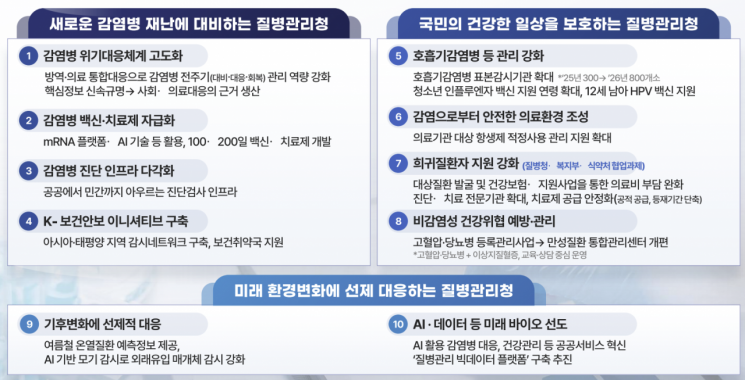
In response to a super-aged society, the agency will reform chronic disease management programs for conditions such as hypertension and diabetes by establishing integrated management centers, and will develop customized policies in accordance with the "First Comprehensive Injury Management Plan," which will be implemented starting next year.
Additionally, the KDCA announced plans to enhance climate health impact assessments and strengthen vector surveillance for mosquitoes and ticks in response to ecological changes. The agency will also promote the establishment of a "Disease Control Big Data" system to enable integrated data management using AI technology.
Commissioner Seungkwan Lim stated, "We will establish a new government infectious disease defense strategy to ensure seamless protection of public safety," adding, "Next year, the KDCA will continue to earn public trust through disease control policies based on data science."
© The Asia Business Daily(www.asiae.co.kr). All rights reserved.
![Clutching a Stolen Dior Bag, Saying "I Hate Being Poor but Real"... The Grotesque Con of a "Human Knockoff" [Slate]](https://cwcontent.asiae.co.kr/asiaresize/183/2026021902243444107_1771435474.jpg)

















