Minutes of November 27 MPC Meeting Released
Shin Sunghwan the Only Member Supporting a Rate Cut
"Private Sector Recovery Still Insufficient"
The Bank of Korea’s Monetary Policy Committee (MPC) decided to keep the base interest rate unchanged last month, a move attributed to heightened volatility in the won-dollar exchange rate and expectations for an economic growth recovery. The committee argued that future monetary policy decisions, including the direction and timing of additional rate cuts, should be made after closely monitoring trends in economic growth, the foreign exchange sector, and financial stability in areas such as the Seoul metropolitan housing market.
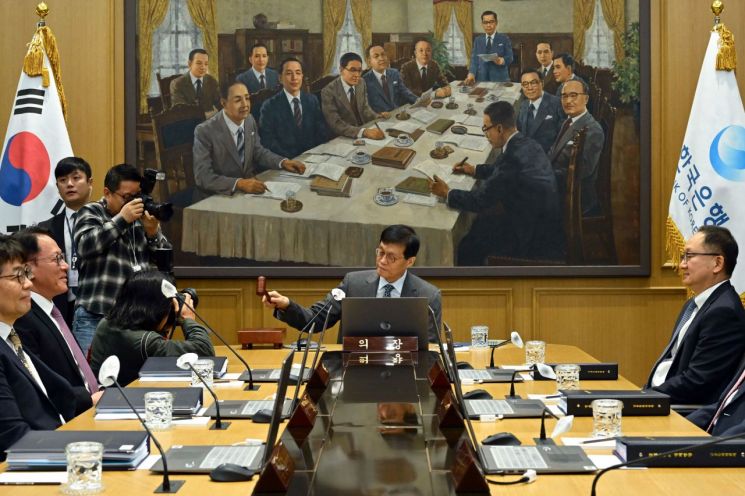 Lee Chang-yong, Governor of the Bank of Korea, is striking the gavel at the Monetary Policy Committee's plenary meeting held at the Bank of Korea headquarters in Jung-gu, Seoul on the 27th. Photo by Yonhap News Agency Joint Coverage Team
According to the minutes of the 20th MPC meeting of 2025 (held on November 27), released by the Bank of Korea on the 16th, one committee member stated, “While the growth rate is expected to continue improving and return to its potential level next year, concerns over financial stability have grown.” The member added, “Expectations for real estate price increases remain high, and in the foreign exchange market, the increased volatility of the exchange rate could impact both inflation and financial stability, which warrants close attention.”
At last month’s MPC meeting, five of the six committee members, excluding Governor Lee Chang-yong, voted to freeze the base interest rate at 2.50% per annum. Only committee member Shin Sung-hwan clearly opposed the decision, expressing a minority view that the rate should be lowered to 2.25% per annum. Additionally, the number of committee members suggesting the possibility of a rate cut within three months decreased from four to three, signaling a somewhat weaker indication of monetary easing.
Committee members who supported maintaining the rate all voiced concerns about the recent rise in the won-dollar exchange rate. One member pointed out, “The recent increase in the exchange rate is largely due to Korea-specific structural factors, such as the reversal of the interest rate differential between Korea and abroad, the strength of the US dollar, and the expansion of overseas investments by residents. This suggests that the exchange rate may remain elevated due to ongoing supply-demand imbalances.”
The member continued, “If the high exchange rate persists, it could negatively impact household consumption by raising import prices and increase the burden on small and medium-sized enterprises and the domestic sector. Therefore, in addition to structural factors, the interest rate differential and global dollar trends should be considered as additional upward pressures on the exchange rate.”
Another member also emphasized, “We need to strengthen monitoring of the inflow and outflow trends of foreign securities investment and the high volatility of the exchange rate.” The member added, “High volatility in the foreign exchange market, resulting from imbalances in foreign exchange supply and demand and external uncertainties, is also a burden.”
Although the pace of household debt growth has slowed somewhat, the persistent expectation of rising real estate prices, particularly in the Seoul metropolitan area, was also cited as a reason for maintaining the rate. One member assessed, “In the domestic housing market, the government’s housing market stabilization measures in October have somewhat eased overheating in the metropolitan area, but expectations for real estate price increases remain.” Another member noted, “Although the pace of household debt growth has slowed due to strengthened macroprudential policies, expectations for real estate price increases persist due to concerns over housing supply, making the trend toward stabilization uncertain.”
Expectations for a recovery in the growth rate also appear to have eased the burden of the decision to maintain the rate. One member stated, “The future growth path of the domestic economy is generally balanced in terms of upside and downside uncertainties related to the semiconductor cycle and trade conditions. As the economy is on a recovery trajectory, the urgency for monetary policy to respond to the business cycle has lessened.”
However, even among those who supported maintaining the rate, there was the opinion that “Although the need for a rate cut has somewhat decreased, as the outlook for inflation and the real economy has been slightly revised upward, inflation is not yet at a concerning level, and the recovery in the private sector, excluding base effects, is not yet robust. Therefore, accommodative monetary policy is still necessary.”
Shin Sung-hwan, the only committee member to express support for a rate cut, explained, “The domestic economic recovery largely reflects base effects from previously low growth rates and the impact of increased government fiscal spending. The actual pace of recovery in the real economy is still insufficient.”
Shin further argued, “Given the significant increase in dependence on the semiconductor sector and the rapid rise in leverage related to US AI investments, the uncertainty surrounding the AI industry is considerable, which means uncertainty for the domestic economy next year is also significant. Although the need for a rate cut has somewhat decreased, as the outlook for inflation and the real economy has been slightly revised upward since the last MPC meeting, inflation is not yet at a concerning level, and the recovery in the private sector, excluding base effects, is not yet robust. Therefore, accommodative monetary policy is still necessary.”
© The Asia Business Daily(www.asiae.co.kr). All rights reserved.
![Clutching a Stolen Dior Bag, Saying "I Hate Being Poor but Real"... The Grotesque Con of a "Human Knockoff" [Slate]](https://cwcontent.asiae.co.kr/asiaresize/183/2026021902243444107_1771435474.jpg)















