2025 Oil Conference Held in Jung-gu, Seoul
Exploring Survival Strategies Such as AI and Process Optimization
Ministry of Trade, Industry and Energy Hints at Policy Support for 'Manufacturing AI'
An opportunity has been created to explore the strategic transformation of the refining industry and directions for sustainable growth amid the rapidly changing energy transition phase.
On December 16 in Seoul, the Ministry of Trade, Industry and Energy held the 7th "2025 Oil Conference" under the theme of "Strategic Transformation and Sustainable Growth of the Refining Industry." The event was attended by more than 200 representatives from the government, industry, academia, and research institutes, who discussed changes in the global oil market environment and the mid- to long-term role of the domestic oil industry. In his opening address, Park Joosun, Chairman of the Korea Petroleum Association, stated, "There are concerns that the oil industry is being left out of policy support as the energy transition accelerates," and added, "The refining industry needs to be reconsidered from the perspectives of energy security and industrial competitiveness."
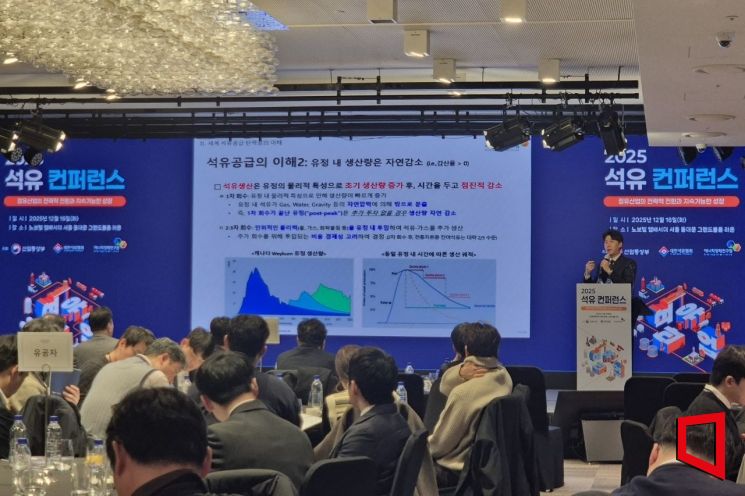 Kim Taehwan, Director of the Oil Policy Research Office at the Korea Energy Economics Institute, is speaking at the "2025 Oil Conference" held on the 16th in Jung-gu, Seoul. Photo by Oh Jieun.
Kim Taehwan, Head of the Oil Policy Research Office at the Korea Energy Economics Institute, who delivered the keynote presentation, highlighted the potential imbalance in the global oil demand and supply structure. Kim explained, "According to the International Energy Agency (IEA) outlook, global oil demand is likely to remain at current levels until 2035," and diagnosed, "However, investment in oil production has essentially stagnated since 2015, which has actually weakened supply conditions."
He pointed out, "While oil production structurally declines over time, demand reduction is progressing more slowly than expected," and emphasized, "Ensuring supply stability is as important a national task as reducing demand." To this end, he proposed the following: strengthening the supply stability function within the energy special account; diversifying crude oil import sources; public-private cooperation in resource development; and the digitalization of storage bases and oil pipeline networks.
Regarding carbon neutrality, Bae Choongsik, Professor at the Korea Advanced Institute of Science and Technology (KAIST), stressed, "To achieve the national greenhouse gas reduction target (NDC) for 2035, a balanced approach that combines various power sources such as hybrids and synthetic fuels (E-Fuel), rather than relying solely on electric vehicles, is necessary."
© The Asia Business Daily(www.asiae.co.kr). All rights reserved.

















