CareDoc Releases "2025 Elderly Care Gap Index" Report
It has been analyzed that the supply of elderly care services in South Korea is failing to keep up with demand, resulting in an ever-widening "care blind spot" each year.
On December 16, CareDoc, a senior total care company, released its "2025 Elderly Care Gap Index" report, which analyzes the current state of elderly care based on public data statistics. This is the second report released since 2023, and it shows that the overall level of the elderly care gap has deepened over the past three years.
CareDoc developed the Elderly Care Gap Index to raise awareness of the realities of elderly care in South Korea and to urge the establishment of effective policies and the constructive growth of the care industry. Using the year 2008, when long-term care insurance was first introduced, as the baseline index (100), the company quantifies the level of the care gap each year, allowing for an intuitive understanding of changes over time.
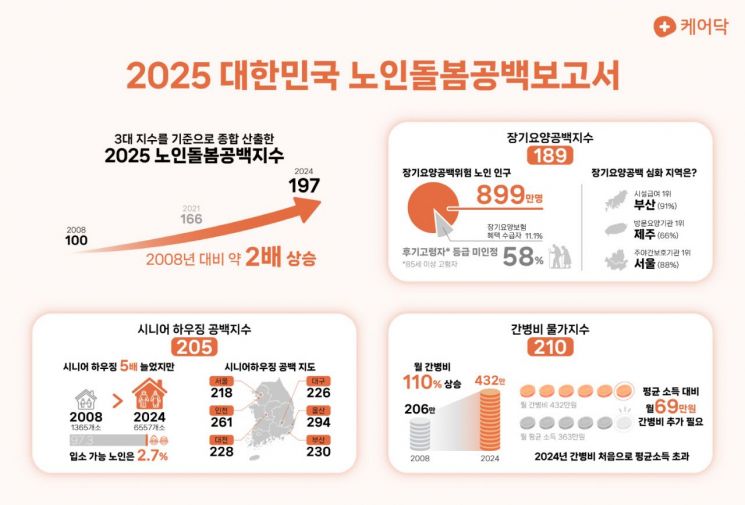
This new report uses the most recent data from 2024 to closely examine changes in the care landscape. In line with the structure of elderly care in South Korea, it analyzes three main indicators: the Long-Term Care Gap Index, the Senior Housing Gap Index, and the Care Cost Price Index, and calculates a final comprehensive index based on these.
The 2025 Elderly Care Gap Index, which evaluates the overall situation, was calculated at 197. This is about twice as high as in 2008 and 31 points higher than in 2021 (166). Park Jaebyung, CEO of CareDoc, explained, "While the overall supply of care services has increased slightly, the care gap continues to grow. The main reason for the rise in the index is that the speed and accessibility of service supply are not keeping pace with the increasing elderly population across all services."
The detailed indicators have also generally worsened. First, the Long-Term Care Gap Index, which aggregates the status of long-term care insurance benefit recipients, reached 189. In 2025, about 8.99 million elderly people, or 89% of the total, are exposed to the risk of a long-term care gap. The number of benefit recipients has increased fivefold to about 1.13 million compared to 2008, but the elderly population has grown even faster, resulting in a larger gap. In particular, those aged 85 and over, the late elderly, were analyzed as the age group with the highest care demand and the most vulnerable to the risk of a long-term care gap.
The Senior Housing Gap Index was recorded at 205. This index analyzes the supply of "senior housing," which provides care and accommodation for the elderly, and serves as a measure of the stability of elderly residential welfare. In 2024, there were 6,557 such facilities, about five times more than in 2008, but the number of available spots was only about 270,000, or 2.7% of the total elderly population. This means that over 97% are inevitably forced to choose between waiting for admission or receiving care at home. In addition, the senior housing gap by region was highest in Ulsan, as well as in major metropolitan cities and Gyeonggi Province. It is interpreted that the more densely populated an area is, the lower the accessibility to senior housing services becomes.
The Care Cost Price Index represents the financial burden of care costs per elderly person. This index stood at 210, more than double the figure in 2008, indicating a heavier burden relative to income. This is also the background for the increasing number of young carers who face difficulties in daily life as they give up their livelihoods to care for family members. In fact, the monthly employment cost for a caregiver in 2025 is about 4.32 million won, which is 690,000 won higher than the average income of 3.63 million won. If an elderly person is hospitalized, this cost increases even further.
CEO Park stated, "As elderly care is emerging as a major social issue due to changes in the country's demographic structure and the limitations of the current system, it is essential to implement practical measures to address the care gap. As a leading private care platform, CareDoc will continue to take the initiative in providing policy and industry direction for building a care system based on on-the-ground data."
© The Asia Business Daily(www.asiae.co.kr). All rights reserved.

















