Average Proportion of Students Who Never Accessed the System: 60%
The Board of Audit and Inspection has found that the Ministry of Education caused confusion in schools by pushing forward the full-scale introduction of the AI Digital Textbook (AIDT) for the 2025 academic year without gathering feedback from stakeholders such as students, parents, and teachers, or conducting pilot operations. An inspection of actual usage in participating schools revealed that the average utilization rate, based on the standard of 'use for more than 10 days,' was only 8.1 percent, while the proportion of students who never accessed the system averaged 60 percent.
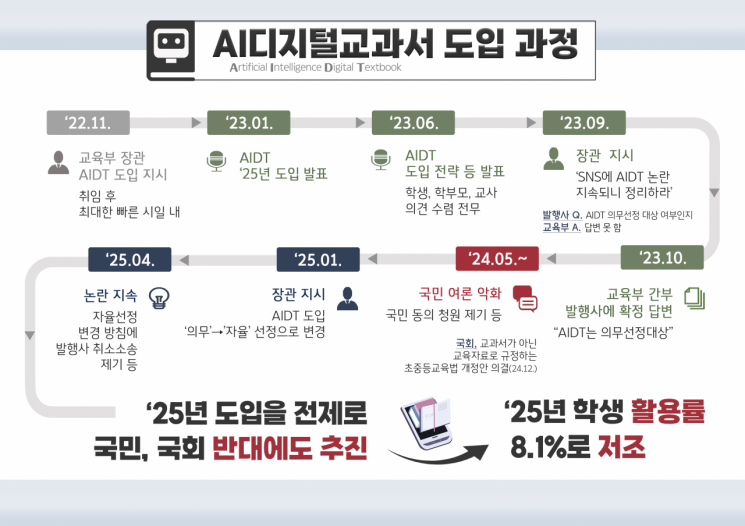
On December 17, the Board of Audit and Inspection released the results of its audit on the introduction of the AI Digital Textbook, stating that it had identified six 'caution' items after reviewing the appropriateness of the Ministry of Education’s process for introducing the AIDT, as well as the fairness and transparency of the evaluation process. This audit was conducted following a request from the National Assembly in February of this year, and the Board of Audit and Inspection carried out its review of the Ministry of Education and related organizations over 15 days from June 9 to June 27. In addition, to assess the status of AIDT usage in selected schools (autonomously chosen), a survey was conducted with 513 English and mathematics teachers from AIDT pilot schools between July 18 and July 29.
According to the Board of Audit and Inspection, after announcing in January 2023 its plan to introduce the AIDT in 2025, the Ministry of Education made the decision through seven internal meetings without collecting external opinions. While the Ministry held 22 meetings, including roundtables, councils, forums, and workshops, during the announcement of the basic plan in February and June of the same year, the Board pointed out that it did not gather input from the students (or their parents) and teachers who would actually use the AIDT regarding whether to introduce it, the timing of introduction, or whether it should be mandatory.
On August 31, 2023, the Ministry of Education issued a public notice for the AIDT evaluation and distributed development guidelines. However, it was found that key technical standards, such as technical specification documents, were only provided in December of that year. The Board of Audit and Inspection stated, "Development proceeded without technical standards, and when the standards were belatedly provided, publishers had to redesign their systems, raising concerns about delays in the development schedule and a decline in quality."
Confusion surrounding the mandatory adoption of the AIDT was also included in the audit findings. The Board of Audit and Inspection reported that, after first explaining at a publishers' meeting on October 19, 2023, that all schools would be required to adopt the AIDT, the Ministry of Education proceeded with its work on the premise of mandatory adoption for all schools. Later, in November 2024, the Ministry sent a mandatory selection manual to provincial and metropolitan offices of education. However, as opposition to the AIDT grew in the National Assembly, the Ministry changed its policy in January 2025 to allow schools to decide autonomously whether to adopt it for that year. The Board explained that, during this process, a publisher filed a lawsuit to cancel the decision in April 2025, and on August 4, 2025, the National Assembly passed an amendment to the Elementary and Secondary Education Act defining the AIDT as educational material, which was promulgated on August 14.
"Average 60% Non-Access Rate... 85.5% of Teachers 'Did Not Use or Discontinued Use'"
An inspection of access and usage status at autonomously selected schools, conducted from March to the end of May 2025 (excluding holidays), showed that the average utilization rate based on 'use for more than 10 days' was only 8.1 percent. By grade and subject, the proportion of first-year high school students who never accessed the system was highest in English at 72.8 percent, followed by mathematics at 71.0 percent, and information science at 67.9 percent.
The teacher survey also revealed a high rate of negative responses. Among teachers at AIDT pilot schools (English and mathematics, 513 respondents), 85.5 percent reported that they had never used the AIDT or had stopped using it, while only 14.5 percent continued to use it (with the sustained usage rate in high schools at 5.4 percent). The most common reason for not using the AIDT, cited by 53 percent of respondents, was that "it is simply a digitized version of the paper textbook and does not provide significant benefits," according to the Board of Audit and Inspection.
Insufficient Discussion on Subscription Fees... Estimated at Over 1 Trillion Won in 2028
The Board of Audit and Inspection also criticized the Ministry of Education for insufficient consultation regarding the funding of AIDT subscription fees, which are structured as a subscription-based pricing system. The Ministry planned to cover the subscription fees using general grants to provincial and metropolitan offices of education, but it was found that the Ministry did not adequately estimate the budget or sufficiently review funding methods, and unilaterally communicated the cost burden to the Council of Provincial and Metropolitan Superintendents without prior consultation. The estimated AIDT subscription fees were presented as 336.1 billion won for 2025, 542.1 billion won for 2026, 863.4 billion won for 2027, and 1.0732 trillion won for 2028.
The Board of Audit and Inspection stated that it had requested the Minister of Education to: △verify the effectiveness and identify issues through pilot operations when introducing new types of textbooks; △establish technical standards before issuing public notices for evaluation; and △review necessary funding and sufficiently consult with provincial and metropolitan offices of education when implementing projects that place a financial burden on local education finances.
© The Asia Business Daily(www.asiae.co.kr). All rights reserved.

















