National Assembly Secondary Battery Forum?Korea Battery Industry Association Discussion
"Like Overseas, Institutionalize Mandatory Installation and Subsidies
and Establish a Mid- to Long-Term ESS Roadmap under the New Government"
As the expansion of renewable energy drives the global growth of the energy storage system (ESS) industry, there is a growing call within South Korea for a government-level mid- to long-term roadmap to foster the domestic ESS sector. Experts point out that, similar to other countries, institutional support such as mandatory installation requirements and tax credits, along with a comprehensive government roadmap, are necessary.
At the "Forum on Revitalizing ESS Demand Markets and Battery Industry Growth Strategies," held on the 16th in Seminar Room 2 of the National Assembly Members’ Office Building-hosted by the National Assembly Secondary Battery Forum and organized by the Korea Battery Industry Association-participants discussed various measures to foster the ESS industry, which has become increasingly important as a new growth engine under the new government's climate response and decarbonization transition policies.
Park Sungmin, Representative Assemblyman of the Secondary Battery Forum (People Power Party), stated in his opening remarks, "ESS is a new growth platform that spans not only the power sector but also manufacturing, the data industry, and digital transformation." He emphasized, "We will do our utmost to support, legislate, and improve systems to strengthen the competitiveness of the ESS and battery industries."
Shin Youngdae, Representative Assemblyman (People Power Party), said, "Although the domestic ESS ecosystem is experiencing a downturn, this is a golden time to overcome the crisis and soar again." He pledged policy support, including enhancing reliability by revising unreasonable regulations, establishing innovative power market systems such as a central contract market for ESS, and creating a market environment where fair compensation can be ensured.
Lee Sanghui, Research Director (People Power Party), remarked, "ESS is not just a segment of the market, but a strategic indicator of what kind of industry a nation aspires to lead." He stressed the need for a comprehensive approach that not only focuses on technology development and market innovation, but also on improving policy and institutional conditions. He pledged to do his best to ensure that the opinions presented through the National Assembly Secondary Battery Forum lead to policy and institutional improvements.
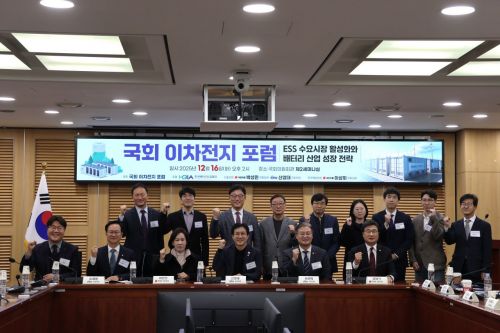 On the 16th, participants are taking a commemorative photo at the National Assembly Secondary Battery Forum held at the National Assembly. 2025.12.16 Korea Battery Industry Association
Kang Bongseok, Team Leader at the Korea Energy Agency, who gave the first presentation of the day, stated, "More than 11.2 gigawatt-hours (GWh) of ESS have been installed domestically so far. However, as major countries are already accelerating various policies to expand ESS adoption-such as mandatory installation, subsidies, and power market participation-we must also pick up the pace."
BloombergNEF estimates that the global ESS facility capacity will increase from 89.5 GWh in 2023 to 789.8 GWh by 2030, with the market size reaching 61.4 billion dollars.
In South Korea as well, the ESS market is expected to grow rapidly as the share of renewable energy increases. In particular, the Korean-style next-generation power grid project is gaining attention under the Special Act on Distributed Energy Activation. This next-generation grid is an intelligent power network that optimizes electricity production, storage, and consumption by controlling distributed energy sources such as renewables and ESS with AI technology.
Kang Bongseok emphasized, "Balancing supply and demand is crucial for electricity energy, so ESS is essential for grid stabilization." He added, "Policies must support the establishment of a market system centered on distributed energy, the expansion of virtual power plants (VPPs), and the activation of various new industries."
Cho Secheol, Team Leader at Korea Power Exchange, explained the purpose and necessity of establishing the Basic Plan for Electricity Supply and Demand, stressing that building ESS is essential for stable grid operation as renewable energy expands.
In the subsequent discussion session, Choi Jongseo, Executive Director of the Korea Battery Industry Association, asserted, "Securing overseas ESS contracts for battery companies is just as important as revitalizing the domestic ESS industry." He explained that although China has led the global ESS market so far, growing concerns about a China-centric supply chain and geopolitical risks are opening new opportunities for South Korea's ESS industry.
In particular, the industry called for the swift enactment of a domestic production tax credit system to strengthen the weak domestic ESS production base. With investments in the lithium iron phosphate (LFP) ESS supply chain increasing recently, they expect that introducing a domestic production tax credit would not only accelerate related investments but also enhance energy security response capabilities.
Additionally, since large-scale overseas ESS projects typically require upfront investment and long-term returns, which are difficult for the private sector to bear alone, the industry emphasized the necessity of government-level policy finance packages, export finance, guarantees, and project financing (PF) to support such projects. They also explained the need to form and operate "Team Korea" to expand overseas ESS orders.
Park Taesung, Executive Vice Chairman of the Korea Battery Industry Association, pointed out that the new government has yet to present a comprehensive ESS development plan, and requested the establishment of a mid- to long-term development roadmap to foster ESS as a new strategic industry.
Park also stressed that, in line with the new government's increased renewable energy targets and policies to promote distributed energy ESS, the ESS installation target should also be raised and reflected in the 12th Basic Plan for Electricity Supply and Demand.
© The Asia Business Daily(www.asiae.co.kr). All rights reserved.


















