550 Billion Won in National Funds to Be Invested Next Year
Plan to Expand by More Than 500 Villages Annually
The government has announced its plan to actively promote the "Solar Income Village" initiative, which enables members of village communities to share profits generated from solar power generation.
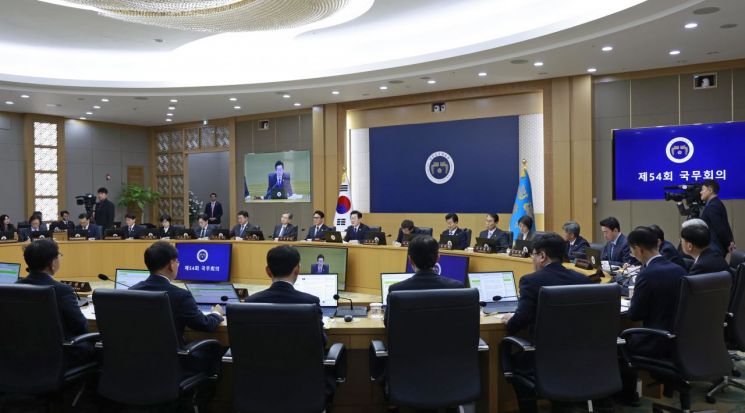
On December 16, the Ministry of the Interior and Safety reported the "National Expansion Plan for Solar Income Villages," which was jointly developed with the Ministry of Agriculture, Food and Rural Affairs and the Ministry of Climate, Energy and Environment, at a Cabinet meeting.
The Solar Income Village is a business model in which a village community takes the lead in installing and operating solar power plants on idle land, farmland, or reservoirs within the village, thereby achieving energy self-sufficiency and sharing the resulting profits among community members.
A representative example is the "Haetbitdure Power Cooperative" established by residents of Guyang-ri, Sejongdaewang-myeon, Yeoju City, Gyeonggi Province. They installed solar power plants on village warehouses and parking lots, using the proceeds to provide free lunches at the village hall and operate a free village bus, thereby revitalizing the community and contributing to carbon reduction.
To spread such exemplary cases nationwide, the government plans to overcome the limitations of village solar support projects that have been promoted by individual ministries and focus its efforts on providing comprehensive and systematic support at the government-wide level. Starting next year, the government aims to establish more than 500 Solar Income Villages annually, targeting approximately 38,000 villages, and to reach over 2,500 villages by 2030. About 550 billion won of national funds is planned to be invested next year.
Under the Ministry of the Interior and Safety, a pan-government task force tentatively named the "Solar Income Village Promotion Team" will be established. The team will consist of relevant ministries such as the Ministry of Agriculture, Food and Rural Affairs and the Ministry of Climate, Energy and Environment, as well as local governments and related organizations including Korea Rural Community Corporation, Korea Water Resources Corporation, and Korea Electric Power Corporation. It will be responsible for overall support functions, including project planning and coordination, designation and evaluation of Solar Income Villages.
In addition, dedicated departments and personnel will be assigned to local governments to actively identify residents' project needs and resolve difficulties. Field support teams will also be operated in cooperation with local environmental offices and related organizations in each region.
The government plans to provide integrated and groundbreaking support for grid connection, site acquisition, and financing required for the establishment of Solar Income Villages, centering on the newly established task force. To address the biggest obstacle of grid connection, the government will push for the enactment and revision of relevant laws to allow Solar Income Villages to have priority access to the grid. In areas with insufficient grid capacity, support will be provided for the installation of energy storage systems (ESS) to resolve connection waiting times and facilitate smooth grid connection.
Public land such as village halls and parking lots, as well as idle sites owned by the Korea Rural Community Corporation and Korea Water Resources Corporation, will be actively identified. Support will also be provided for permits and leases for national and public property, construction of permanent facilities, and reduction of usage and lease fees.
Financial and tax support will be significantly increased to drastically reduce the initial investment burden on residents. In 2025, approximately 450 billion won in renewable energy financial support will be provided, offering long-term low-interest loans for up to 85% of the investment cost for solar facilities. Local financial institutions such as regional agricultural cooperatives and credit unions will also participate as policy fund handling institutions to improve financial accessibility for village communities.
In particular, in areas experiencing population decline, local governments will be allowed to use the "Local Extinction Response Fund" to support residents' self-financing contributions. Acquisition tax exemptions and property tax reductions will be provided for renewable energy startups and new business sites.
The government will also promote expedited permits and simplified procedures for small-scale environmental impact assessments by local governments, and plans to require the use of domestically produced solar modules and inverters for Solar Income Villages.
Yoon Hojoong, Minister of the Interior and Safety, stated, "Solar Income Villages are an innovative model that can simultaneously revitalize village communities and the social solidarity economy, as well as achieve carbon reduction. The Ministry of the Interior and Safety will work together with the Ministry of Agriculture, Food and Rural Affairs, the Ministry of Climate, Energy and Environment, local governments, and public institutions to fully support the nationwide expansion of Solar Income Villages."
© The Asia Business Daily(www.asiae.co.kr). All rights reserved.
![Clutching a Stolen Dior Bag, Saying "I Hate Being Poor but Real"... The Grotesque Con of a "Human Knockoff" [Slate]](https://cwcontent.asiae.co.kr/asiaresize/183/2026021902243444107_1771435474.jpg)















