Three Core Strategies: Educational Safety Net, Customized Growth, and Happy Community
Bridging Educational Gaps by Ensuring Learning, Care, and Basic Competencies
To Be Reflected in Four Key Areas and Sixteen Priority Projects for Gwangju Education Next Year
The Gwangju Metropolitan Office of Education is implementing a 'basic education' strategy as a successful model for public education, built on three pillars: educational safety net, customized growth, and a happy community. The plan aims to bridge educational gaps by guaranteeing students' learning, care, and basic competencies within the framework of public education.
On December 16, the Gwangju Metropolitan Office of Education officially announced its basic education strategy. Basic education refers to providing the optimal conditions for student growth through public education, going beyond compulsory education. The focus is on ensuring each student's learning, care, and core competencies, and supporting their happy development.
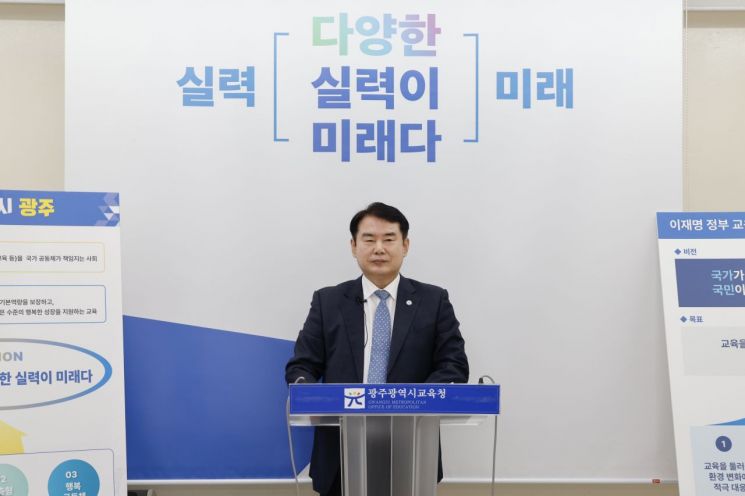 Lee Jungseon, Superintendent of Gwangju Metropolitan Office of Education, explains the basic education concept during the declaration of 'Basic Education Special City Gwangju' held on the 16th at the briefing room of the Gwangju Metropolitan Office of Education. Provided by Gwangju Metropolitan Office of Education
The Office cited several reasons for this initiative: the deepening of educational inequality, the potential stigmatization effect of existing educational welfare programs, an increase in students and staff struggling emotionally, the growing importance of digital skills such as artificial intelligence, and changes in multicultural and international environments.
The educational safety net focuses on restoring the emotional well-being and relationships of all members of the educational community. The plan is to strengthen mental health, character, and life education, and to protect students' daily lives through a safe care system.
Customized growth involves diversifying basic academic achievement, reading and humanities, career and academic guidance, vocational training, and education in culture, arts, and sports. It also supports future competencies such as mathematics, science, AI and digital skills, and global competencies. Support for students with borderline intelligence, previously limited to elementary schools, will be expanded to secondary schools, with the goal of eliminating the rate of students falling below basic academic standards.
The happy community aims to realize education based on communication and collaborative governance by strengthening the balance between teachers' authority and students' rights, school autonomy, and cooperation with the local community.
The Office plans to incorporate the three main strategies of basic education into next year's four key areas and sixteen priority projects for Gwangju education.
Superintendent Jeongseon Lee stated, "We will expand the achievement of a perfect score in the national college entrance exam, accomplished for the first time in ten years through public education, by spreading the basic education model." He continued, "Through the recovery, growth, and happiness of all members of the educational community, we will create a driving force for the region's sustainable development." Lee also clarified, "This announcement is unrelated to the recent prosecution's warrant request and dismissal or the resignation demands from educational organizations. It is a plan that has been refined based on past discussions with President Lee Jaemyung, and was released in response to the recent announcement by the Ministry of Education."
© The Asia Business Daily(www.asiae.co.kr). All rights reserved.
![Clutching a Stolen Dior Bag, Saying "I Hate Being Poor but Real"... The Grotesque Con of a "Human Knockoff" [Slate]](https://cwcontent.asiae.co.kr/asiaresize/183/2026021902243444107_1771435474.jpg)
















