KERI Releases “Economic Trends and Outlook” Report
Exports Expected to Rise 0.8% Year-on-Year in 2024
Solid Semiconductor Demand and Favorable Shipbuilding Orders
Current Account Surplus Estimated at 89 Billion Dollars
Gradual Improvem
There is a forecast that the Korean economy will grow by 1.7% next year, driven by a recovery in the semiconductor and shipbuilding sectors.
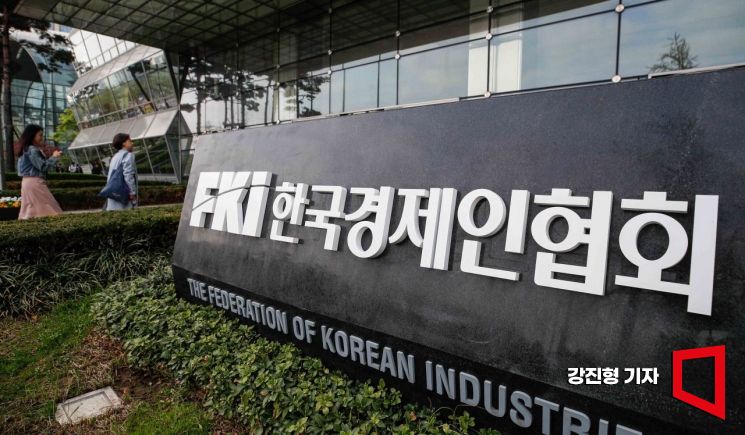 Employees of tenant companies are moving at the Korea Economic Association in Yeouido, Seoul. Photo by Jinhyung Kang aymsdream@
The Korea Economic Research Institute, under the Korea Economic Association, presented this analysis in its “KERI Economic Trends and Outlook” report released on December 16.
The report set this year’s GDP growth rate at 1.0%, and projected that exports will expand next year, particularly in semiconductors and shipbuilding, leading to a 0.8% year-on-year increase in exports. It analyzed that, globally, continued investment in artificial intelligence (AI) and data centers will keep semiconductor demand robust, while the shipbuilding industry will maintain a favorable order flow, especially for high value-added and specialized vessels.
The current account surplus is expected to reach 89 billion dollars. However, the report pointed out that this is mainly the result of a few leading sectors, rather than an overall industrial restructuring, making the economy potentially vulnerable to changes in the global economy and trade environment.
The report forecasted that the domestic demand sector will improve gradually next year. Private consumption is expected to increase by 1.6%. However, the pace of real wage improvement is slow, and the burden of living costs and housing expenses remains high, so the scope of recovery may be limited. Facility investment is likely to grow only 1.5%, due to sluggish global demand in traditional manufacturing industries such as steel and machinery, as well as excess capacity. Construction investment is projected to grow by 2.9%, but the report noted that it is still too early to view this as a normalization, given the impact of adjustments in project financing and weak indicators for construction starts and pre-sales. Consumer prices are expected to rise by 1.9% year-on-year, maintaining a stable trend. However, the report cautioned that the burden of costs such as electricity, gas, services, and housing may keep perceived inflation high for consumers.
The report also stated that business sentiment next year may be limited in its recovery due to structural cost pressures, including exchange rates, energy, and logistics costs. In the foreign exchange market, the strong dollar trend and increased overseas investment were cited as factors contributing to a weaker won, while uncertainty in trade policy and geopolitical risks were mentioned as factors that could increase won volatility. The financial market is expected to remain highly volatile due to the expansion of fiscal burdens in the United States, uncertainty over the path of monetary policy, and concerns about overheating in AI investments.
Jung Chul, President of the Korea Economic Research Institute, said, “While signs of recovery will become clearer in 2026, sustainable growth can only be achieved if the government simultaneously fosters new growth industries and supports domestic demand recovery. The government must establish a trade environment and a stable business environment that enable companies to increase investment and employment.”
© The Asia Business Daily(www.asiae.co.kr). All rights reserved.
![Clutching a Stolen Dior Bag, Saying "I Hate Being Poor but Real"... The Grotesque Con of a "Human Knockoff" [Slate]](https://cwcontent.asiae.co.kr/asiaresize/183/2026021902243444107_1771435474.jpg)
















