STEPI: "Opening the Path to the Global Market Through Licensing System and Rationalized Security Regulations"
While the number of domestic private companies directly operating ultra-high-resolution commercial satellites is increasing, there are concerns that the systems supporting the collection, sale, and export of satellite imagery remain predominantly public sector-oriented. Analysts point out that for the private satellite imagery industry to advance into the global market, not only technological competitiveness but also institutional transformation must occur simultaneously.
The Science and Technology Policy Institute (STEPI) published Issue 353 of 'STEPI Insight' on December 16, diagnosing the structural changes and institutional gaps in Korea's satellite imagery utilization industry and presenting related policy implications. The report recommends the urgent introduction of a licensing system and the rationalization of security regulations to support private sector satellite operation, utilization, and export.
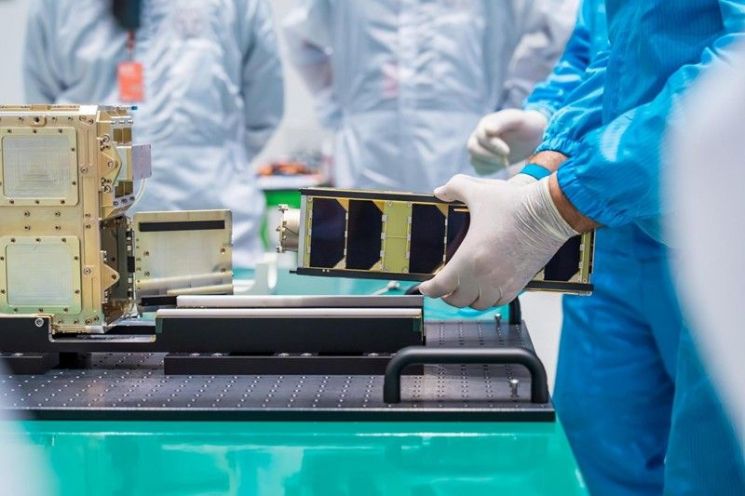 K-HERO CubeSat mounted on the Nuri rocket's CubeSat deployer (Photo for illustrative purposes only and not directly related to the article content) Provided by Korea Aerospace Research Institute
Private Sector Shifts to 'Satellite Operator'... Institutions Remain Public Satellite-Centric
According to the report, the revenue of Korea's satellite imagery utilization industry increased by approximately 29.8%, from 74.6 billion won in 2018 to 96.9 billion won in 2023. During the same period, the number of related companies and employees also grew at an average annual rate of 5.8% and 2.9%, respectively, indicating an expansion of the industry.
In particular, private companies are rapidly shifting from a government satellite sales agency (SIIS)-centered structure to becoming 'satellite operators' that develop or purchase and operate their own satellites. They are also expanding into high value-added areas such as securing data through high-frequency imaging and providing platform services that combine artificial intelligence (AI) analysis.
However, despite this growth trend, satellite imagery service exports have declined over the past three years, indicating limitations in entering the global market. The report identifies the lack of a clear institutional foundation to regulate the collection, processing, sale, and export of imagery by private operators as the cause.
Abroad: 'License-Based Differential Regulation'... Korea: Government Approval Structure
The report explains that major countries such as the United States, Germany, and Japan are pursuing institutional reforms in line with the expansion of private-led satellite imagery markets. In the United States, the Department of Commerce (DOC) and the National Oceanic and Atmospheric Administration (NOAA) operate a licensing system, applying different regulations depending on the sensitivity of the data. The so-called 'Shutter Control'-a restriction on imaging-is only invoked during national security crises, balancing commercial viability and national security.
In contrast, the report points out that although Korea's capacity to acquire ultra-high-resolution imagery is rapidly expanding, the country still maintains a government-centered regulatory system that requires 'imaging approval → export approval,' restricting the expansion of private sector services and overseas exports.
Accordingly, the report recommends revising relevant laws or enacting a separate law on satellite information to establish a legal basis for private satellite operators' collection, utilization, and sale of imagery, as well as building a licensing system that separates satellite operation from data provision. It also emphasizes the need to rationalize security regulations to consider both national security and industrial competitiveness, and to strengthen the institutional foundation for public-private cooperation by expanding public procurement of private satellite services.
Ahn Hyungjun, Head of the Space Public Team at STEPI, said, "The high-resolution satellite imagery market is a core national security asset and a growth engine for the future space economy. Korea can only secure competitiveness in the global satellite imagery market by shifting from security-centered regulations to a coherent and flexible regulatory system tailored to the industry's pace and characteristics." He added, "It is necessary to clarify the roles and responsibilities among imagery providers, users, and supervisory agencies, and to establish a national-level strategic framework that considers international and private sector demand."
© The Asia Business Daily(www.asiae.co.kr). All rights reserved.


















