Long-duration Submersion, Waiting for the Right Moment to Self-Destruct
Capable of Shooting Down Helicopters with Onboard Missiles
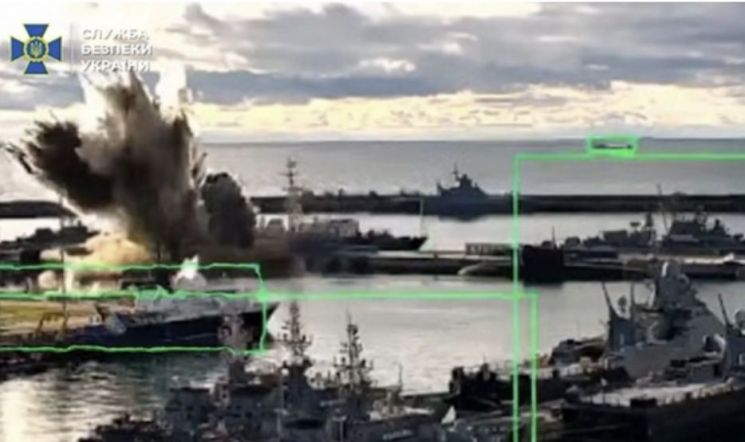 On the 15th (local time), the Security Service of Ukraine (SBU) claimed to have struck a submarine docked at the Russian Novorossiysk port using an underwater unmanned vehicle (drone), showing an explosion scene in the video they released. SBU Facebook account
The Ukrainian military has claimed to have destroyed a Russian submarine using an underwater unmanned vehicle (drone). Ukraine's announcement that it sank an expensive submarine with a relatively inexpensive underwater drone has drawn worldwide attention. Underwater drones can remain at depth for extended periods and are difficult to detect, prompting countries such as the United States and China to intensify their development efforts. Some experts predict that, in the future, the mainstay of naval weaponry will shift from warships and submarines to underwater drones.
Ukraine: "Underwater drone destroys Russian submarine"... Russia denies
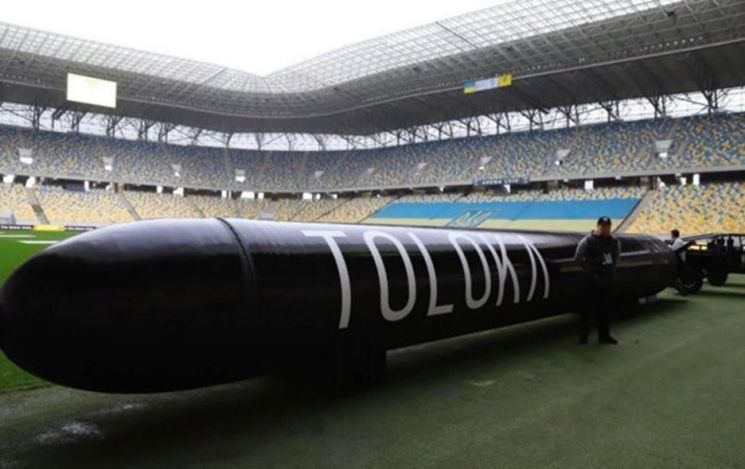 The underwater unmanned vehicle (drone) Toloka-1000, revealed by the Ukrainian military last September. Ukrainian Ministry of Defense website
On the 15th (local time), the Security Service of Ukraine (SBU) announced in a statement that it had deployed an underwater drone to attack a Russian submarine at Novorossiysk, a Russian naval base in the Black Sea, and succeeded in destroying it. The SBU also released a video showing the attack, in which a large explosion suddenly occurs at Novorossiysk port. The SBU emphasized, "For the first time in history, an underwater drone has destroyed a Russian submarine. The submarine has suffered severe damage and is now unable to operate."
The destroyed Russian submarine is reported to be a Kilo-class diesel-powered conventional submarine, which was carrying cruise missiles used in Ukrainian airstrikes. It is known as a "black hole" because its special hull absorbs sound, making it difficult to detect with underwater sonar. Dmytro Pletenchuk, spokesperson for the Ukrainian Navy, said, "This has once again overturned perceptions about the potential for maritime combat using drones," adding, "Russia has lost one of the four submarines stationed at Novorossiysk, and it will now be difficult for them to bring the submarine to the surface for repairs."
The Security Service of Ukraine referred to the underwater drone used in this operation only by its nickname, "Sub sea baby," without disclosing the exact model. The Toloka model, an underwater drone previously revealed by Ukrainian authorities, is considered a likely candidate. Some speculate that it could be a new model based on modifications to existing underwater drones.
In contrast, the Russian side claims that Ukraine's attack failed. Alexei Rulev, spokesperson for Russia's Black Sea Fleet, said, "The enemy's attempts to attack with underwater drones failed," and insisted, "Not a single surface vessel or submarine of the Black Sea Fleet docked at Novorossiysk naval base was damaged in the attack, and no crew members were injured."
Ukrainian underwater drones are hard to detect... Capable of interception and self-destruction in diverse attacks
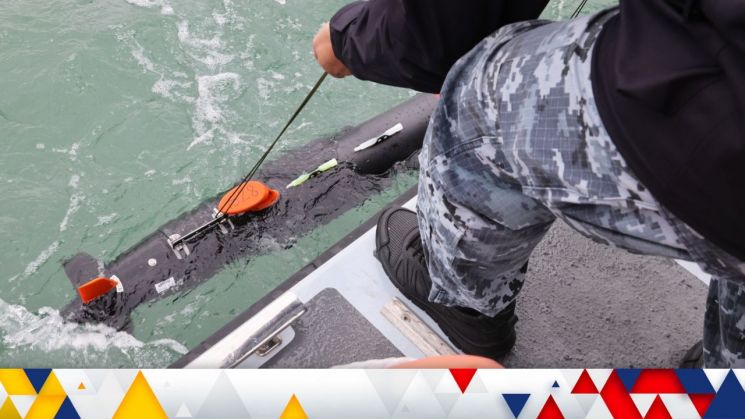 A Ukrainian soldier deploying a small underwater unmanned vehicle (drone) in the Black Sea. Official website of the Ministry of Defense of Ukraine
If Ukraine's successful attack on the submarine is confirmed, it could bring significant changes to naval strategies involving underwater drones. There is even speculation that underwater drones, which are less expensive to manufacture than submarines and do not require crew members, could replace submarine capabilities.
The price of the Russian Kilo-class submarine reportedly destroyed by Ukraine is about 400 million dollars (approximately 587.8 billion won) per vessel. In contrast, the underwater drones developed by Ukraine cost about 350,000 to 400,000 dollars (514 million to 580 million won) each, roughly one one-thousandth the price of a Russian submarine. Cynthia Cook, Senior Fellow at the Center for Strategic and International Studies (CSIS), told the Wall Street Journal, "If the submarine was indeed attacked by a drone as Ukraine claims, it would mark a new phase in underwater warfare," adding, "This could open the way for underwater drones to replace submarines as strategic assets."
Underwater drones have the advantage of not requiring oxygen, allowing them to remain submerged for long periods, and they are difficult to detect with underwater sensors. Ukrainian underwater drones are highly regarded for their versatility, as they are equipped with both self-destruct and interception functions. Naval News, a naval specialist media outlet, reported, "Even if the Russian military manages to intercept about 70% of the underwater drones, the remaining 30% that fail to be intercepted and self-destruct on target can cause significant losses," adding, "So far, the Russian military has tried various countermeasures such as nets and jamming devices, but has not been able to respond effectively."
The United States and China accelerate underwater drone development... Unmanned submarine arms race
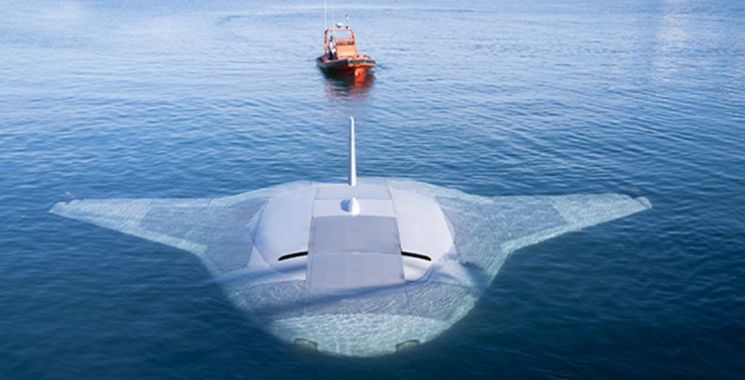 The Manta Ray drone, the latest underwater unmanned vehicle (drone) developed by the United States Department of Defense's Defense Advanced Research Projects Agency (DARPA) and Northrop Grumman. Northrop Grumman website
Not only Ukraine, but also countries such as the United States and China are accelerating the development of underwater drones.
According to Defense News, in May of last year, the United States unveiled the "Manta Ray" underwater drone, which is being jointly developed by the Defense Advanced Research Projects Agency (DARPA) and defense contractor Northrop Grumman. The drone is designed to resemble a manta ray and features the ability to recharge its batteries using ocean currents. This enables it to operate for over a year without resupply, carrying out a variety of missions.
China also unveiled its unmanned submarine "AJX002" at the 80th Victory Anniversary military parade last September. This massive submarine, over 20 meters in length, is equipped with reconnaissance and attack capabilities similar to conventional submarines and is specialized for long-duration underwater operations. Russia is also developing the "Poseidon," a nuclear-powered underwater drone, and is reportedly experimenting with joint operations involving existing nuclear submarines.
© The Asia Business Daily(www.asiae.co.kr). All rights reserved.



















