Leaders Index Analyzes Changes in Migration Patterns of Millennials & Gen Z
Net Inflow Seen Only in Gyeonggi, Seoul, Incheon, Sejong, Chungnam, and Daejeon
Jeju Records the Largest Decline Nationwide
Over the past eight years, spanning before and after the COVID-19 pandemic, there has been a notable shift in the migration patterns of Millennials & Gen Z (ages 20 to 39).
On December 16, Leaders Index released an analysis comparing and examining the migration of Millennials & Gen Z over the four years prior to the pandemic (2018-2021) and the four years after (2022-October 2025), citing data from the National Data Agency.
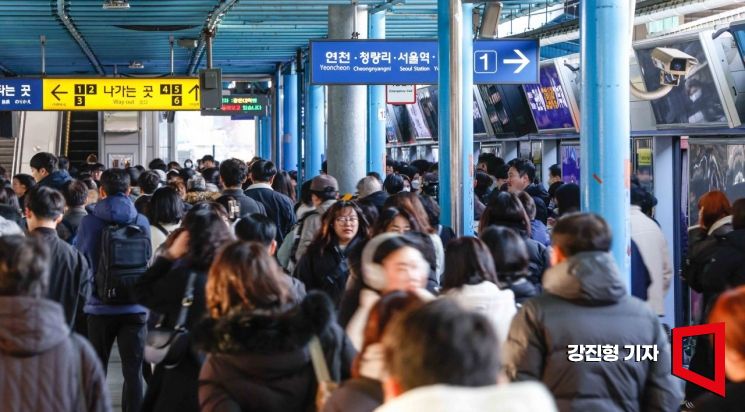 Photo for article understanding purposes only and unrelated to the content. The Asia Business Daily DB.
The analysis found that, in the past four years, six metropolitan regions-Gyeonggi, Seoul, Incheon, Sejong, Chungnam, and Daejeon-recorded a net inflow of Millennials & Gen Z.
Both Seoul and Gyeonggi had already been attracting Millennials & Gen Z before the pandemic, but their trends have since diverged. The net inflow into Gyeonggi slowed, dropping from the 300,000 range to the 100,000 range. In contrast, Seoul saw its net inflow more than triple, rising from about 25,000 to 77,000-an increase of over 200%.
While the total population of Seoul declined, the number of Millennials & Gen Z increased. Despite high housing and living costs, factors such as access to jobs, education, and culture appear to have played a decisive role.
The most dramatic change nationwide was seen in Incheon. While Incheon experienced a net outflow of 547 Millennials & Gen Z in the four years before the pandemic, this reversed to a net inflow of 46,245 in the subsequent four years-an increase of over 8,500%. This shift is attributed to a combination of factors: proximity to Seoul, new housing supply, and relatively lower housing costs.
 Population Movement Status of Millennials & Gen Z in Metropolitan Autonomous Regions. Leaders Index.
Some regions in the central part of the country showed similar trends. Sejong, Chungnam, and Daejeon, which had a net outflow of Millennials & Gen Z before the pandemic, saw a reversal to net inflow afterward. In particular, Daejeon’s total population continued to decline, but the number of Millennials & Gen Z increased. The influx is believed to be driven by new city development and improved residential environments in Yuseong District.
In contrast, several metropolitan regions continued to experience a net outflow of Millennials & Gen Z before and after the pandemic. These include Gyeongnam, Gyeongbuk, Busan, Daegu, Gwangju, Jeonnam, Jeonbuk, Ulsan, and Gangwon. Notably, the Gyeongsang region saw the largest net outflow of Millennials & Gen Z nationwide. Gyeongnam recorded a net outflow of over 50,000 both before and after the pandemic, making it the region with the highest outflow, followed by Gyeongbuk and then Busan.
Jeju saw an increase of 4,150 Millennials & Gen Z in the four years before the pandemic. However, in the subsequent period, this trend reversed, with a decrease of 6,018-marking the largest decline rate nationwide at -249%.
© The Asia Business Daily(www.asiae.co.kr). All rights reserved.
![Clutching a Stolen Dior Bag, Saying "I Hate Being Poor but Real"... The Grotesque Con of a "Human Knockoff" [Slate]](https://cwcontent.asiae.co.kr/asiaresize/183/2026021902243444107_1771435474.jpg)

















