56.3% Cite "High Inflation" as the Biggest Burden
90.4% Feel Pressure from Loan Principal and Interest Payments
According to a recent survey, 9 out of 10 small business owners expect the business environment next year to remain the same as this year or worsen.
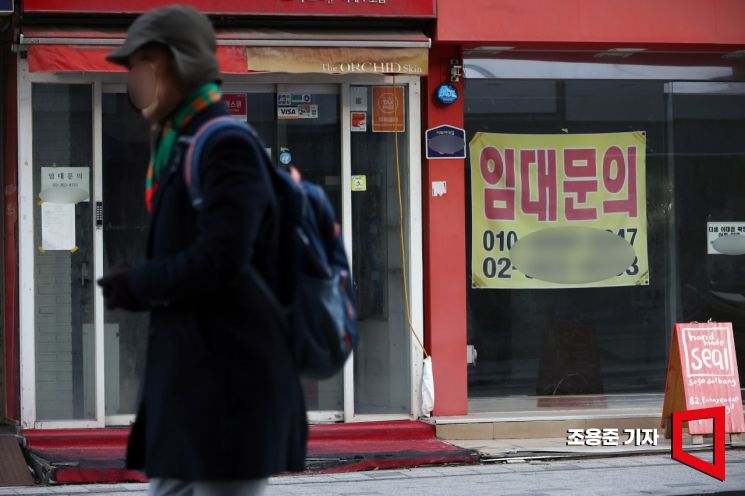 Amid domestic and international challenges such as economic recession and sluggish domestic demand, the number of small business closures is rapidly increasing, leaving many vacant stores lined up in a densely populated commercial area in Sinchon, Seoul. Photo by Jo Yongjun
On December 16, the Korea Federation of SMEs announced the results of the "Survey on the Business Conditions and Policy Tasks of Small Businesses." The survey was conducted from November 4 to 21, targeting 800 small businesses in sectors closely related to daily life, such as retail, wholesale, accommodation, food and beverage, as well as manufacturing.
The results showed that 89.3% of all respondents predicted that "next year's business environment will be similar to this year (51.3%)" or "worsen (38.0%)." Only 10.8% had a positive outlook.
The largest business burden this year was "high inflation," such as rising raw material and supply costs, cited by 56.3% of respondents. This was followed by a decrease in sales due to sluggish domestic demand (48.0%), rising labor costs and difficulties in securing personnel (28.5%), and the burden of loan repayment (20.4%).
However, the vast majority of small business owners (97.4%) responded that they are "not considering closing their business." This is interpreted as being due to the fact that 91.4% of businesses are started for livelihood reasons, such as difficulties in finding employment and preparing for retirement.
The rate of small businesses entering online platforms was 28.1%, up 3.5 percentage points from the previous year. In particular, the platform entry rate for accommodation and food service businesses was 44.3%, which was higher than that for retail and wholesale (20.3%) and manufacturing (15.5%).
Dependence on platforms continued to increase. Among businesses on platforms, the proportion of sales generated through platforms averaged 41.7%, up 6.3 percentage points from the previous year.
Total loans among small businesses continued to rise, increasing their financial burden. Of all respondents, 25.7% said their loan amount increased compared to the previous year, with an average loan interest rate of 4.4%. In addition, 46.2% of small business owners with loans said they felt "very burdened," and 44.2% felt "somewhat burdened," meaning a total of 90.4% felt pressure from interest and principal repayments.
Policies to boost domestic demand, such as livelihood recovery consumption coupons implemented this year, were felt to be most effective in the accommodation and food service sectors. More than half (52.3%) of accommodation and food service businesses reported feeling the impact of these policies, while only 18.0% of retail and wholesale and 8.5% of manufacturing businesses reported similar effects.
Among small business owners who said the policies were effective, 65.4% responded that "the effect was only temporary," indicating the need for both mid- and long-term policy support in the future. Other responses included direct effects such as short-term sales increases (19.7%), indirect effects such as improved business district atmosphere (8.8%), and increased new and repeat customers (5.7%).
When asked about improvements for future consumption promotion policies, the most common response was "adjusting usage criteria" so that consumption is concentrated in local commercial districts, cited by 41.8%. This was followed by expanding the scale and duration of support (31.8%) and policy promotion (24.5%).
The most needed support policies for small businesses on the ground were support for revitalizing domestic demand and consumption (49.5%), financial support (41.5%), support for sales channels (4.6%), and spreading a culture of mutual cooperation (1.8%).
The top priorities that the National Assembly or government should address this year were cited as boosting consumption and regional economic recovery (52.1%), resolving rising labor costs and labor shortages (45.0%), alleviating the burden of high-interest loans (42.8%), and easing the burden of energy costs (26.3%).
Choo Moon-gap, Director of Economic Policy at the Korea Federation of SMEs, said, "In addition to continued high inflation and sluggish domestic demand, the recent surge in exchange rates has made the business environment for small businesses increasingly challenging. While consumption promotion policies such as livelihood recovery consumption coupons have had some effect, most of the impact has been short-term. Therefore, it is necessary to implement mid- to long-term growth policies that small business owners can truly feel."
© The Asia Business Daily(www.asiae.co.kr). All rights reserved.
![Clutching a Stolen Dior Bag, Saying "I Hate Being Poor but Real"... The Grotesque Con of a "Human Knockoff" [Slate]](https://cwcontent.asiae.co.kr/asiaresize/183/2026021902243444107_1771435474.jpg)















