Travel Time Reduced from 57 to 27 Minutes
Targeting Opening in 2031, Total Project Cost 2 Trillion Won
New Stations in Deogeun, Gokang, and Sinwol... Four Transfer Stations Planned
On December 15, Hyundai Engineering & Construction broke ground on the long-awaited “Daejang-Hongdae Metropolitan Railway Private Investment Project” in the western Seoul metropolitan area. The line will connect Daejang New Town in Bucheon to Hongdae Entrance Station in Seoul, spanning 20.1 kilometers. Once opened, travel time will be reduced from 57 minutes to 27 minutes. Hyundai Engineering & Construction is responsible for two of the five construction sections: Section 1, which is the starting point of the railway, and Section 4, which passes under the Han River from Gayang Station to Sangam. The company will be in charge of these technically challenging and key segments.
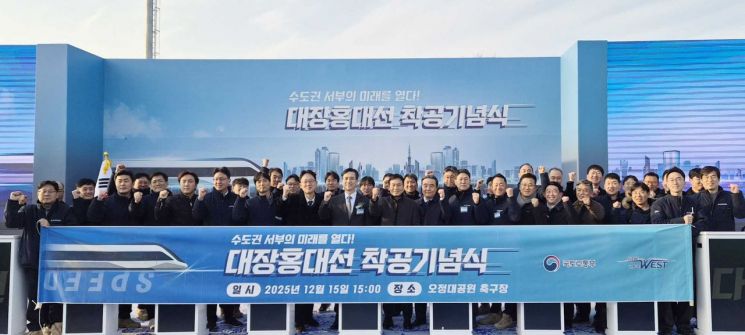 Hanwoo Lee, CEO of Hyundai Engineering & Construction (center), is taking a group photo with Hyundai Engineering & Construction executives and employees while pledging safe construction at the groundbreaking ceremony of the Daejang-Hongdae Line held near Daejang New Town in Bucheon, where the Daejang-Hongdae Line departs on the 15th. Hyundai Engineering & Construction
According to Hyundai Engineering & Construction on December 16, a groundbreaking ceremony was held that day at Ojeong Grand Park, near Daejang New Town in Bucheon, where the Daejang-Hongdae Line will begin. The event was attended by Kim Dongyeon, Governor of Gyeonggi Province; Kim Yongseok, Chairman of the Metropolitan Transport Commission at the Ministry of Land, Infrastructure and Transport; and Hanwoo Lee, CEO of Hyundai Engineering & Construction. This ceremony marks the start of the metropolitan railway private investment project connecting Daejang New Town in Bucheon and Hongdae Entrance Station in Mapo-gu, Seoul. Hyundai Engineering & Construction aims to open the line by 2031, constructing 12 stations and one train depot. The total project cost is 2.1287 trillion won.
The road to groundbreaking was not smooth. The Daejang-Hongdae Line was first discussed in the early 2010s under the name “Wonjong-Hongdae Line,” but the project was scrapped multiple times due to low economic feasibility (B/C ratio). Later, Hyundai Engineering & Construction proposed to the government a mixed private investment model combining Build Transfer Operate (BTO) and Build Transfer Lease (BTL), which enabled the project to move forward. A national project that had stalled due to fiscal constraints was revived through private sector planning capabilities.
Once the line is completed, the western metropolitan area will be incorporated into Seoul’s commuter belt. Stations will also be established in previously underserved areas such as Deogeun-dong in Goyang, Gokang-dong in Bucheon, and Sinwol-dong in Yangcheon-gu, Seoul, which have long been considered transportation blind spots due to the lack of rail service.
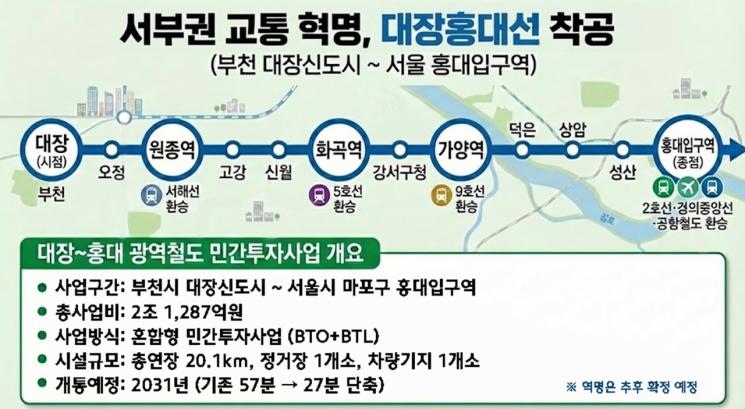
Among the 12 new stations, four will serve as transfer stations: Wonjong (Seohae Line), Hwagok (Line 5), Gayang (Line 9), and Hongdae Entrance (Line 2, Airport Railroad, and Gyeongui-Jungang Line). In particular, the new railway will directly connect the Deogeun District in Goyang and Sangam-dong in Mapo-gu, Seoul, which were previously separated by the Han River.
A Hyundai Engineering & Construction representative stated, “As this is a technically demanding project that passes through the Han River and urban areas, we will mobilize all of our technology and expertise to ensure safe construction. We will do our utmost to open the railway on schedule, not only to ease the commuting burden for residents in the western metropolitan area but also to contribute to balanced regional development.”
© The Asia Business Daily(www.asiae.co.kr). All rights reserved.
![Clutching a Stolen Dior Bag, Saying "I Hate Being Poor but Real"... The Grotesque Con of a "Human Knockoff" [Slate]](https://cwcontent.asiae.co.kr/asiaresize/183/2026021902243444107_1771435474.jpg)

















