Park Jaesik Stresses, "Diagnose Before Blaming Fiscal Shortfalls
A Compass Needed to Uncover Potential Resources"
A proposal to restructure the overall fiscal management of Jinju City in South Gyeongsang Province based on data was raised at the city council on December 15. The main point is to fundamentally transform fiscal operations by establishing an 'AI-based Local Fiscal Pathfinder System.'
On this day, Park Jaesik, a member of the Jinju City Council, stated during his 5-minute free speech, "Jinju City complains every year about budget shortages and a decrease in local allocation tax," but also pointed out, "It is necessary to clearly diagnose whether we are failing to uncover resources hidden within the complex accounting structure," highlighting the difficulties of the current fiscal system.
He also identified structural issues in Jinju City's fiscal management based on the results of previous research groups of council members, such as delays in closing accounts, lack of linkage between funds, non-tax revenues, and expenditures, and the difficulty of monitoring budget execution status in real time.
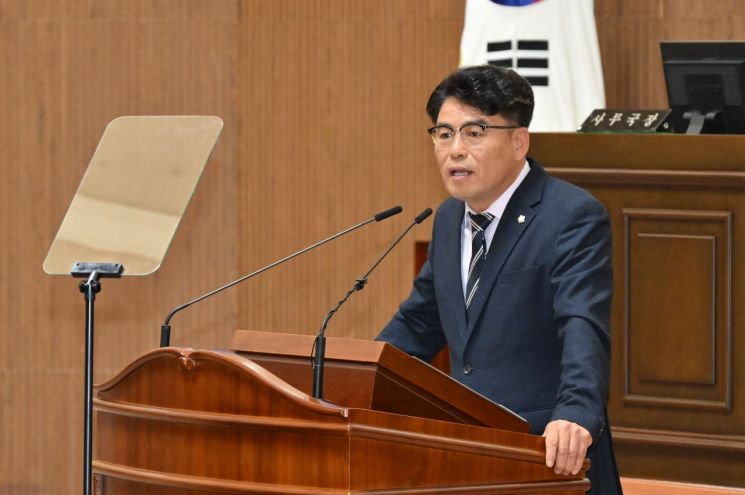
Councilor Park criticized, "These limitations prevent us from accurately assessing fiscal capacity and risk, and even undermine the credibility of policy decisions."
The proposed alternative is the 'AI-based Local Fiscal Pathfinder.'
He explained, "'Pathfinder' means 'guide,' and it is a smart fiscal management tool that integrates and analyzes the overall flow of the city's finances to suggest the optimal direction for fiscal operations." He argued, "If AI analyzes expenditure patterns by project and provides real-time information on projected balances, execution speed, and risk factors, inefficiencies that previously only surfaced after the fiscal year-end can be prevented in advance." He added that the system would serve as a 'fiscal compass,' providing crucial support in setting policy priorities and determining investment timing.
He further emphasized that by scientifically integrating and analyzing key indicators such as local taxes, population, industrial structure, and economic fluctuations within the system, it would be possible to make precise forecasts of fiscal revenues several years ahead. By linking this with budget settlements and fund data, the city could accurately calculate both actual available resources and potential liabilities.
© The Asia Business Daily(www.asiae.co.kr). All rights reserved.
![Clutching a Stolen Dior Bag, Saying "I Hate Being Poor but Real"... The Grotesque Con of a "Human Knockoff" [Slate]](https://cwcontent.asiae.co.kr/asiaresize/183/2026021902243444107_1771435474.jpg)















