Miran Criticizes Current Rate as "Tight"
"Actual Core Inflation at 2.3%... Phantom Inflation Distorting Judgment"
Williams: "Monetary Policy Near Neutral Level"
As the Federal Reserve (Fed) cut its benchmark interest rate for the third consecutive time last week, internal differences within the Fed regarding the appropriate interest rate level are becoming increasingly pronounced. Amid the conflicting trends of a slowing labor market and persistent high inflation, analysts say that diverging views among committee members on policy priorities and the appropriate rate are making monetary policy decisions even more challenging.
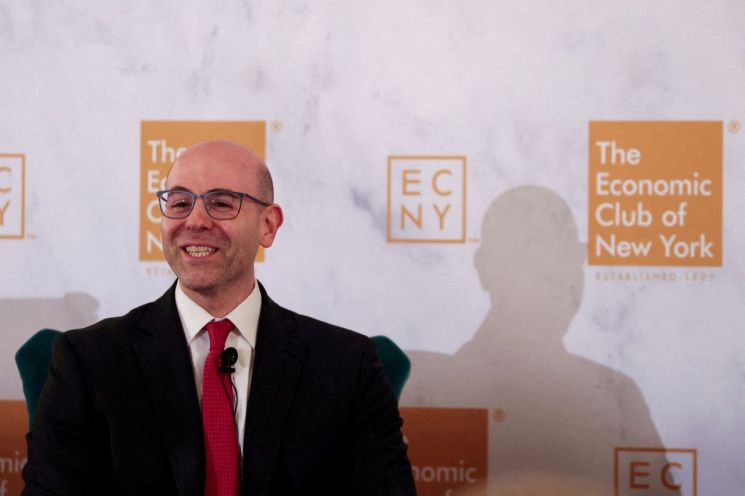
Fed Governor Stephen Miran stated on December 15 (local time) during a lecture at Columbia University's School of International and Public Affairs that "phantom inflation is distorting the Fed's judgment," arguing that "as a result, the benchmark interest rate remains excessively high." He emphasized the need to carefully assess the underlying inflationary pressures, adding that "the currently measured excessive inflation rate does not fully reflect the current supply and demand conditions."
Governor Miran pointed out that if temporary and distorted factors, such as those from the housing sector, are excluded from the calculation of price indicators, the core inflation rate-which shows the underlying trend-stands at only 2.3%. He explained that this is close to the Fed's inflation target of 2%. However, the most recent data show that both the Consumer Price Index (CPI) and core CPI for September still rose by 3% year-on-year.
He warned that maintaining an unnecessarily tight monetary policy could lead to job losses.
Miran, known as the "economic advisor" to President Donald Trump, has attended the Federal Open Market Committee (FOMC) regular meetings since September for the first time and has opposed the three consecutive 0.25 percentage point rate cuts, instead advocating for a 0.5 percentage point cut-a so-called "big cut." However, in an interview with CNBC on the same day, he stated that if the Fed continues to ease policy constraints by lowering rates, "the need to dissent by demanding a larger cut will diminish."
In contrast, mainstream figures within the Fed have assessed that the current monetary policy is close to a neutral level. They emphasized that the recent rate cuts were an adjustment process to balance the twin risks of employment and inflation.
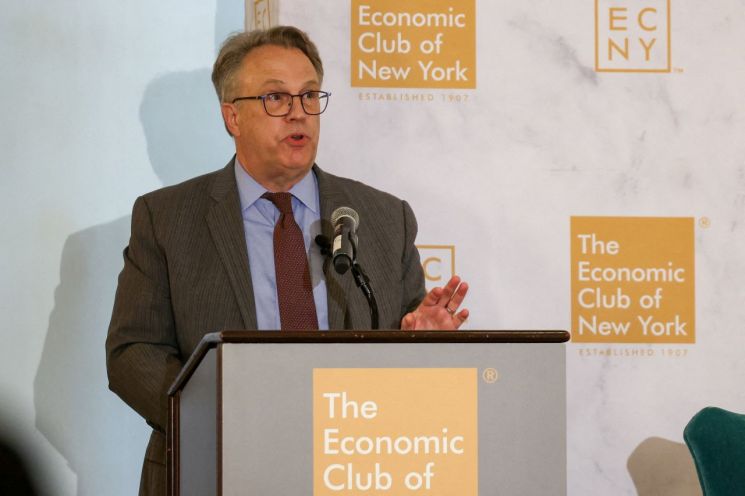
John Williams, President of the Federal Reserve Bank of New York, attended an event in Jersey City, New Jersey, and stated that last week's rate cut brought monetary policy closer to a neutral stance, placing it in a suitable position in preparation for next year. Williams, who has a voting right on the FOMC as an ex officio member, is considered the "de facto number two" at the Fed.
President Williams said, "The FOMC has adjusted its somewhat tight monetary policy stance to a neutral level," adding, "This move puts us in a more advantageous position as we head toward 2026." The neutral rate refers to the theoretical interest rate level that neither stimulates nor restrains the economy.
He expressed strong support for the rate cut implemented this month, but remained cautious and refrained from commenting on the direction of monetary policy for January next year.
Caution about inflation remains prevalent within the Fed.
Susan Collins, President of the Federal Reserve Bank of Boston, wrote on LinkedIn that while she supported the recent rate cut, the decision was "a close call." She noted, "The likelihood of a significant further rise in inflation has diminished, but given that high prices have persisted for nearly five years, concerns about prolonged inflation remain."
President Collins emphasized the need for a clearer outlook on the direction of inflation before any further rate cuts.
As these differences in views on the appropriate interest rate level persist, even those who have been relatively supportive of rate cuts are now indicating that monetary policy is approaching a neutral stance, raising expectations that the threshold for further cuts will be higher going forward. In fact, the Fed's dot plot, which outlines the future rate path, projects only one additional rate cut next year, suggesting a likely moderation in the pace of policy easing.
This cautious stance was also evident in the recent rate decision process. On December 10, the Fed lowered its benchmark rate by 0.25 percentage points to a range of 3.5-3.75% per annum, but three of the twelve FOMC members with voting rights dissented. Of the three, two favored holding rates steady, while one advocated for a big cut. This marks the first time since September 2019 that there have been three dissenting votes, highlighting the increasing difficulty the Fed faces in setting clear policy priorities between addressing labor market and inflation challenges. This also underscores the growing uncertainty surrounding the future path of monetary policy.
© The Asia Business Daily(www.asiae.co.kr). All rights reserved.


















