"Balancing Employment and Inflation Risks...
Monetary Policy in an Appropriate Position"
Avoids Commenting on Possible Rate Cut in January
John Williams, President of the Federal Reserve Bank of New York, stated on December 15 (local time) that last week’s Federal Reserve (Fed) interest rate cut has brought monetary policy close to a neutral stance, and that the Fed is now well-positioned as it heads into next year. He projected that the U.S. economic growth rate in 2026 will be in the low 2% range, supported by fiscal policy and investments in artificial intelligence (AI), and that inflation will fall below 2.5%.
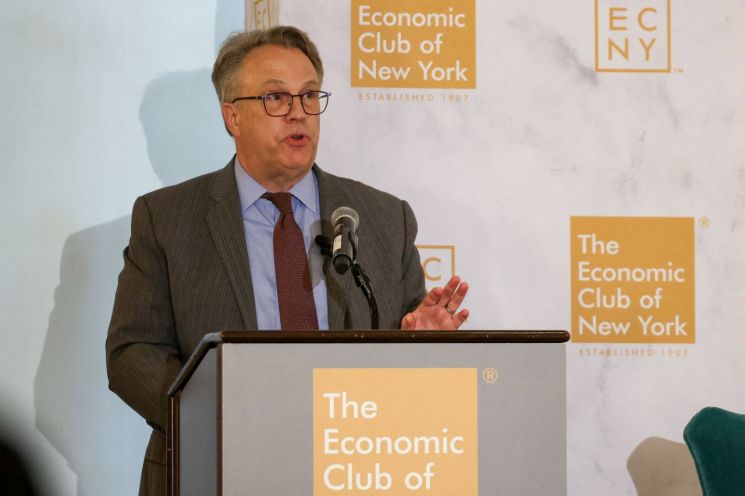
Speaking at an event in Jersey City, New Jersey, Williams said, “Monetary policy is very much focused on balancing the two risks of employment and inflation,” adding, “To achieve this, the Federal Open Market Committee (FOMC) has adjusted its previously somewhat restrictive policy stance to a neutral level.” He continued, “These measures have put us in a favorable position as we move toward 2026,” and expressed strong support for last week’s rate cut.
He also noted, “By lowering rates based on data and outlook, we have largely balanced these two opposing risks,” and emphasized, “While we cannot know exactly how trade policy, inflation, or economic conditions will unfold next year, I believe we are well prepared for them.”
The Fed held its final regular FOMC meeting of the year on December 10 and cut its benchmark rate by 0.25 percentage points to a range of 3.5% to 3.75%. This marked the third consecutive 0.25 percentage point cut following those in September and October. According to Williams, this means rates are now close to a neutral level, neither stimulating nor restraining the economy.
Williams forecast that next year’s economic growth rate will be around 2.25%. He explained that support from fiscal policy, a favorable financial environment, and increased AI investment will help sustain growth in the low 2% range.
He expects inflation to fall slightly below 2.5% by the end of next year, and to reach the Fed’s target of 2% by 2027.
Regarding the nonfarm payroll report for November, which is set to be released the following day, he said, “It will basically be in line with the trends we have observed so far,” adding that he expects to see signs of relatively slow job growth and a gradual cooling of the labor market.
However, he was cautious about commenting on the direction of monetary policy for January next year, saying it is too early to make such statements.
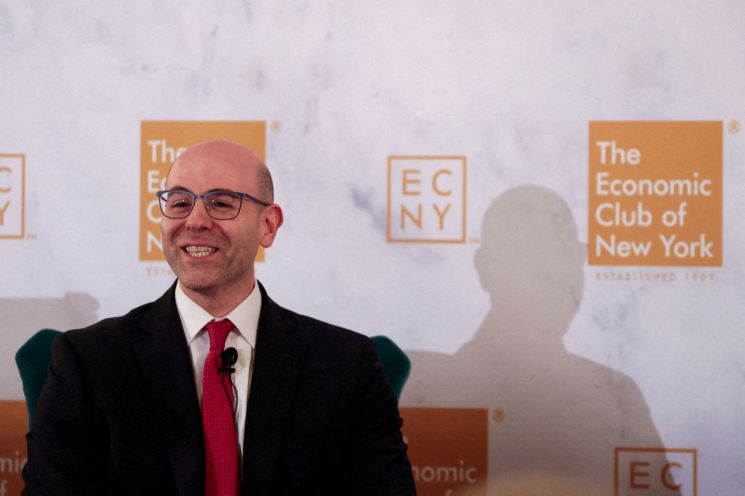
Meanwhile, Fed Governor Stephen Miran, known as President Donald Trump’s “economic advisor,” said in a CNBC interview that he does not plan to continue dissenting on monetary policy at future FOMC meetings. Since first attending the FOMC in September, Miran has opposed the majority’s 0.25 percentage point rate cuts at every meeting, advocating instead for a 0.5 percentage point cut. However, he explained that as the Fed continues to lower rates and gradually eases policy constraints on the economy, “the need to dissent by calling for larger cuts will decrease accordingly.”
Miran, who succeeded former Fed Governor Adriana Kugler after her early resignation, will serve until January next year. He stated that he will remain in his position until a new Fed governor is nominated and confirmed.
© The Asia Business Daily(www.asiae.co.kr). All rights reserved.
![Clutching a Stolen Dior Bag, Saying "I Hate Being Poor but Real"... The Grotesque Con of a "Human Knockoff" [Slate]](https://cwcontent.asiae.co.kr/asiaresize/183/2026021902243444107_1771435474.jpg)
















