Passed with 443 Votes in Favor Out of 597 Total
The Democratic Party of Korea approved a revision to its party constitution regarding nomination rules on the 15th, ahead of next year's June 3 local elections.
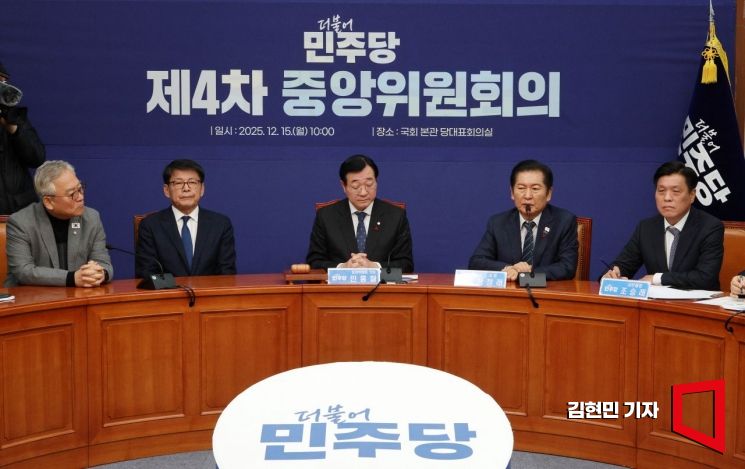 Jeong Cheongrae, leader of the Democratic Party of Korea, is speaking at the 4th Central Committee meeting held at the National Assembly on the 15th. 2025.12.15 Photo by Kim Hyunmin
On this day, the Democratic Party held a Central Committee meeting and put the proposed constitutional amendment, which includes the method for primary elections in the local elections, to a vote. Out of 597 eligible votes, 443 were in favor and 85 were against, passing the amendment. A total of 528 Central Committee members, representing 88.44%, participated in the vote.
The main point of the amendment is to set the voting ratio for basic proportional representative candidate primaries at 50% from executive committee members and 50% from dues-paying party members. For metropolitan proportional representative candidate primaries, the amendment stipulates that the vote will be conducted entirely by dues-paying party members.
Previously, the party constitution stipulated that both basic and metropolitan proportional representative candidates would be determined by a 100% vote of executive committee members. However, in an effort to strengthen the rights of party members, the Democratic Party pushed for an amendment to have these primaries conducted entirely by dues-paying party members. This amendment, however, was rejected at the Central Committee meeting on the 5th, along with the so-called "one person, one vote" system. After some revisions, the proposal was resubmitted on this day. In particular, during the revision process, the opinion that some rights of executive committee members should be maintained was accepted, and thus the voting ratio for basic proportional representative primaries was adjusted to reflect 50% from executive committee members.
The revised party constitution also introduces a new provision that allows for a preliminary primary if there are five or more candidates for public office, with the method and implementation of the primary to be determined by the Supreme Council.
Additionally, the amendment adjusts the additional points given to young candidates in primaries to a three-tier system: 25% for those aged 35 or younger, 20% for those aged 36 to 40, and 15% for those aged 41 to 45. Previously, the system was divided into four tiers: 25% for those aged 29 or younger, 20% for those aged 30 to 35, 15% for those aged 36 to 40, and 10% for those aged 41 to 45.
Furthermore, the amendment introduces a "Nomination Grievance Center" system, allowing appeals regarding the results of local councilor screening reviews. It also stipulates that among candidates recognized as exceptions despite being otherwise disqualified, habitual defectors will have 25% of their votes deducted, while those with reasons such as corruption, abuse of power, or sexual harassment will have 20% deducted, respectively.
The amendment also newly stipulates that for candidates with a history of defying nomination decisions, the amount of vote deduction in the primary can be adjusted by a Supreme Council decision, depending on the reason.
© The Asia Business Daily(www.asiae.co.kr). All rights reserved.
![Clutching a Stolen Dior Bag, Saying "I Hate Being Poor but Real"... The Grotesque Con of a "Human Knockoff" [Slate]](https://cwcontent.asiae.co.kr/asiaresize/183/2026021902243444107_1771435474.jpg)















