Korea Road Traffic Authority’s Five-Year Analysis of Icy Road Accidents
Bridges and Overpasses Freeze Faster and Melt Slower
Risk of Rear-End Collisions on Icy Roads 14.0 Percentage Points Higher
The fatality rate of traffic accidents caused by icy roads on bridges and overpasses during winter is more than four times higher than that of regular roads.
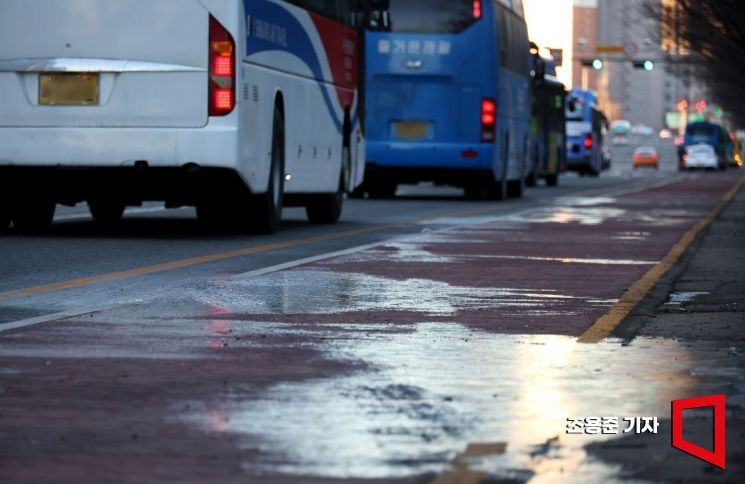
The Korea Road Traffic Authority announced on December 15 the results of an analysis of 4,112 icy road traffic accidents that occurred over the past five years (2020-2024). The findings revealed that the likelihood of death in accidents occurring on bridges and overpasses is significantly higher.
The fatality rate for icy road traffic accidents (number of deaths per 100 accidents) was recorded at 4.8 on overpasses and 5.9 on bridges. This is approximately 2.4 to 3 times higher than the average fatality rate for all icy road accidents (2.0), and about four times higher than the average fatality rate on dry roads (1.3).
This difference stems from the structural characteristics of the roads. Bridges and overpasses, by design, do not retain ground heat and are exposed to cold air above and below, causing snow and rain to freeze more quickly than on the ground and making it difficult for ice to melt. According to research by the Korea Insurance Development Institute (Automobile Technology Research Center), the road surface temperature on bridges or overpasses is about 5 to 6 degrees Celsius lower than that of regular roads, significantly increasing the risk of ice formation.
The risk of vehicle-to-vehicle collisions is also higher on icy roads. The proportion of rear-end collisions among vehicle-to-vehicle accidents on icy roads was 14.0 percentage points higher than on dry roads. In addition, the proportion of accidents on downhill sections was 12.3 percentage points higher.
Road surface freezing occurs particularly frequently in specific sections such as bridges, overpasses, tunnel entrances and exits, underpasses, shaded curves, and areas near rivers or low-lying areas, as these are greatly affected by road structure and environmental factors. The Korea Road Traffic Authority has identified locations with frequent road icing accidents over the past five years and made them publicly accessible through a web service. Areas at risk for icy road traffic accidents can be checked via the Traffic Accident Analysis System (TAAS).
In these vulnerable sections, drivers can reduce the risk of accidents by sufficiently lowering their speed and maintaining a safe distance from the vehicle ahead. On downhill sections, shifting to a lower gear and using engine braking can help decelerate safely even on slippery surfaces.
Furthermore, if a driver discovers road black ice or icy patches, reporting them by phone enables a prompt response. Local governments are responsible for regular roads, while the Korea Expressway Corporation handles on-site measures for expressways.
Hyun Cheolseung, Head of the AI Digital Division at the Korea Road Traffic Authority, emphasized, "If drivers fail to recognize icy road conditions during winter, they may face dangerous situations. On icy roads, always drive at reduced speeds, maintain a safe distance, and avoid sudden starts, braking, or sharp steering."
He added, "Even when the weather is clear, be especially careful on bridges, overpasses, shaded sections, and tunnel entrances and exits, as pre-existing road ice may not have completely melted and can still remain."
© The Asia Business Daily(www.asiae.co.kr). All rights reserved.
![Clutching a Stolen Dior Bag, Saying "I Hate Being Poor but Real"... The Grotesque Con of a "Human Knockoff" [Slate]](https://cwcontent.asiae.co.kr/asiaresize/183/2026021902243444107_1771435474.jpg)















