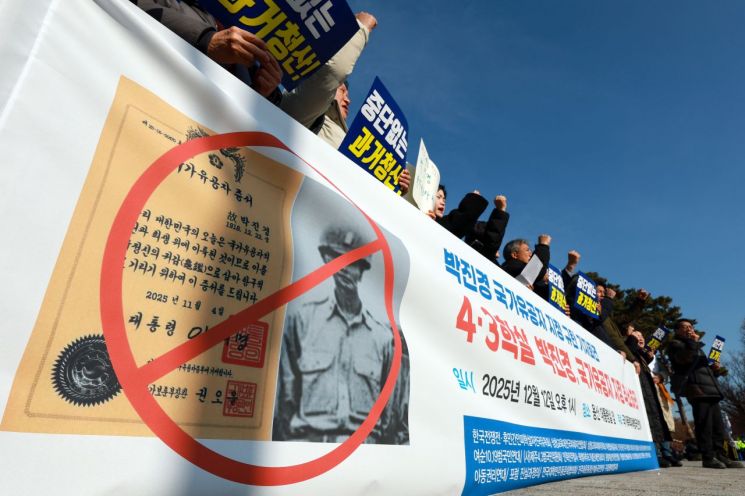
 On the 12th, in front of the War Memorial in Yongsan-gu, Seoul, members of the National Coalition for Victims of State Violence and the Jeju 4·3 National Committee condemned the registration of the late Colonel Park Jin-kyung, who led the harsh suppression during the Jeju 4·3 Incident, as a national merit recipient and called for the cancellation of his registration. Photo by Yonhap News
Regarding President Lee Jaemyung's directive on the 15th to review the cancellation of the late Colonel Park Jin-kyung's designation as a national merit recipient, the presidential office explained that this means "social discussion and review are necessary."
Kang Yujeong, spokesperson for the presidential office, made this statement during a briefing at the presidential office in Yongsan on the same day. Spokesperson Kang said, "Normally, one must go through deliberation and resolution by the Veterans Affairs Review Committee to become a national merit recipient. However, there is a provision that allows recipients of military merit awards to bypass this process," adding, "Although this is a matter that requires social discussion, the existence of this provision has led to social controversy and debate."
The Ministry of National Defense has stated that it "will take possible measures after a comprehensive review" regarding President Lee's order to cancel Park's national merit registration. Since the designation as a merit recipient was based on the Eulji Order of Military Merit, the Ministry of Patriots and Veterans Affairs cannot unilaterally revoke it; the Ministry of National Defense must first cancel the military merit award, after which the designation as a national merit recipient can be revoked accordingly.
However, when asked whether other merit recipients who, like Colonel Park, received military merit awards without going through a review would also be subject to cancellation, spokesperson Kang drew a line, saying, "It is difficult to say that a retroactive or comprehensive investigation will be conducted for all recipients of military merit awards."
According to the Jeju 4·3 Incident Fact-Finding Report, Colonel Park was appointed as the commander of the 9th Regiment of the Joseon Constabulary in May 1948. During his approximately 40-day tenure, he arrested more than 5,000 Jeju residents, and in the process, many residents were executed or went missing. About a month after his appointment, in June 1948, he was assassinated by his subordinates while sleeping in his quarters after a promotion celebration, and he was posthumously awarded the Eulji Order of Military Merit in 1950.
Various 4·3 organizations have long criticized Colonel Park as "responsible for the massacre of civilians." However, controversy erupted when the Seoul Regional Office of Patriots and Veterans Affairs approved the application for national merit registration submitted by his family in October, based on his Eulji Order of Military Merit.
Afterward, Minister of Patriots and Veterans Affairs Kwon Oeul met with the 4·3 Bereaved Families Association and apologized, but as the controversy did not subside, he announced on his Facebook page on this day that follow-up measures would be taken.
© The Asia Business Daily(www.asiae.co.kr). All rights reserved.
![Clutching a Stolen Dior Bag, Saying "I Hate Being Poor but Real"... The Grotesque Con of a "Human Knockoff" [Slate]](https://cwcontent.asiae.co.kr/asiaresize/183/2026021902243444107_1771435474.jpg)















