Hallym University Successfully Demonstrates 'AI Local Healthcare'
Achieves 98% Resident Satisfaction Rate
The Sports Science Research Institute at Hallym University (President Yanghee Choi) successfully concluded the 'Bomnae Healing School' and 'Bomnae Healing Festival' on December 9 at the Gyodong-Soyang Community Care Center, as part of the 2025 Urban Regeneration Support Project.
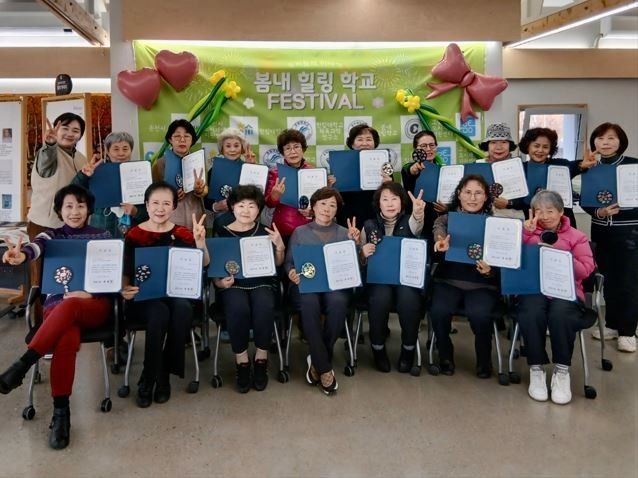 Hallym University (President Yanghee Choi) Sports Science Research Institute held the 'Bomnae Healing School' and 'Bomnae Healing Festival' on the 9th at the Gyodong-Soyang Community Care Center as part of the 2025 Urban Regeneration Support Project. Provided by Hallym University
This project marked the first case of demonstrating an AI-based regional health and culture program model that comprehensively supports the physical, mental, and daily health of local residents, centered around the Gyodong-Soyang Community Care Center area.
The 'Bomnae Healing School' consisted of eight programs encompassing physical exercise, mental health, dietary habits, and digital competency enhancement, with approximately 200 local residents participating over a two-month period. In particular, the integrated programs that spanned generations and interests-such as AI-based health measurement and strength training, healing stretching, traditional food storytelling classes, art and craft activities, and video autobiography (Vlog) production-received an overwhelmingly positive response, achieving a 98% satisfaction rate among participants.
Jung Eunhee, the lead researcher and research professor at the Hallym University Sports Science Research Institute, stated, "This project went beyond simple exercise programs; it was a process in which residents planned their own health, shared their lives with one another, and restructured their community together." She added, "We have confirmed that a model for urban regeneration, in which the local community and the university create healthy changes together, can be practically implemented."
She further emphasized, "Some residents completed the 'Senior Health Leader' course and assisted in program operations, making this an important first step in realizing a virtuous cycle of 'resident participation → resident capacity building → resident self-management.'"
Choi Boyoung, Director of the Hallym University Sports Science Research Institute, introduced the resident-customized health assessment using an AI-based physical fitness measurement system, stating, "The institute has been accumulating health data of local residents based on the scientific measurement and analysis equipment of its AI system." She continued, "In the future, we plan to contribute to the substantial improvement of local residents' health by establishing a data-driven regional health platform in connection with urban regeneration projects."
She also highlighted, "The direct connection between the university's research capabilities and the lives of local residents is the core of the RISE era, and this demonstration is an important starting point that shows its potential."
At the Bomnae Healing Festival, which marked the conclusion of the Bomnae Healing School, residents exhibited artworks and videos they had created over the past two months. The event also featured traditional food demonstrations and sharing programs, as well as a line dance performance. In particular, the screening of '5-Minute Life Videos' produced by Vlog program participants deeply moved families and neighbors, further enriching the festival's significance as a resident-centered cultural event.
Resident A (age 72), who participated in the festival, shared, "This was my first time recording my story on video. I felt reassured knowing that I could grow together with my fellow villagers, not alone." Another participant, Resident B (age 74), said, "The measurements were even more accurate than at the hospital, and after receiving an exercise program based on those results, I felt stronger and much of my pain disappeared. I hope to continue participating in the future."
Meanwhile, the Hallym University Sports Science Research Institute plans to contribute to the development of the Urban Regeneration Support Project, not merely as infrastructure construction, but as an initiative to build a regional health-based model for local living zones. Based on the achievements of the 2025 project, the institute also aims to establish an 'AI-based local healthcare platform model' that can be expanded throughout Chuncheon and Gangwon Province in the future.
© The Asia Business Daily(www.asiae.co.kr). All rights reserved.
![Clutching a Stolen Dior Bag, Saying "I Hate Being Poor but Real"... The Grotesque Con of a "Human Knockoff" [Slate]](https://cwcontent.asiae.co.kr/asiaresize/183/2026021902243444107_1771435474.jpg)















