Pukyong National University Hosts Trans-Pacific Colloquium on "Experiencing Moscow"
A Trans-Pacific Colloquium was held, providing an academic analysis and comparative study of Chinese intellectuals’ visits to Moscow and their experiences of the Russian Revolution.
Pukyong National University announced on December 15 that the Institute of Global Area Studies, led by Director Park Sanghyun (Professor of International Area Studies), hosted the 19th Trans-Pacific Dialogue on December 11 in Room 509 of the Humanities and Social Sciences Building.
On this day, Professor Cho Sehyun (Department of History) at Pukyong National University presented a study comparing the travelogues of three Chinese intellectuals who visited Moscow shortly after the Bolshevik Revolution in 1921.
Professor Cho analyzed the differing perspectives on Soviet Russia at the time through the travelogues left by Zhang Kanghu, Qu Qiubai, and Bao Pu.
According to Professor Cho, Zhang Kanghu, founder of the Chinese Socialist Party, participated in the Third Congress of the Comintern and made objective observations, but remained skeptical of the New Economic Policy.
Journalist Qu Qiubai viewed revolutionary Russia optimistically and later became a leader of the Chinese Communist Party. In contrast, student Bao Pu became disillusioned after his experiences and subsequently turned to anarchism.
Professor Cho explained, "The fact that as many as five groups claimed to represent the 'Chinese Communist Party' at the Third Congress of the Comintern demonstrates the instability of the party's early days and the competition among various socialist factions in China."
He added, "These travelogues reveal the complex realities of the early socialist movement, which are often obscured by winner-centered historical narratives, and vividly illustrate the contradictions of the early Soviet era, including the Bolshevik government's repression of intellectuals and the role of anarchist groups."
Park Sanghyun, Director of the Institute of Global Area Studies, stated, "The purpose of this colloquium is to explore the historical connections within the Trans-Pacific region in depth," and added, "I hope this serves as an opportunity to discover the implications that the ideological exchanges between East Asia and Russia in the early 20th century hold for us today."
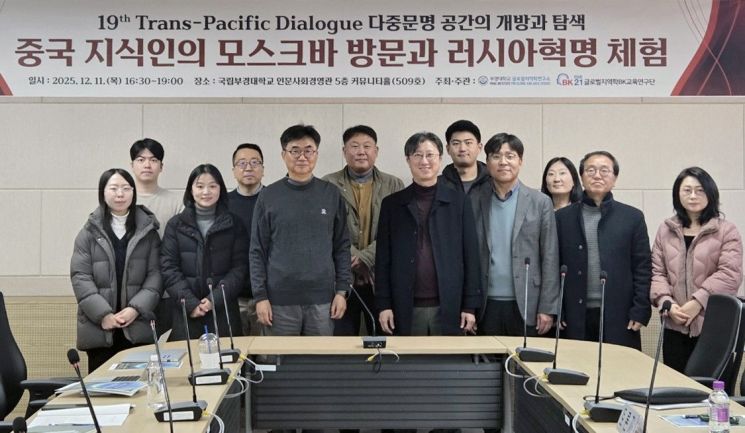 Researchers attending the 19th Colloquium organized by the National Pukyong National University Institute of Global Regional Studies posed in front of the camera.
© The Asia Business Daily(www.asiae.co.kr). All rights reserved.
![Clutching a Stolen Dior Bag, Saying "I Hate Being Poor but Real"... The Grotesque Con of a "Human Knockoff" [Slate]](https://cwcontent.asiae.co.kr/asiaresize/183/2026021902243444107_1771435474.jpg)















