Gwangju Civic Groups Point Out Limitations of 'Donation-for-Compensation' Method
First Six-Party TF Meeting on Military Airport Relocation Scheduled for the 17th
Government Mediation Plan Includes Prior Relocation of Civilian Airport and 1 Trillion Won Support
Experts: "Relocation Unrealistic Without Alternative Funding Sources"
Gwangju City: "Consensus Reached at Preliminary Meeting... Requesting Agreement Draft"
As discussions on the relocation of the Gwangju military airport accelerate to the stage of consultations between the government and local governments, local civil society is urging the government and the Democratic Party to amend the special law under state leadership, arguing that relocation is impossible under the current donation-for-compensation method.
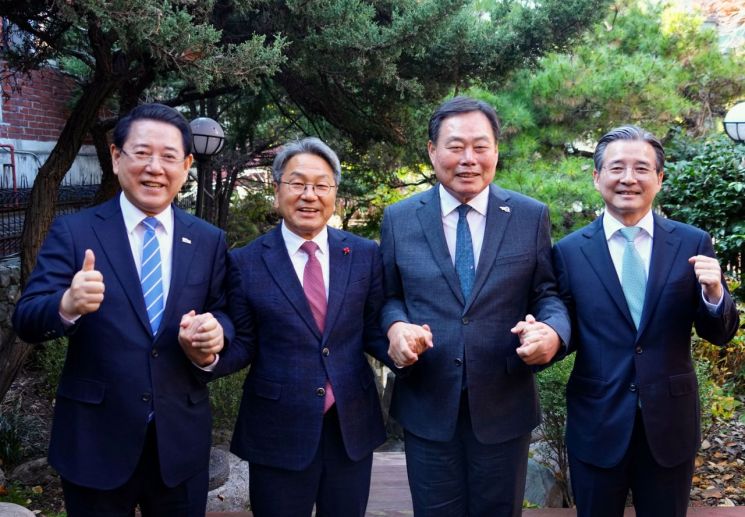 On the 19th of last month, a commemorative photo was taken after a meeting in Seoul to discuss the issue of integrating and relocating the Gwangju civilian and military airports. From left to right: Kim Youngrok, Governor of Jeonnam Province; Kang Kijeong, Mayor of Gwangju; Kim San, Mayor of Muan County; Kim Yongbeom, Chief of Policy Office at the Presidential Office. Provided by Gwangju City
On the 15th, the Gwangju Citizens’ Coalition issued a statement ahead of the first meeting of the six-party task force (TF) on military airport relocation, scheduled for the 17th. The TF includes Gwangju City, Jeonnam Province, Muan County, the Ministry of Economy and Finance, the Ministry of National Defense, and the Ministry of Land, Infrastructure and Transport. This TF meeting is a follow-up to the preliminary consultation presided over by Kim Yongbeom, Chief of Policy Office at the Presidential Office, on the 19th of last month. The government is said to have proposed a mediation plan centered on the following: the prior relocation of the Gwangju civilian airport, 1 trillion won in support for Gwangju City (including 300 billion won from the central government), and the provision of national-level incentives.
The coalition pointed out that there are fundamental problems if these principles maintain the donation-for-compensation approach. With the cost of relocating the military airport estimated at a minimum of 10 trillion won, it is realistically difficult for Gwangju City, which has an annual budget of 8 trillion won and a fiscal independence rate of about 40 percent, to shoulder this burden. They also raised concerns that if the relocation costs are covered by selling the existing site, the sales price would reach 8 million won per pyeong, making the project unviable. In this scenario, only the civilian airport would be relocated, while the military airport would remain.
The coalition emphasized that "the relocation of the military airport is a project the state must take responsibility for." Citing cases from the United States, Germany, and Japan, they noted that central government-led initiatives are the norm. They called for the state to take full responsibility for all stages, including free transfer of the existing site, compensation, maintenance, and urban regeneration.
They also addressed Jeonnam Province and Muan County, noting that relocating Gwangju Airport to Muan would require Gwangju citizens to accept significant inconvenience. They urged that demands for the prior relocation of the civilian airport and incentives should not be excessive without progress on the military airport relocation. They also stressed the need for measures to offset burdens such as noise and accident risks if the military airport is moved to Muan.
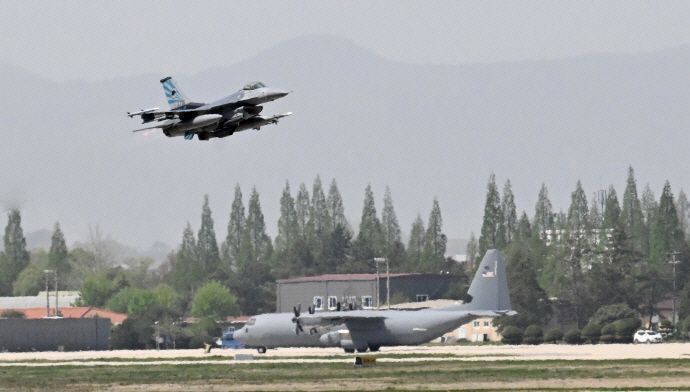 Pilots of the 1st Combat Flight Wing in Gwangsan-gu, Gwangju, are landing after completing aerial training with combat aircraft. Provided by the 1st Combat Flight Wing
Previously, at a Gwangju Airport relocation project forum on the 9th, experts highlighted the structural limitations of the donation-for-compensation method. Opinions were raised that alternative funding sources are essential, and concerns were expressed about the sales price burden, the scale of relocation costs, and financial expenses. It was concluded that it would be difficult to cover the relocation costs solely by selling the existing site. Gwangju City explained that if it becomes possible to utilize the Gongja Fund, it would be easier to fulfill the 1 trillion won support for Muan County by expanding the difference funds.
The government is reportedly of the view that, since the relocation costs for the military airport run into the trillions of won, fairness with other regions such as Daegu must be considered. Gwangju City aims to reach at least an agreement on the "direction of support" at the first TF meeting, with plans to establish a concrete funding structure during the project implementation process.
Jeong Jeonguk, head of the Military Airport Relocation Promotion Team, stated, "The time and place for the TF meeting have been set, but due to a request for confidentiality, they cannot be disclosed at this time." He added, "Gwangju City believes a certain level of consensus was reached at the previous preliminary meeting, and this time, we hope to take a step further and proceed to drafting an agreement, which we are continuously requesting."
© The Asia Business Daily(www.asiae.co.kr). All rights reserved.
![Clutching a Stolen Dior Bag, Saying "I Hate Being Poor but Real"... The Grotesque Con of a "Human Knockoff" [Slate]](https://cwcontent.asiae.co.kr/asiaresize/183/2026021902243444107_1771435474.jpg)

















