Cho Eunseok: "Yoon called Han Donghoon a communist... said he would shoot him dead"
"Yoon did not act out of conviction... sought to eliminate those who defied him through martial law"
"I have emergency powers. Even if it means I face execution, I will sweep everything away." (Remarks made at a People Power Party leadership dinner on November 25, 2022)
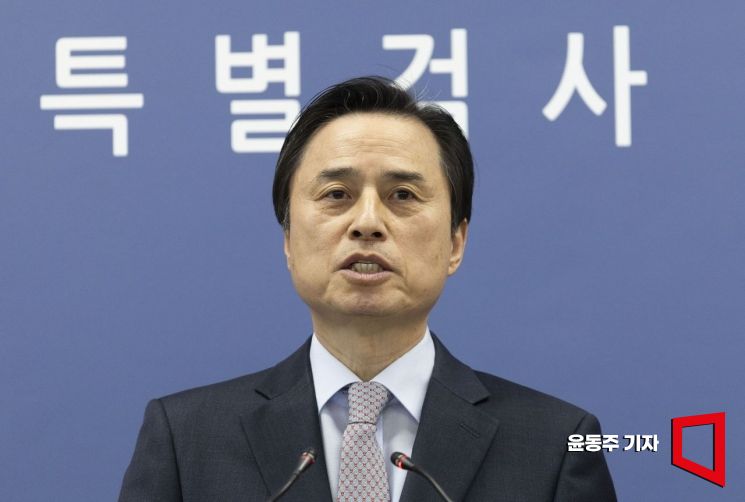 Special Prosecutor Joeunseok is announcing the investigation results, including the motives behind former President Yoon Seokyeol's declaration of martial law and the initial preparation timeline, at the Seoul High Prosecutors' Office in Seocho-gu, Seoul on December 15, 2025. Photo by Yoon Dongju
The special prosecutor team led by Joeunseok, which has been investigating the 12·3 Martial Law incident and related charges of insurrection and treason, has indicted former President Yoon Seokyeol and 26 others, concluding its 180-day investigation. The team determined, based on Yoon's remarks and other evidence, that preparations for martial law effectively began in 2022. However, they believe that concrete discussions about martial law took place even before the military leadership appointments in October 2023.
The special prosecutor's perspective is that former President Yoon sought to seize judicial authority through the military and legislative authority through an emergency legislative body, aiming to eliminate political opposition by force and monopolize and maintain power.
On December 15, Special Prosecutor Joeunseok announced the investigation results, stating, "Yoon Seokyeol and others attempted to create a justification for declaring martial law by provoking a North Korean military response through abnormal military operations, but failed because North Korea did not respond militarily. Yoon and his associates labeled political activities in the National Assembly as 'anti-state acts' and 'anti-state forces' plotting insurrection, and used this as a pretext to declare martial law."
Special Prosecutor Joeunseok explained that Yoon and former Defense Minister Kim Yonghyeon decided to implement martial law after the 2024 general election, regardless of the outcome, and continued to discuss the methods for doing so.
He further stated, "Yoon Seokyeol and Kim Yonghyeon, after attending the North Atlantic Treaty Organization (NATO) summit in July 2024, told Deputy Chairman Kang Hopil of the Joint Chiefs of Staff in Hawaii, 'Han Donghoon is a communist. Shouldn't the military get involved?' expressing both hostility toward Han Donghoon and the necessity of martial law. At a dinner with military commanders on October 1, 2024, Yoon said, 'Bring Han Donghoon here. I will shoot him dead.' He also attempted to arrest a judge who had issued a ruling he disliked. These facts confirm that Yoon's actions were not based on conviction, but rather on a desire to eliminate those who opposed or defied him by labeling them as anti-state forces and removing them through martial law."
Discussion and Planning of 'Martial Law' Began Before October 2023 Military Leadership Appointments
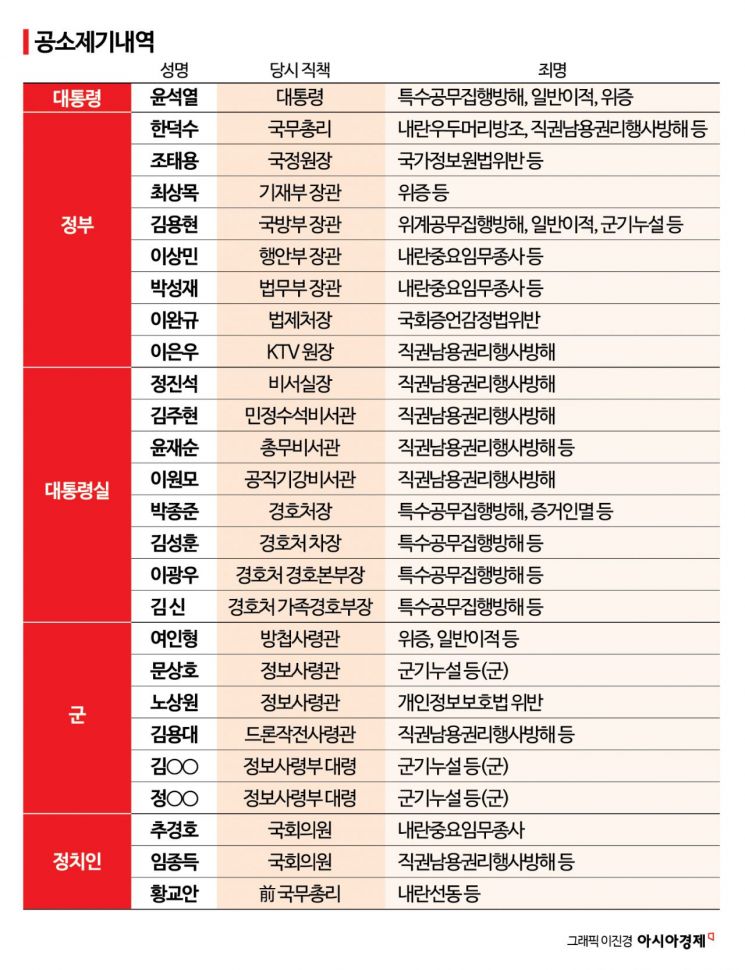
The special prosecutor team believes that former President Yoon first planned martial law before the military leadership appointments in October 2023. During these appointments, Yoon named Park Ansu as Army Chief of Staff, Yeo Inhyeong as Director of the Defense Counterintelligence Command, Kwak Jonggeun as Commander of the Army Special Warfare Command, and Lee Jinwoo as Commander of the Capital Defense Command, forming the core team to execute martial law. These individuals are currently on trial for mobilizing troops during the martial law incident.
The basis for the team's conclusion that the martial law lineup was established with the 2023 military appointments is that the personnel details written in the notebook of former Intelligence Command chief Noh Sangwon, identified as a planner of martial law, were reflected exactly in the actual appointments. This indicates that personnel decisions were coordinated in advance for martial law. The special prosecutor team also obtained testimony from a former high-ranking official in an intelligence agency stating that, around July or August 2022, he heard that Yoon was planning martial law after the general election.
The team concluded that Yoon attempted to create conditions for martial law by provoking a military response through abnormal operations, but failed. Forensic analysis of former Commander Yeo's mobile phone revealed notes such as "The enemy must act first. A situation must arise where control is impossible by police or in wartime," and "military codification, offensive measures, creating the enemy's conditions," indicating efforts to provoke North Korean aggression. These findings supported the team's assessment.
Additionally, it was found that Yoon and his associates intended to use "election fraud" as a justification to suspend the functions of the National Assembly. They allegedly formed an investigation team composed of intelligence officers, not law enforcement, to carry out anti-North Korean operations, and prepared baseball bats, awls, and hammers to fabricate the previous year's general election results as fraudulent acts committed by anti-state forces.
Failure to Detain Han Deoksoo, Chu Kyungho, and Park Sungjae... Criticism of 'Targeted Investigation'
While the special prosecutor team achieved visible results by indicting and detaining former President Yoon, it has also faced criticism for conducting a "targeted investigation" through excessive requests for detention warrants.
There are concerns that the team's intense efforts to detain key figures such as former Prime Minister Han Deoksoo, former People Power Party Floor Leader Chu Kyungho, and former Justice Minister Park Sungjae, have undermined the original purpose of the special investigation, which was to uncover the truth.
From the outset, the special prosecutor team acted swiftly, re-arresting Yoon just 22 days after the investigation began. After re-arresting Yoon, the team quickly secured the detention of former Interior Minister Lee Sangmin on charges of aiding insurrection, achieving all possible results in the early phase of the investigation. They summoned key cabinet members who participated in the martial law decision-making process, and secured the detention of some individuals.
However, as the investigation progressed, problems arose due to excessive attempts to detain major figures such as former Prime Minister Han. The team's requests for detention warrants were repeatedly denied, stalling the investigation. Ultimately, 6 out of 13 detention warrant requests submitted by the special prosecutor team were rejected, leading to criticism that the investigation had become a "fishing expedition."
Transition to Prosecution Maintenance System... Two Assistant Special Prosecutors and 20-30 Dispatched Prosecutors
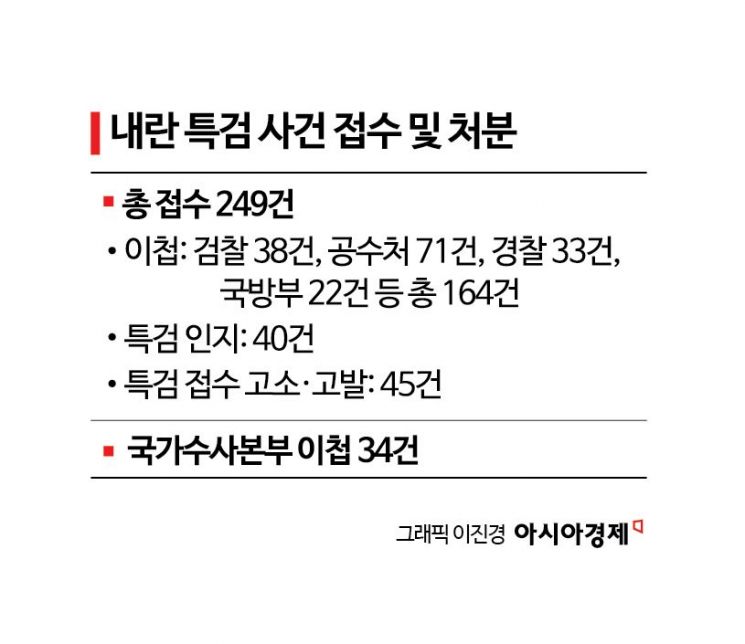
The special prosecutor team received a total of 249 cases, processed 215, and transferred 34 to the National Investigation Headquarters. The previous day, it dismissed charges of insurrection-related major duty violations against judiciary officials, including the Chief Justice and presiding judges of insurrection cases.
The team has now reduced its personnel and transitioned to a full prosecution maintenance system. Assistant Special Prosecutors Park Eoksu and Jang Woosung remain to oversee the prosecution, with Park reportedly staying only until the first trial verdict for former President Yoon. The number of dispatched prosecutors will be maintained at 20 to 30, and considering staff shortages at dispatching agencies, an appropriate number of prosecution investigators and police officers will remain as well.
The special prosecutor's office, which had occupied the 6th, 12th, 14th, and 15th floors of the Seoul High Prosecutors' Office, will be downsized and maintained for efficient prosecution, taking into account its proximity to the court.
© The Asia Business Daily(www.asiae.co.kr). All rights reserved.
![Clutching a Stolen Dior Bag, Saying "I Hate Being Poor but Real"... The Grotesque Con of a "Human Knockoff" [Slate]](https://cwcontent.asiae.co.kr/asiaresize/183/2026021902243444107_1771435474.jpg)

















