Recognition for Resident-Centered Services Based on AI and Big Data
Gwanak District in Seoul (District Mayor Park Junhee) has won the Smart City Certification for the second consecutive time in the '2025 Smart City Certification' contest organized by the Ministry of Land, Infrastructure and Transport, following its achievement in 2023.
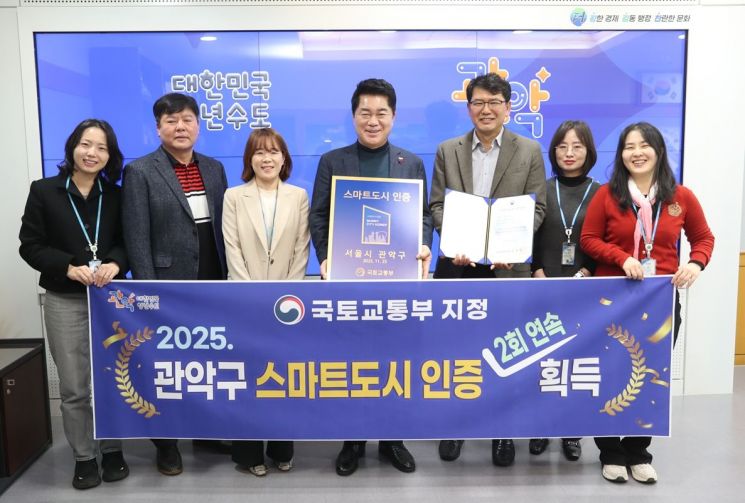 Gwanak-gu has won the Smart City Certification for the second consecutive time in the '2025 Smart City Certification' contest. Photo in the center: Park Junhee, Mayor of Gwanak-gu. Courtesy of Gwanak-gu.
The 'Smart City Certification' is a system that comprehensively evaluates local governments' smart city projects using quantitative (1,000 points) and qualitative (1,000 points) indicators, and grants certification only to cities scoring more than 1,400 points in total. Since its initial certification in 2023, Gwanak District has further solidified its status as a leading local government in the smart city sector through this successful recertification.
Since the 7th popularly elected administration, the district established a dedicated smart city organization. In the 8th administration, it restructured the team into the 'AI Data Team' and enacted relevant ordinances, proactively establishing an institutional foundation for the full-scale introduction of artificial intelligence (AI) in administration.
The district focused on expanding smart infrastructure to enhance urban safety and daily convenience. It increased the deployment of intelligent closed-circuit (CC) TVs with object and density analysis capabilities, built an ICT-based wildfire monitoring platform, implemented IoT monitoring for aging facilities, and installed smart road heating systems. Through these measures, Gwanak District completed a disaster safety management system that detects risks in advance and minimizes damage.
In the fields of administration and daily life, the district fully introduced data- and AI-based administrative services. An AI chatbot for health, welfare, tax, and civil affairs was launched on the district website, enabling users to easily and quickly access information in each area through AI.
Additionally, the district continues to expand practical, resident-centered smart services that bring tangible changes to daily life, such as establishing smart shelters, IoT-based shared and unmanned parking lots, a smart storm drain reporting platform, and digital competency education using educational robots.
Next year, the district plans to accelerate the transition to AI administrative services by integrating AI throughout its administration and further advancing its existing smart infrastructure. It will also continue to provide AI and digital education for residents and staff, as well as nurture young data talent, with the goal of realizing "a smart city in daily life enjoyed by all generations in Gwanak."
Park Junhee, Mayor of Gwanak District, stated, "We have created a 'resident-centered smart city' that enhances safety and convenience for residents through AI- and data-driven smart city policies. Going forward, we will actively utilize AI across all administrative fields and continuously upgrade our smart infrastructure to build an inclusive smart city in Gwanak that all residents can experience."
© The Asia Business Daily(www.asiae.co.kr). All rights reserved.

















