The Gyeonggi Provincial Office of Education has established the nation’s first public-private partnership model for defect management in educational facilities, marking its initial step toward institutionalization.
On December 15, the Office announced the release of the “Task Force Report on Monitoring Defect Management in Construction Projects,” which details the achievements of this year’s initiatives to improve defect management work.
The report focuses on the activities of the special task force, which consists of 22 members including advisory committee members, Office of Education officials, and school representatives, and presents concrete case studies of innovation in defect management. It also outlines strategies for expanding defect inspection services in the future and optimizing their implementation.
Previously, the Office conducted pilot defect inspection service projects in four regions: Suwon, Ansan, Pyeongtaek, and Hwaseong-Osan. These efforts demonstrated practical effectiveness in the field, such as increasing the defect detection rate.
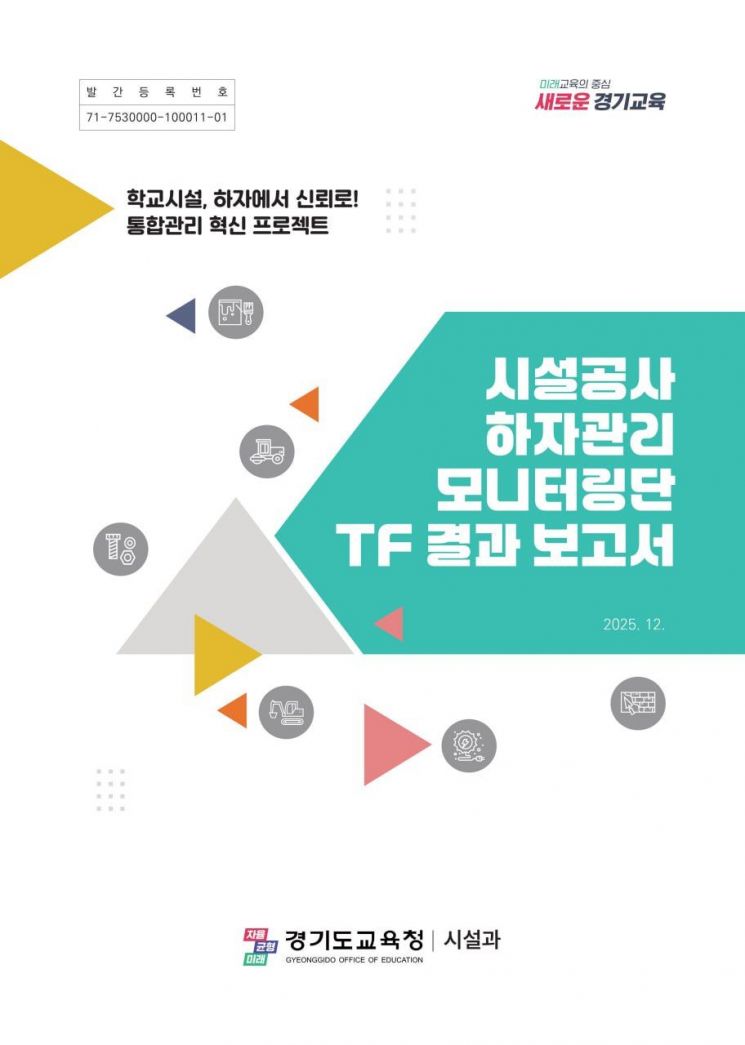 Cover of the Gyeonggi Provincial Office of Education's Educational Facility Defect Management Monitoring Task Force Report
In particular, based on a memorandum of understanding (MOU) with the Gyeonggi Chapter of the Korean Institute of Architects, joint public-private inspections were carried out across 25 education support offices, thereby ensuring both expertise and objectivity at the sites.
Defect inspections conducted by professional organizations were managed through the Integrated Educational Facilities Information Network, which helped prevent omissions in defect repairs and reduced unnecessary facility budget expenditures.
In addition, the Office promoted the standardization of work procedures, analysis of defect types, and improvement of the integrated information network’s functions, thereby establishing a “data-driven defect management system.”
Starting in 2026, the Office plans to gradually expand the application of this model to further enhance the safety and quality of educational facilities. As defect management in educational facilities becomes more systematic, it is expected that this model could serve as a benchmark for similar efforts nationwide in the future.
© The Asia Business Daily(www.asiae.co.kr). All rights reserved.
![Clutching a Stolen Dior Bag, Saying "I Hate Being Poor but Real"... The Grotesque Con of a "Human Knockoff" [Slate]](https://cwcontent.asiae.co.kr/asiaresize/183/2026021902243444107_1771435474.jpg)
















