Rare Sighting of the Seven-Armed Octopus Near Shore
Various Theories: Climate Change, Predator Attacks, and More
The discovery of the carcass of an extremely rare deep-sea creature, the "seven-armed octopus," on a beach in Scotland has drawn significant attention from the scientific community.
The BBC, Daily Mail, and other British media recently reported that a citizen found the massive tentacle of an octopus on the beach at Forvie National Nature Reserve near Collieston, Scotland, and reported it to the authorities.
Officials who arrived at the scene initially considered the possibility that the specimen was another type of octopus or a giant squid, both of which are occasionally found in the region. However, after examination by various institutions including the Department of Zoology at the University of Aberdeen, it was confirmed that the creature was a "seven-armed octopus," known scientifically as Septopus.
Despite its name, this octopus actually has eight arms. In males, however, one arm used for reproduction is folded inside a pouch in its body, making it appear as if it has only seven arms. This species is known for its enormous size and is considered, along with the giant Pacific octopus, as one of the largest octopus species in the world. The body length of a female can reach up to 4 meters, more than twice the height of an adult man.
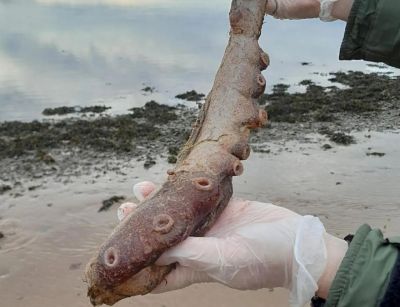 The carcass of a rare deep-sea creature, the "seven-armed octopus," was found on a beach in Scotland. Photo by Daily Mail
Catriona Reid, manager of the Forvie National Nature Reserve, described the scene, saying, "Both the diameter and the size of the suckers were incomparable to those of octopuses usually seen along the coast."
The seven-armed octopus typically inhabits deep-sea areas at depths below 500 meters, making its discovery so close to shore extremely rare. According to the Marine Biological Research Institute (MBARI) in the United States, despite nearly 40 years of deep-sea exploration using remotely operated vehicles, there have only been four confirmed sightings of this species.
Experts speculate that the octopus may have been discarded after becoming entangled in fishing nets, washed ashore after being attacked by a large predator such as a whale, or died after losing its sense of direction and swimming into shallow waters.
The discovered carcass is currently being kept frozen for research purposes, with some samples set to be transferred to the National Museum of Scotland and the Natural History Museum in London. Researchers believe that this case could provide important clues for understanding deep-sea ecology and the migration patterns of octopus species.
Previously, in September 2020, a specimen believed to be a "seven-armed octopus" was also found on the beach of Whidbey Island in Puget Sound, Washington State, United States, attracting considerable attention. At the time, local media reported that while this species is typically found in the warmer waters of the Atlantic Ocean, its habitat range may be gradually expanding northward due to the effects of climate change.
© The Asia Business Daily(www.asiae.co.kr). All rights reserved.

















