Files Lawsuit with Seoul Administrative Court to Annul Personnel Order
Violation of 'Presidential Decree and Prosecutors' Office Act' Alleged... Ministry of Justice Claims "Lawful Reassignment"
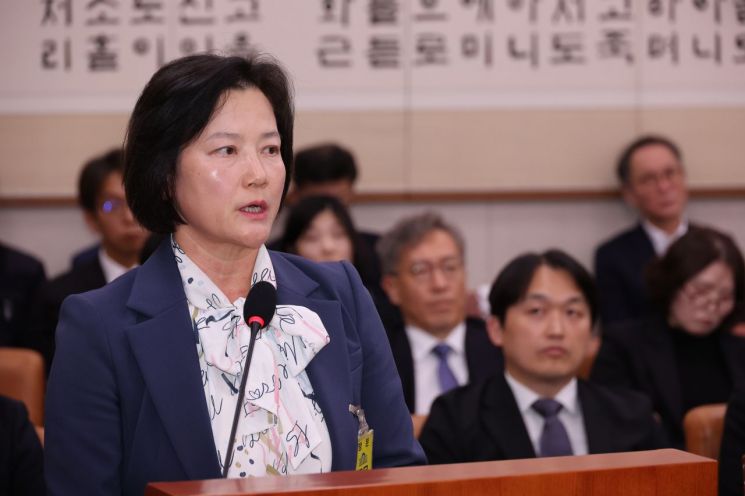 Jung Yumi, Research Fellow at the Judicial Research and Training Institute, is responding to a member's inquiry at the National Assembly's Legislation and Judiciary Committee hearing held on October 21 in Yeouido, Seoul. Photo by Yonhap News
Jung Yumi, Research Fellow at the Judicial Research and Training Institute and former chief prosecutor, who was demoted to a high prosecutor, is filing a lawsuit against Minister of Justice Jeong Seongho to annul the personnel order.
According to the legal community on December 12, Jung is expected to submit a petition for annulment of the personnel order to the Seoul Administrative Court later this afternoon.
Jung was transferred to the Daejeon High Prosecutors' Office as a high prosecutor in the senior officials reshuffle carried out by the Ministry of Justice the previous day. This effectively constitutes a 'demotion' from a chief prosecutor-level (prosecutor general) position to a high prosecutor-level (deputy or division chief prosecutor) position.
Jung has been a strong critic of the Lee Jaemyung administration's prosecution reform and the prosecution leadership's decision to forgo an appeal in the Daejang-dong development corruption case. As a result, she was demoted to high prosecutor in the personnel changes announced the previous day. This is only the second time a chief prosecutor has been reassigned as a high prosecutor, following the case of former Chief Prosecutor Kwon Taeho, who was transferred from Director of Planning at the Judicial Research and Training Institute to Seoul High Prosecutors' Office in March 2007.
It is reported that Jung will argue in her petition that this personnel decision violates the 'Regulation on the Scope of Positions for Chief Prosecutor-Level Officials at the Supreme Prosecutors' Office (Presidential Decree)'.
According to the Presidential Decree, chief prosecutor-level positions include Prosecutor General, High Prosecutor General, Deputy Prosecutor General at the Supreme Prosecutors' Office, President of the Judicial Research and Training Institute, Chief Prosecutor at the Supreme Prosecutors' Office, Director General for Planning and Coordination at the Ministry of Justice, Director General for Legal Affairs, Director General for Criminal Affairs, Director General for Crime Prevention Policy, Inspector General, Director General of Immigration and Foreign Policy, District Prosecutor General, Vice President of the Judicial Research and Training Institute, Director of Planning at the Judicial Research and Training Institute, Deputy High Prosecutor General, and Research Fellow at the Judicial Research and Training Institute. Therefore, transferring her to a high prosecutor position without amending the regulation is problematic.
Additionally, Jung is expected to argue that the personnel order violates Article 30 of the Prosecutors' Office Act. Article 30 stipulates that the qualifications for appointment as a high prosecutor exclude prosecutors who fall under Article 28 (chief prosecutor-level). Jung claims that, as she holds a chief prosecutor-level position, she cannot be appointed as a high prosecutor.
However, the Ministry of Justice maintains that, under the Prosecutors' Office Act, prosecutors are classified only as Prosecutor General or Prosecutor, and therefore, assigning a chief prosecutor to a high prosecutor position is not a demotion but a lawful reassignment of duties.
© The Asia Business Daily(www.asiae.co.kr). All rights reserved.
![Clutching a Stolen Dior Bag, Saying "I Hate Being Poor but Real"... The Grotesque Con of a "Human Knockoff" [Slate]](https://cwcontent.asiae.co.kr/asiaresize/183/2026021902243444107_1771435474.jpg)















