Special Hotel Rates Emerge Amid Decline in Chinese Group Travelers
Departure Tax Hike and Earthquake Concerns Remain as Variables
Japanese hotels, facing a demand gap due to a decline in Chinese group travelers, are rolling out short-term special offers to attract Korean tourists, who now make up their largest customer base. As concerns about travel safety in Southeast Asia grow, demand for travel from Korea to Japan is also on the rise. However, factors such as the potential increase in departure taxes and the recent earthquakes in Japan are being cited as variables that could influence future demand trends.
According to the travel industry on December 12, package tour bookings to Japan through Hanatour have increased by 25-30% compared to the same period last year, with bookings to Tokyo, Osaka, and Fukuoka nearly doubling. In smaller regional cities such as Shikoku and South Kyushu, the combined effects of expanded flight routes and special offers have driven bookings up by as much as 500%.
Industry sources explain that with the decline in demand from Chinese groups, not only hotels in major Japanese cities but also those in regional cities are offering short-term special rates targeting the Korean market.
Strengthened Demand for Japan: Price Cuts and Safety Concerns in Southeast Asia
Yellow Balloon Tour has also confirmed an increase in demand for travel to Japan. In the fourth quarter, bookings for Japanese package tours rose by 2.3% year-on-year, with the increase in regional routes such as Shikoku and Honshu outpacing that of major cities.
During the winter season (December to February), Japan accounted for 21.9% of Kyowon Tour's bookings, a 2.5 percentage point increase from the previous year. By region, Sapporo was the most popular destination at 28.8%, followed by Matsuyama (18.4%), Fukuoka (17.0%), Osaka (16.7%), and Tsushima (8.4%). Demand for new destinations such as Nagoya and Wakayama also increased, indicating a trend toward diversification of travel destinations.
Nol Interpark, which primarily serves independent travelers, is seeing a similar trend. As of December 10, transactions for Japanese accommodations had increased by 26% compared to the previous year, with Tokyo, Osaka, and Fukuoka accounting for 68% of the total. Sapporo and Okinawa also saw slight increases.
This trend is attributed not only to price reductions by Japanese hotels but also to growing concerns over public safety and security in Southeast Asia, which have led travelers to view Japan as an alternative destination.
Departure Tax Hikes and Earthquake Concerns Remain Variables
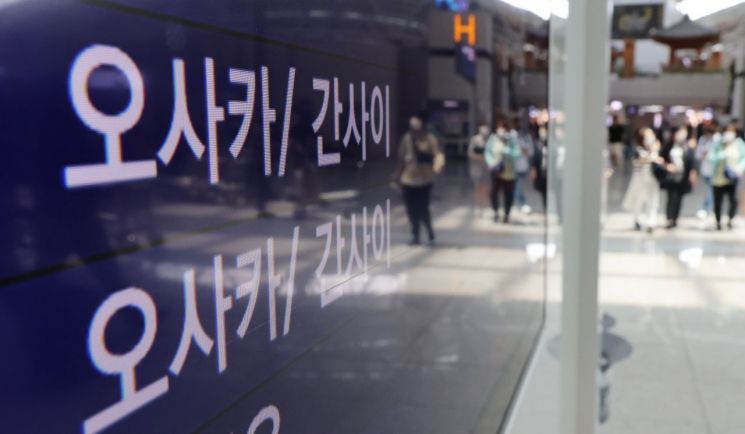 A flight information board at Incheon International Airport Terminal 1 showing flights departing to Japan. Photo by Yonhap News
However, concerns remain about cost-related variables such as increases in departure and accommodation taxes. The Japanese government and the Liberal Democratic Party are considering raising the International Tourist Tax (departure tax) from the current 1,000 yen (about 9,400 won) to 3,000 yen (about 28,000 won), more than tripling the amount, as a means to secure funds to address overtourism.
Additionally, following the magnitude 7.5 earthquake off the coast of Aomori Prefecture on December 8, the possibility of further earthquakes has been raised, which is also being cited as a factor that could affect future demand for tourism to Japan.
Meanwhile, the number of Koreans who visited Japan last year was recorded at 8.82 million. According to the Japan National Tourism Organization (JNTO), in the first half of this year (January to June), Koreans accounted for about 4,783,500 of all foreign visitors to Japan, ranking first ahead of China and Taiwan.
© The Asia Business Daily(www.asiae.co.kr). All rights reserved.



















