Urban Policy Discussed at the Urban Infrastructure Forum
The University of Seoul announced on December 15 that it hosted the 101st Urban Infrastructure Forum, inviting Lee Myung-bak, the 17th President of South Korea, to deliver a lecture on the theme, "Seoul's Bus Reform and Cheonggyecheon Restoration: Achievements and Lessons."
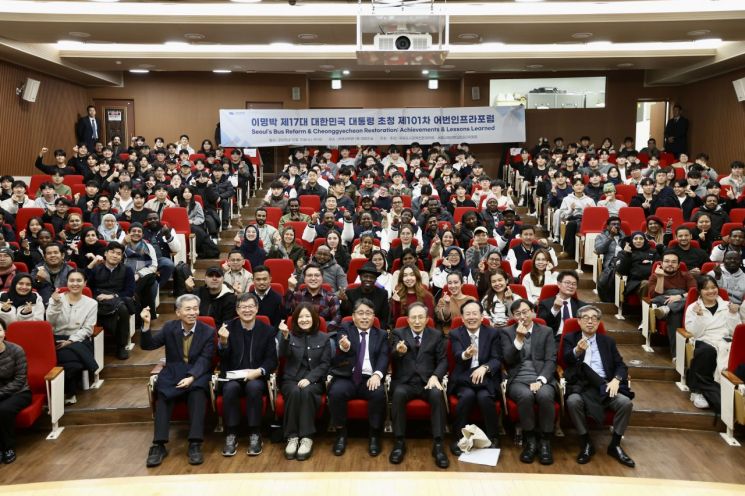
Approximately 200 participants, including public officials from developing countries and university (and graduate) students, attended the forum both online and offline.
This forum was co-hosted by the International School of Urban Sciences and the ESG Committee of the University of Seoul. It was organized to share the background and implementation process of Seoul's bus reform and Cheonggyecheon restoration projects, which are regarded as leading examples of urban transportation reform and ecological restoration, and to discuss directions for urban leadership and policy design.
During the lecture, former President Lee Myung-bak introduced the background of the two projects, the process of gathering public opinion, and the challenges encountered in institutional design and implementation during his tenure as Mayor of Seoul (2002-2006).
He especially highlighted the long-term achievements of restoring the public nature of urban transportation, reviving the urban ecosystem, and improving citizens' quality of life, emphasizing that "bold decision-making and execution are key to urban transformation."
The forum was moderated by Professor Park Hyun and conducted with consecutive interpretation in Korean and English. After the lecture, a Q&A session was held, focusing on public officials from developing countries. Participants discussed a wide range of topics, including the feasibility of expanding public transportation policies in developing cities, the policy and financial foundations required to secure public support, and long-term management strategies for environmental restoration projects.
Lee Shin, Dean of the International School of Urban Sciences, stated, "This lecture provided an opportunity to share Seoul's experience in urban policy implementation with international trainees and offered valuable insights for urban leaders from various countries. The University of Seoul will continue to promote international cooperation and educational exchange based on practical experience in urban policy."
In January of this year, the University of Seoul transitioned the International School of Urban Sciences into a professional graduate school and now offers master's and doctoral programs in Global Construction, Advanced Green Urban Development, and International Development Cooperation. Each year, the university invites about 80 public officials from developing countries and supports their capacity building as policy practitioners in urban development, infrastructure, and environment through four programs: MUAP (Master of Urban Administration and Planning, supported by the Seoul Metropolitan Government), MUD (Master of Urban Development Policy, supported by the Korea International Cooperation Agency [KOICA] under the Ministry of Foreign Affairs), MGLEP (Master of Global Environmental Policy, supported by the Korea Environmental Conservation Institute [KECI] under the Ministry of Environment, Climate, and Energy), and MUDSIP (Master of Urban Development and Smart Infrastructure Policy, supported by the International Contractors Association of Korea [ICAK] under the Ministry of Land, Infrastructure, and Transport).
© The Asia Business Daily(www.asiae.co.kr). All rights reserved.
![Clutching a Stolen Dior Bag, Saying "I Hate Being Poor but Real"... The Grotesque Con of a "Human Knockoff" [Slate]](https://cwcontent.asiae.co.kr/asiaresize/183/2026021902243444107_1771435474.jpg)















