Cost Savings Claimed from Integration
Fare Reduction Promised Through Increased Seat Supply
Estimated Net Loss of 500 Billion Won Last Year
Accumulated Debt Expected to Grow Beyond 21 Trillion Won
"If Deficits Widen, Benefits Will Be Cut First
Passengers Will Bear the Full Impact"
As the government pushes for the integration of Korail and SR, criticism has arisen that Korail's proposal to reduce KTX fares by 10% as a benefit of the merger is unrealistic. While Korail claims that fare reductions are possible through cost savings from eliminating redundancies and increasing seat supply, an analysis of its actual financial structure suggests that this could instead deepen deficits and increase the financial burden on the public.
The SR labor union argued that the government's calculation of "an increase of 16,000 seats" is misleading. An SR union representative stated on December 12, "Korail's claimed seat increase is based on deploying the high-capacity KTX-1 (20-car trains) at Suseo Station to add 24,000 seats, but this is offset by removing available trains from Seoul Station, reducing seats there by 8,000. Ultimately, this is nothing more than a zero-sum calculation, simply shifting capacity from one place to another."
Given that the track capacity between Pyeongtaek and Osong is already saturated, without expanding train maintenance capabilities, increasing departures from Suseo will inevitably reduce departures from Seoul. The Ministry of Land, Infrastructure and Transport also acknowledged in a recent briefing, "In the short term, as the number of trains departing from Suseo increases, there may be inconvenience due to a decrease in seats departing from Seoul."
Korail's Fluctuating Fare Policy
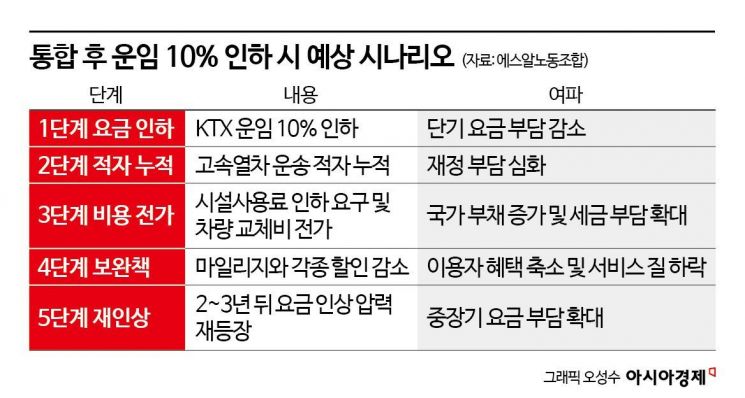
Korail's inconsistent fare policy has also come under scrutiny. In March, Korail announced plans to increase KTX fares by 17% and conventional rail fares by 10%, citing worsening business performance. However, as integration discussions gained momentum in August, Korail reversed its stance, internally reviewing the possibility of a 10% fare reduction if the merger proceeds. The SR union commented, "If a 17% increase is not enough, a 10% cut would create a perceived 27% fiscal gap. Even if fares are temporarily reduced as a promotional event immediately after integration, this will ultimately result in unsustainable deficits and lead to a large-scale fare hike in the future."
There are also concerns that an excessive fare reduction will accelerate Korail's financial deterioration. According to the SR union's analysis, Korail is expected to post a net loss of about 500 billion won in 2024. If KTX fares are reduced by 10%, annual revenue will decrease by an additional 250 billion won. Considering that about 45% of SR's annual revenue, or approximately 360 billion won, is used to repay high-speed rail construction debt, and fixed costs such as outsourcing fees to Korail amount to 200 billion won, a fare reduction after integration could further increase Korail's accumulated debt, which already stands at 21 trillion won.
There are concerns that worsening financial conditions will negatively impact passenger services. The SR union stated, "If deficits grow after the merger, mileage benefits and various discount programs will be the first to be eliminated. The cost of replacing aging KTX-1 trains, which is expected to reach 6 trillion won, will also be difficult for Korail to cover on its own, and will ultimately have to be financed with taxpayer money."
There is also criticism that the government's claim of "eliminating 40.6 billion won in redundant costs" as a basis for integration is inconsistent with reality. The redundant costs cited by the government include personnel expenses for SR employees. The SR side argues that promising no forced restructuring while claiming to reduce labor costs is logically inconsistent.
In fact, resolving the seat shortage is already underway, regardless of integration. SR has already placed an order with Hyundai Rotem for 14 new high-speed trains (EMU-320) using its own budget. When these trains are introduced sequentially starting at the end of next year, the number of seats supplied per day will increase dramatically from the current 52,000 to 77,000. The SR labor union insisted that, rather than destabilizing the market with uncertain integration justifications, the government should first present a concrete plan for repaying massive debts and covering the costs of new train purchases.
The integration schedule was abruptly moved forward. Initially, the government had set the target for the end of 2027, as stated at a meeting on the 28th of last month, but within just a few days, this was advanced to the end of 2026. The SR union commented, "At first it was three years, then two, and now suddenly it's one. It seems they are rushing before the shaky rationale for integration is further exposed."
Government: "Eliminating Redundant Costs and Enhancing Public Convenience"
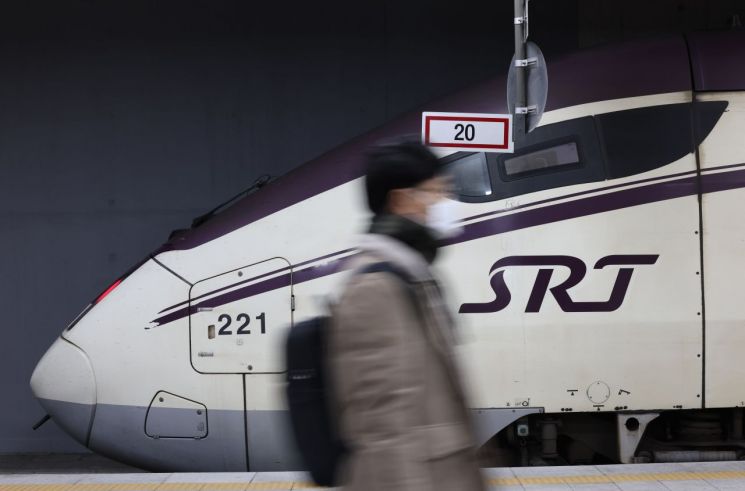 The government plans to gradually integrate the high-speed rail services KTX and SRT by the end of next year. Starting from March next year, cross-operation of KTX and SRT will begin, with SRT trains running at Seoul Station and KTX trains at Suseo Station. From the second half of the year, trains will be connected and operated without distinguishing between KTX and SRT, moving towards integrated formation and operation. On the 8th, a train was stopped at the SRT platform at Suseo Station in Gangnam-gu, Seoul. Photo by Yonhap News
On December 8, the Ministry of Land, Infrastructure and Transport announced a "high-speed rail integration roadmap" that includes the merger of Korail and SR. This integration is a concrete step to fulfill President Lee Jaemyung's campaign pledge to "unify the dualized high-speed rail system, increase service frequency, and significantly enhance public convenience."
The government and Korail analyzed that integration would save about 40.6 billion won in redundant costs between the two entities and increase daily seat supply by 16,000. If this improves the revenue structure, the government explained, there would be room to lower KTX fares, which are currently about 10% higher than SRT fares.
If the government roadmap is followed and integration is completed, the two companies will reunite after 13 years since their separation in 2013, and the competitive high-speed rail system introduced with the launch of SRT in 2016 will officially end after 10 years.
A Korail representative stated, "With an integrated app, passengers will be able to conveniently purchase train tickets, and benefits such as discounts when transferring from KTX to Mugunghwa-ho will increase public convenience. In March, we mentioned a 17% fare hike because government support for replacing aging KTX trains had not yet been decided, but the situation has since changed with the passage of relevant legislation."
© The Asia Business Daily(www.asiae.co.kr). All rights reserved.
![Clutching a Stolen Dior Bag, Saying "I Hate Being Poor but Real"... The Grotesque Con of a "Human Knockoff" [Slate]](https://cwcontent.asiae.co.kr/asiaresize/183/2026021902243444107_1771435474.jpg)
















