Post-Briefing by the Ministry of Economy and Finance on December 11
Benchmarking Singapore’s Temasek and Australia’s Future Fund
Active Investments in Real Estate, Industry, and Bio Sectors
Different from KIC, Which Manages Foreign Exchange Reserves
On December 11, Deputy Prime Minister and Minister of Economy and Finance Koo Yooncheol held a post-briefing following a work report at the Sejong Government Complex. He stated that regarding the “Korean-style sovereign wealth fund” currently being promoted by the government, “If there are items that can actively generate national wealth, we will invest in them regardless of the industry, including promising future sectors.”
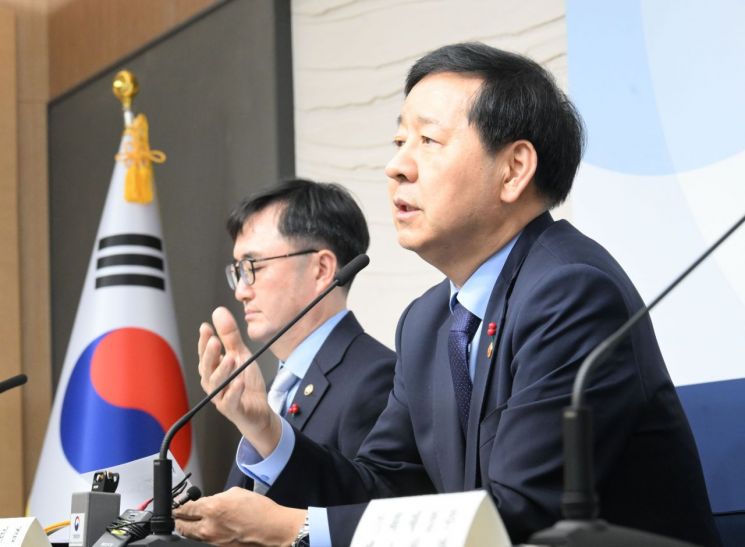
Deputy Prime Minister Koo emphasized that the government would benchmark overseas cases such as Singapore’s Temasek and Australia’s Future Fund. He explained, “Temasek in Singapore basically engages in mergers and acquisitions (M&A), invests, and purchases many buildings in industries with future growth potential. However, since the Korea Investment Corporation (KIC) manages foreign exchange reserves, it cannot be operated in such a manner, and therefore cannot actively generate national wealth.”
He added, “To enable active national wealth creation, investments should be possible in real estate, industries, and bio sectors alike, as long as high returns can be expected. That is the nature of the fund.” The only sovereign wealth fund in South Korea is the Korea Investment Corporation (KIC), which manages foreign currency assets entrusted by the Ministry of Economy and Finance and the Bank of Korea.
However, KIC is mainly tasked with managing foreign currency assets such as foreign exchange reserves from the government and the Bank of Korea, which restricts it from making high-risk, high-return investments. Unlike KIC, which is limited by its mandate to manage foreign reserves, entities like Temasek are able to make aggressive investments by managing state-owned assets, such as government-held shares in public enterprises.
Regarding the initial size of the fund, he said, “Temasek in Singapore also started very small, with about 200 million dollars, and has now grown to 320 billion dollars. Instead of securing enormous funding from the beginning, we will allow stocks received in kind to be used as resources.” He further explained, “When assets are contributed to the sovereign wealth fund, they are not simply sold off; if necessary, we can buy more or sell with management rights attached.” He added, “Although the initial resources may not be large, we will create national wealth by proactively acquiring good companies overseas through M&A in advance and investing in domestic ventures.”
The government will also introduce regulatory exemptions to promote investment in high-tech industries. The rule requiring a holding company’s second-tier subsidiary to own 100% of its third-tier subsidiary will be relaxed to a minimum of 50%. The aim is to improve the investment structure of industries requiring large-scale investments, such as semiconductors. However, to promote balanced regional development, investments will be linked to local areas and subject to review and approval by the Fair Trade Commission. Deputy Prime Minister Koo said, “We must understand that investment should not be concentrated only in the Seoul metropolitan area. While investment in the capital region will be allowed, we intend to ensure that local regions are included as well.”
The government also announced plans to maximize the value and utilization of state-owned assets to generate wealth. For sales of state-owned assets valued at 30 billion won or more, prior reporting to the relevant National Assembly standing committee will be required, and specialized review bodies for asset sales will be established within each ministry. Discounted sales that do not secure fair value will, in principle, be prohibited. The government will also increase the supply of public housing through the development of state-owned assets. By utilizing idle properties such as government buildings over 30 years old and closed police substations, the plan is to begin construction of 25,000 public housing units in the Seoul metropolitan area by 2030.
© The Asia Business Daily(www.asiae.co.kr). All rights reserved.

















