Government's K-Semiconductor Development Strategy Briefing
Emphasis on Power Procurement from North Gyeongsang and Honam Regions
Concerns Over Increased Electricity Costs and Supply Shortfalls in the Seoul Metropolitan Area
President Lee Jaemyung mentioned the "transmission distance-based electricity pricing system" during an industry meeting aimed at fostering the semiconductor industry, raising concerns among companies that, contrary to their hopes for relief, their electricity cost burden may actually increase. If this system is implemented, it is estimated that annual electricity costs for manufacturing in the Seoul metropolitan area will rise by about 1.4 trillion won, leading to criticism that the government's current power procurement policy could become a burden on semiconductor investment. The Yongin Semiconductor Cluster, in which SK Hynix and Samsung Electronics are participating, is targeting operations by 2027, but a supply plan for 6GW out of the required 15GW has yet to be established.
Samsung Electronics Vice Chairman Jun Younghyun and SK Hynix CEO Kwak Nojeong attended the "K-Semiconductor Vision and Development Strategy Briefing" held at the presidential office in Yongsan on the 10th and stated that additional power is needed for the Yongin Cluster, which is currently under construction. Vice Chairman Jun said at the event, "Of the 9GW, 6GW has been secured, and the remaining 3GW is being discussed with the Ministry of Climate, Energy and Environment." CEO Kwak expressed the same position.
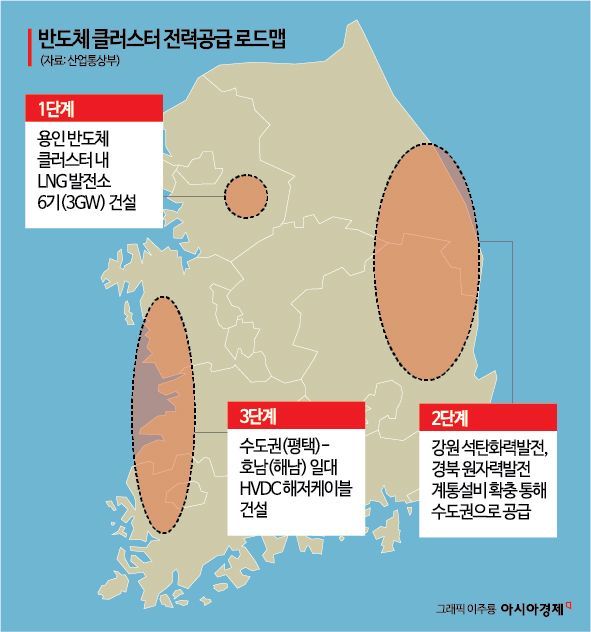
Although discussions are ongoing with the government regarding power supply measures, industry leaders emphasized that, with only about a year left until the cluster's target completion in 2027, the issue "remains unresolved." This is because, contrary to industry demands, the government is maintaining its policy of easing concentration in the metropolitan area.
At the meeting, President Lee and government officials explained the government's roadmap for sourcing electricity from regions such as Gangwon, North Gyeongsang, and Honam. President Lee stated, "Balanced development is important, and it would be preferable to procure electricity locally whenever possible." He added, "To be direct, I encourage you to turn your attention to the southern regions, which are rich in renewable energy, and focus on building new industrial ecosystems there. The government will also introduce groundbreaking policies to support this."
As one of the support policies discussed, President Lee raised the "transmission distance-based electricity pricing system," proposing that building production bases in the regions where power plants are located would allow companies to lower their electricity costs. The core of this system is to adjust electricity rates in power production areas to be lower than in major consumption regions. President Lee said, "In the future, it will be unavoidable to have a system in which transmission costs are reflected in electricity rates." This is part of President Lee's emphasis on balanced regional development and is intended to encourage companies to establish production bases in regional areas. President Lee reiterated, "Lowering electricity rates in power production areas, in accordance with the principle of 'produce locally, consume locally,' is an unavoidable government policy," and stressed, "Balanced development is important, so it would be preferable to operate production facilities in local areas whenever possible."
However, the industry has voiced concerns about the limitations of the government's power supply plan. In addition to the challenge of building external supply networks for electricity, water, and gas in an area that must accommodate a power density 32 times that of Seoul (15GW), stable supply after the facilities are built is also crucial. The National Assembly Research Service pointed out, "If there is a disruption in power supply to the semiconductor cluster, the factories themselves cannot operate, so responsibility for power and fuel procurement must be clearly defined in detail at the contract stage."
The issue of electricity cost burden has also been raised. This is because the farther electricity is transmitted to the metropolitan area, the higher the industrial electricity rates become. According to the Korea Economic Research Institute's report, "Impact and Implications of Introducing Regional Differential Electricity Rates by Industry," the introduction of such a system would increase the total annual electricity costs for manufacturing in the metropolitan area by about 1.4 trillion won. Even if clusters are built, companies such as Samsung Electronics and SK Hynix would still have to bear enormous electricity costs. In addition, there are numerous unresolved issues, such as addressing complaints from residents affected by long-distance transmission lines.
Participants at the briefing commonly pointed out the lack of a comprehensive plan to expand power infrastructure. Kim Jeonghoe, Vice Chairman of the Korea Semiconductor Industry Association, said, "There is still uncertainty due to unresolved issues such as complaints about the Hanam East Seoul Substation and problems with building transmission networks. Since there is a consensus that semiconductor fabs are essential in the era of artificial intelligence (AI), I hope we can continue discussions on how to resolve these issues." He added, "The most important issue right now is whether we can secure a stable power supply. If the power is cut, the losses would be enormous." Hwang Cheolju, Chairman of Jusung Engineering, and Kim Yongseok, Distinguished Professor at Gachon University College of Semiconductor, who also attended, emphasized, "It is a critical time for the government to provide clear solutions and make decisions regarding the supply of electricity and water."
© The Asia Business Daily(www.asiae.co.kr). All rights reserved.


















