Mandatory Weight Labeling of Chicken Ingredients Begins on the 15th
Franchise Headquarters Scramble to Develop Response Strategies
Unclear Standards and Error Margins for Partial Cuts
Franchise Owners Bear Responsibility for Complaints, Refunds, and Re-cooking
As the government has decided to immediately enforce the mandatory labeling of raw ingredient weights for chicken franchise businesses starting on the 15th, major brands are accelerating their efforts to develop response strategies. Although a grace period will be provided until June next year, strong penalties such as business suspension may follow after that. As a result, companies are holding daily meetings and moving quickly. There are growing concerns that the burden may be concentrated on franchise owners who are at the front lines.
According to the food service industry on December 12, the headquarters of chicken franchise companies have recently scheduled a series of meetings with the National Assembly and relevant ministries, requesting that the difficulties faced in the field be taken into account during the policy design process. An official from one franchise said, “Weight labeling is a sensitive issue as it directly conveys a message to consumers, so headquarters are adjusting their positions on a daily basis,” and added, “While we agree with the intent of the policy, there are many variables to consider before it can be applied directly in the field.”

The “Chicken Weight Labeling System,” prepared by the Fair Trade Commission, the Ministry of Food and Drug Safety, and the Ministry of Agriculture, Food and Rural Affairs, will take effect on the 15th. The top 10 brands, including bhc, BBQ Chicken, Kyochon Chicken, and Cheogajip Yangnyeom Chicken, will be required to indicate the weight of the chicken before cooking on both in-store and delivery menus. The weight must be indicated in grams (g) as a rule, but for whole chicken menu items, grade-based labeling such as “Grade 10 (951-1050g)” will also be permitted.
However, since the weight labeling is based on “raw ingredients before cooking,” it is inevitable that the final product will differ from the labeled weight after cooking. Fresh chicken undergoes significant moisture changes during trimming, thawing, and cooking, and there are also individual differences between chickens, making it difficult to ensure a consistent actual serving weight.
In this situation, consumer complaints are highly likely to be directed at franchise owners, who are the most visible point of contact. Owners simply cook the raw ingredients supplied by headquarters or designated vendors and have no authority to control the variation in the raw materials themselves. Nevertheless, complaints about actual weight differences must be handled at the store level.
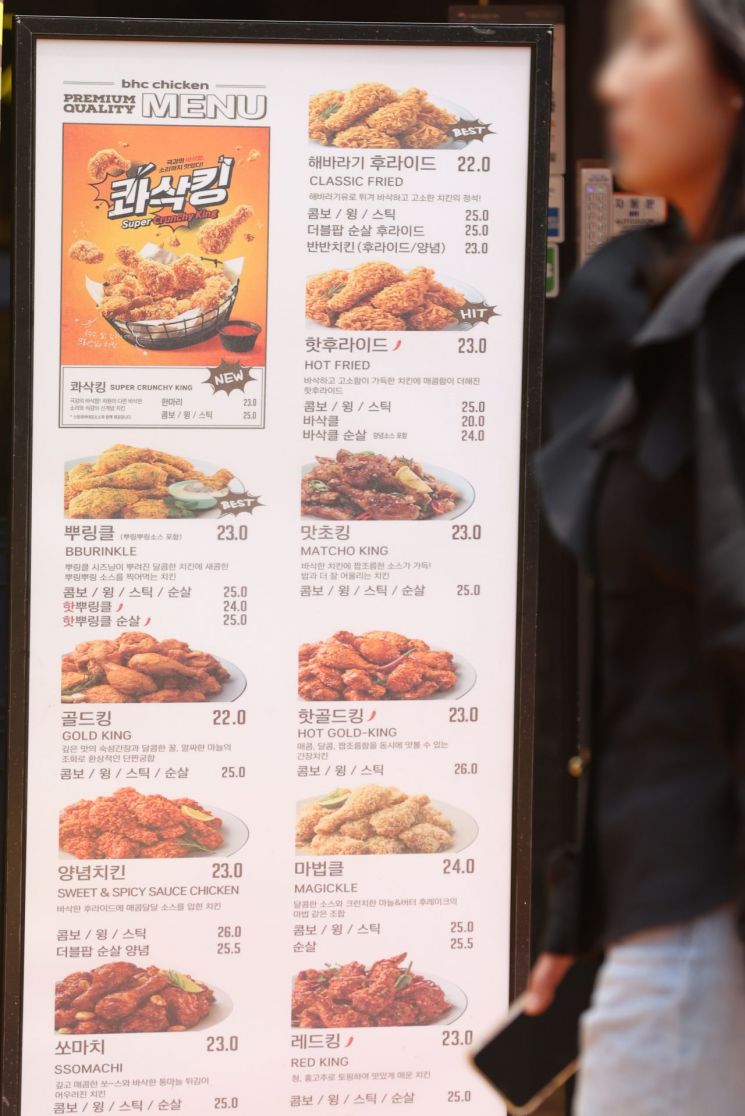
Some franchises, such as bhc and Kyochon, are already labeling the weight for major products, but they argue that it is difficult to label the weight for partial cuts (such as combo, wings, or sticks). Because these items are sold by the piece, and each piece can vary in size, bone content, and moisture, it is hard to specify a clear pre-cooking weight standard. Even with the same number of pieces, the actual weight will inevitably vary each time.
For example, with combo products, even if the number of pieces is the same, the size of each piece will inevitably differ slightly. It is virtually impossible to guarantee the exact weight in advance, and even if it is specified, there is no clear institutional standard for how much deviation is acceptable. Another industry official expressed concern, saying, “There are no concrete guidelines for permissible error ranges, so headquarters are struggling with how to set labeling standards for each menu item. Applying uniform weight labeling to irregular products that are difficult to quantify may only increase disputes.”
There are also calls that standardization at the chicken slaughtering and processing stages is essential to ensure the effectiveness of weight labeling. If major suppliers such as Harim and Maniker cannot consistently manage the weight, discrepancies between the labeled and actual weights are inevitable, no matter how precise the standards set by headquarters and franchise owners. This is why some analysts say that weight labeling is not simply a “labeling obligation,” but a system that requires a comprehensive quality management framework across the entire supply chain to be effective.
Experts note that while this measure could serve as an opportunity to restore trust in the overall chicken market, if the system is implemented without sufficient consideration of on-site realities, franchise owners may end up shouldering not only the burden of handling complaints but also increased operational costs such as refunds and re-cooking.
An industry insider with deep knowledge of the franchise sector emphasized, “The system should be improved so that unavoidable discrepancies due to cooking characteristics are not unfairly blamed on franchise owners.”
© The Asia Business Daily(www.asiae.co.kr). All rights reserved.


















