Overseas Securities Investments by Individuals and Other Economic Agents Lead to High Exchange Rate
From an Analytical Perspective, Foreign Exchange Authorities Need to Consider Supply and Demand Improvements Amid These Trends
Impact of Exchange Rat
"All economic agents act rationally, bearing risks under their own responsibility. However, overseas securities investments by individuals and other economic agents have ultimately led to a high exchange rate. The foreign exchange authorities must consider countermeasures for the resulting situation. Please understand that this is not about blaming any specific party, but rather about addressing concerns arising from these developments."
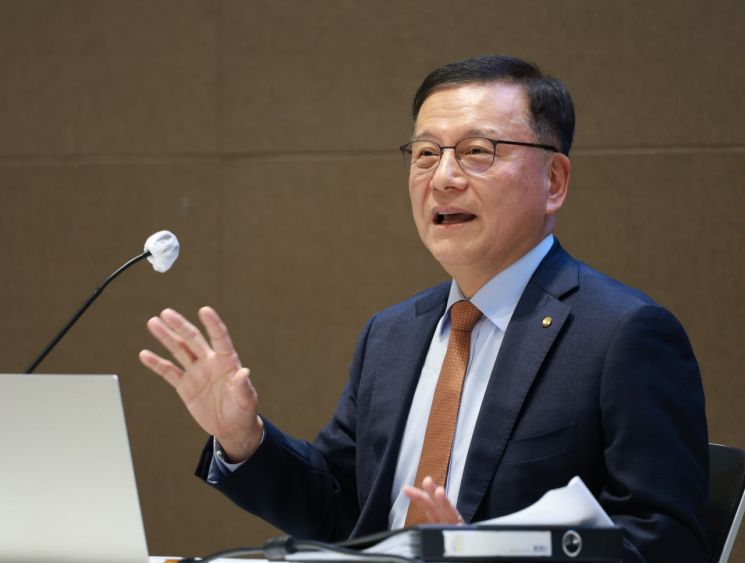 Kim Joungho, a member of the Monetary Policy Committee of the Bank of Korea, is speaking at a press conference held on the 10th at the Bank of Korea in Jung-gu, Seoul. Bank of Korea
Kim Joungho, a member of the Monetary Policy Committee of the Bank of Korea, made this statement at a press conference held on the 10th at the Bank of Korea in Jung-gu, Seoul, in response to a question about whether the recent high exchange rate can be attributed to individual investors seeking high returns in overseas stocks, often referred to as "Seohak Ants."
Kim explained, "There are various factors that affect the exchange rate, such as relative price differences, growth rate differences, and interest rate differences, but in the short term, supply and demand have a significant impact. While foreign exchange demand exists among companies and other entities, recently, economic agents such as the National Pension Service, asset management companies, and individuals have increased their demand by investing in overseas stocks or bonds with relatively higher returns. According to a Bank of Korea survey, about two-thirds of the recent exchange rate increase is due to supply and demand factors."
He continued, "The intention is not to blame any specific party, but when analyzing the factors influencing the exchange rate, it is clear that supply and demand account for a considerable portion." He further explained, "From the perspective of the overall economy, this leads to differentiated impacts across sectors due to the high exchange rate, and it results in negative effects on economic policy." He emphasized that, in light of these unintended outcomes, the foreign exchange authorities need to consider ways to improve supply and demand.
When asked whether communication with the market was clear following last month's Monetary Policy Committee decision on the base interest rate, Kim said, "It would be difficult to meet everyone's expectations, but I believe we conveyed our message to the market in a neutral manner." Regarding the split among the six committee members on the three-month interest rate outlook-three favoring a freeze and three favoring a cut-Kim explained, "Those open to a rate cut focused on the fact that upside and downside risks to growth remain for next year, and that, excluding the IT sector, the growth rate is as low as 1.4%, making it hard to see this as solid growth." He added, "Those open to maintaining the current rate highlighted that the growth rate itself has been revised upward to the potential growth rate, inflation forecasts have slightly exceeded expectations, and that it is still necessary to monitor financial stability issues such as real estate, household debt, and the exchange rate."
He further noted, "In the market, each participant has their own view. Some may have quickly acted on the expectation that 'the Bank of Korea could end its rate-cutting cycle in the near future,' while others took the opposite stance."
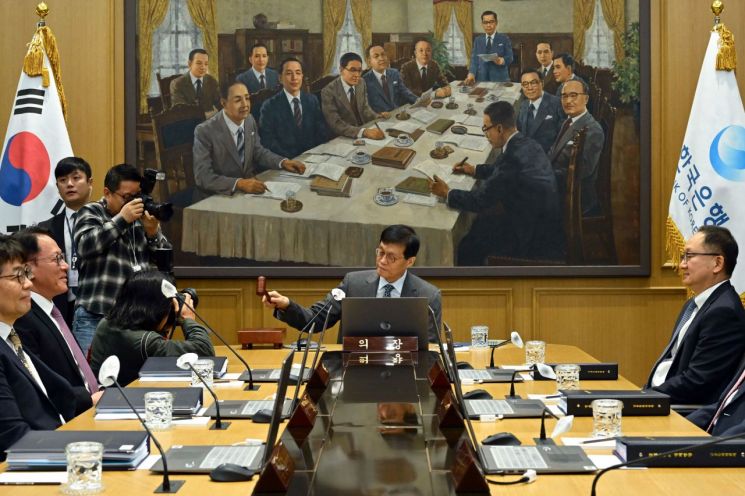 Lee Chang-yong, Governor of the Bank of Korea, is striking the gavel at the Monetary Policy Committee meeting held at the Bank of Korea headquarters in Jung-gu, Seoul, on the 27th of last month. Photo by Yonhap News
Regarding the assessment that the previous day's outright purchase of 1.5 trillion won had a limited impact, Kim said, "Coincidentally, issues with the Reserve Bank of Australia and the European Central Bank (ECB) emerged the previous day, sending signals favoring monetary tightening. This led to speculation in the market about a possible change in the interest rate cycle. The outright purchase was conducted to secure securities for repurchase agreement (RP) sales, as 24 trillion won worth of government bonds were maturing that day."
Kim emphasized that the Bank of Korea's quarterly outlook is helping inform the Monetary Policy Committee's decisions. He noted, "When the quarterly outlook was first introduced, uncertainty happened to increase. Forecasts can be wrong for the Bank of Korea as well as other institutions if conditions change." Regarding the recent increase in money supply, he pointed out that it is similar to the average during rate cuts, and that funds have flowed into linked investment securities as the stock market has performed well.
However, he stressed that all committee members are paying close attention to price stability, which is a key goal of monetary policy. Kim said, "Despite the recent rise in consumer prices, the annual forecast is expected to remain stable near the target (2.0%) for both this year and next year. However, the committee is also considering the impact of the exchange rate on inflation."
Kim said that communication between the Bank of Korea and the government is sometimes necessary for sharing economic perspectives and coordinating policy. However, he emphasized that means and methods should be determined independently, and that communication is conducted with this in mind.
© The Asia Business Daily(www.asiae.co.kr). All rights reserved.


















