Semiconductors, Electrical Equipment, and Shipbuilding: "Positive" vs. Petrochemicals, Steel, and Batteries: "Negative"
Expansion of AI Infrastructure Investment vs. Ongoing Impact of Chinese Oversupply
There is a forecast that next year, South Korean companies will show a clear polarization in performance depending on their industries. While sectors such as semiconductors and electrical equipment are expected to see improved results thanks to increased investments in artificial intelligence (AI) infrastructure, the petrochemical and steel industries are projected to continue underperforming due to factors such as oversupply from China.
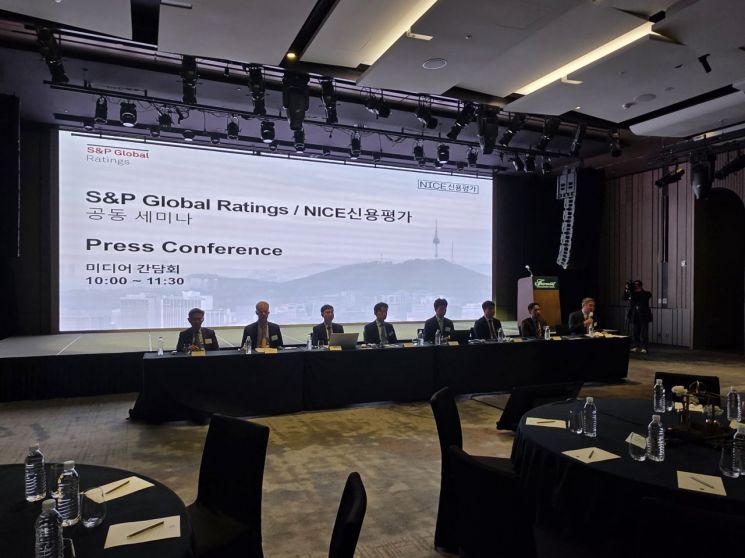
On December 10, NICE Investors Service and S&P Global Ratings held a joint seminar in Yeouido under the theme "Changes in the Global Trading Environment and Credit Risk."
At the seminar, NICE Investors Service predicted that the economic growth rate would rebound in 2026, driven by the base effect from this year's low growth, the expansion of global AI investments, and expansionary fiscal policies. However, the agency anticipated that the economic recovery would be concentrated in certain industries, resulting in a so-called "K-shaped" recovery.
Song Kijong, Executive Director at NICE Investors Service, explained, "As competition intensifies among big tech companies to dominate the market, AI infrastructure investment will continue to expand for the time being. This will benefit the semiconductor and electrical equipment industries in particular."
According to NICE Investors Service, the combined sales of 14 major industry companies are expected to increase by 5.0%, from 1,564 trillion won in 2024 to 1,642 trillion won in 2026. Operating profit is also projected to rise by 39.3%, from 122 trillion won to 170 trillion won. However, the agency emphasized that performance trends will vary significantly by industry.
Choi Yuseok, Executive Director at NICE Investors Service, stated, "Semiconductors, electrical equipment and cables, shipbuilding, and the defense industry-which are supported by AI growth and U.S. policy-have a positive credit outlook. In contrast, the credit outlook for petrochemicals, secondary batteries, steel, and construction, which are affected by intensified competition from China and weak domestic demand, is negative."
S&P Global Ratings also expressed a similar view, expecting positive trends in semiconductors, shipbuilding, and electronics. On the other hand, secondary batteries, petrochemicals, and steel are still expected to face negative prospects. Earlier, in March 2024, S&P downgraded the rating outlook for POSCO Holdings, POSCO, and POSCO International from "stable" to "negative," and also lowered the credit ratings or outlooks for seven companies in the EV battery, chemical, and steel sectors. The agency has maintained this outlook.
Park Junhong, Executive Director at S&P Global Ratings, explained, "We are seeing industry-wide polarization, and this trend is likely to continue. The semiconductor sector is showing the most positive momentum, and shipbuilding is similar." He added, "Battery companies are going through a difficult period due to declining demand in the United States."
Regarding U.S. tariff policies, the agencies noted that negative impacts remain, but as policy details become clearer, uncertainty is expected to decrease. Park stated, "Industries such as semiconductors and shipbuilding are benefiting from U.S. policies and reduced competition from China."
Despite challenging conditions, a gradual improvement is expected. S&P Global Ratings forecasts that South Korea's GDP growth rate will rebound from 1.1% in 2025 to 2.3% in 2026. Park commented, "Looking at the credit cycle, the overall trend has been difficult, but we are seeing a rebound starting in the second half of the year. Although the situation remains tough, the credit outlook for next year is likely to improve compared to this year."
© The Asia Business Daily(www.asiae.co.kr). All rights reserved.
![Clutching a Stolen Dior Bag, Saying "I Hate Being Poor but Real"... The Grotesque Con of a "Human Knockoff" [Slate]](https://cwcontent.asiae.co.kr/asiaresize/183/2026021902243444107_1771435474.jpg)















