Will the Export Tax Controversy Be Resolved?
Questions Remain Over Security Review Effectiveness
Nvidia's H200 chips destined for China are reportedly set to undergo a separate national security review in the United States before shipment.
On December 9 (local time), The Wall Street Journal (WSJ) reported, citing government sources, that Nvidia's H200 chips will be subject to a special security review in the United States before being exported to China. Since most of Nvidia's artificial intelligence (AI) chips are manufactured by Taiwan's TSMC, the H200 chips will likely have to be shipped from Taiwan to the United States for inspection and then sent onward to China.
This complex shipping route is seen as a measure reflecting concerns that exporting Nvidia chips to China could harm national security, especially amid the ongoing competition for AI supremacy between the two countries. Currently, bipartisan lawmakers in the U.S. Senate have introduced the "SAFE Act" (Securing America's Future and Ensuring the Export of Semiconductors Act), which would allow the Secretary of Commerce to deny export licenses for advanced chips to China for the next 30 months. This reflects growing concerns about permitting exports of the H200 chips to China.
Exporting Nvidia chips to China via the United States could also resolve legal issues related to the government's plan to claim 25% of sales revenue. There have been criticisms that former President Donald Trump's proposal to impose a levy on a certain percentage of semiconductor exports to China would be unconstitutional, as it effectively amounts to a tax on exported goods. However, if tariffs or import duties are imposed when Nvidia chips enter the United States from Taiwan, and then they are re-exported to China, this could circumvent the controversy.
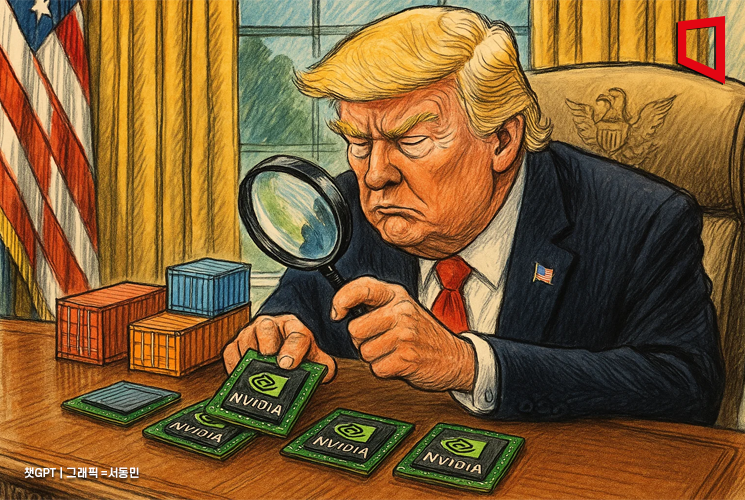
However, questions remain as to whether the security review will have any real effect, as the core security issue is where the chips ultimately end up and how they are used. While U.S. lawmakers have expressed concerns that Nvidia's AI chips could aid the Chinese military, Nvidia CEO Jensen Huang maintains that, due to its own security concerns, China would not use American chips in its military.
Meanwhile, Bloomberg News reported, citing sources, that President Trump allowed the export of the H200 chips because Huawei in China already offers AI systems with similar performance, which he judged to pose a lower security risk. Huawei's latest AI platform, CloudMatrix384, based on the Ascend chip, reportedly offers performance comparable to Nvidia's NVL72, which is based on the Blackwell architecture. Sources also indicated that the expectation that Huawei could produce millions of Ascend chips by 2026 influenced the decision to allow exports.
President Trump reportedly concluded that, even with the export of the H200 to China, the United States would maintain an 18-month technological lead, and that China would remain dependent on the U.S. technology ecosystem. However, according to Bloomberg News, neither the Department of Commerce nor Nvidia responded to requests for comment on the matter.
© The Asia Business Daily(www.asiae.co.kr). All rights reserved.


















