Thai Military Launches Preemptive Strike on Cambodian Chinese Rockets
Taiwan's 'T-Dome' Threatened... "Difficult to Defend"
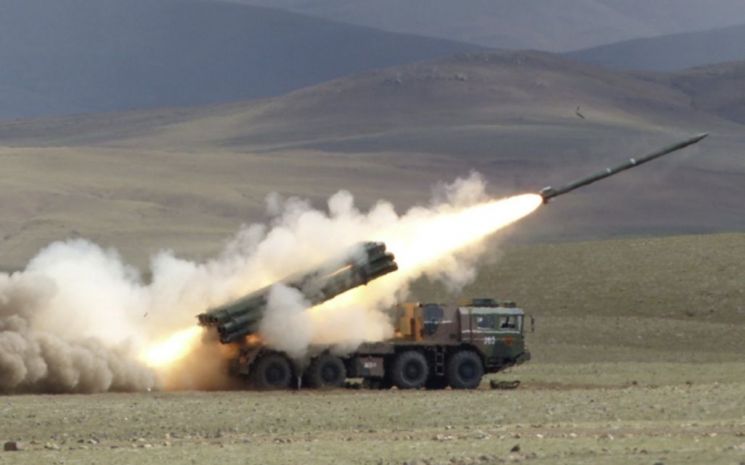
As clashes between Thailand and Cambodia have resumed, the primary cause of the conflict is being attributed to Cambodia's use of multiple launch rocket systems imported from China. The weapon is considered so powerful that some within and outside the Thai military claim a preemptive strike was necessary to prevent civilian casualties. This weapon was previously deployed during the border dispute between China and India and is now believed to be stationed in significant numbers around the Taiwan Strait. Some experts are expressing concerns that China's multiple launch rocket systems could severely disrupt Taiwan's plans to establish an advanced air defense network.
Resumption of Thailand-Cambodia Military Clashes..."Preemptive Strike on Chinese Rockets Owned by Cambodia"
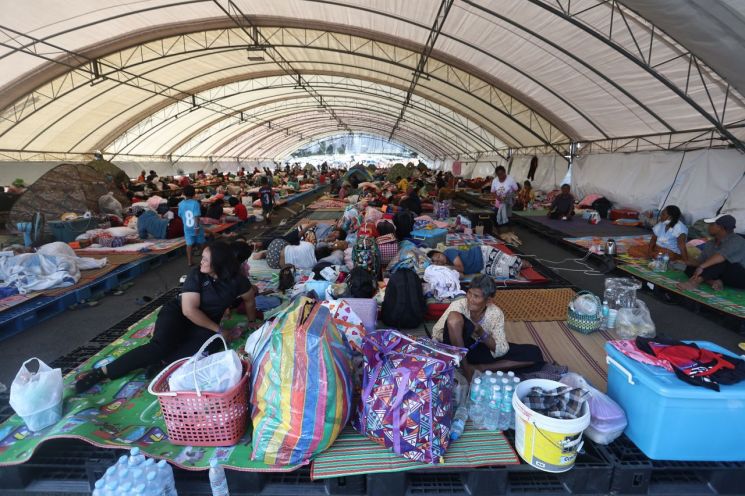 On the 8th (local time), as clashes resumed between Thai and Cambodian forces, residents near the Thai border gathered at temporary shelters. Photo by AP Yonhap News
According to AFP, the Thai and Cambodian militaries resumed hostilities on the 7th (local time). The Thai military launched airstrikes on Cambodian bases using F-16 fighter jets, after which both sides continued artillery shelling and small-scale skirmishes along the border. Just two months after a ceasefire agreement was brokered by the United States in October, renewed armed conflict in the border area has resulted in the deaths of over 10 soldiers and civilians, and forced more than 600,000 residents near the border to evacuate.
The Thai government insists that Cambodia was the first to violate the ceasefire agreement and has emphasized its determination to continue resistance. Thai Prime Minister Anutin Charnvirakul stated in a televised address immediately after the clashes, "We will take all necessary measures to protect our territory," adding, "There will be no dialogue or negotiations with Cambodia, and to halt the fighting, they must meet the conditions we have presented."
Within and outside the Thai military, there are claims that a preemptive strike was launched because Cambodia attempted to use Chinese-imported multiple launch rocket systems to attack civilian areas. Surasant Kongsiri, spokesperson for the Thai Ministry of Defense, said in an interview with major foreign media, "The Thai military assessed that the Cambodian military could use Chinese-made PHL-03 multiple launch rocket systems to bomb local civilian airports and state-run hospitals within Thailand," adding, "There were attempts by the Cambodian military to obtain coordinates for such civilian facilities, and to prevent this, we targeted Cambodian military bases, including artillery rocket storage facilities."
Chinese Multiple Launch Rockets Deployed During China-India Dispute...Comparable to U.S. HIMARS
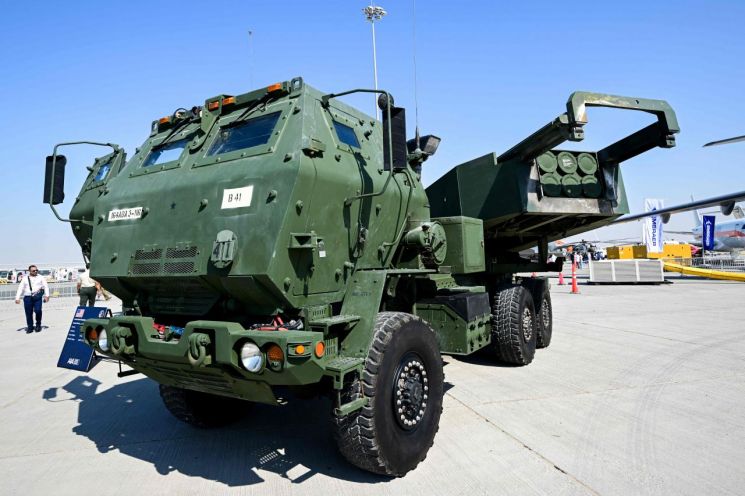 The M142 High Mobility Artillery Rocket System (HIMARS), a multiple launch rocket system from the United States, displayed at the airshow held in Dubai, United Arab Emirates (UAE) on the 20th of last month (local time). Photo by AFP Yonhap News
The Chinese-made PHL-03 multiple launch rocket system, which has emerged as a major factor in the current conflict, is known for its range of up to 130 kilometers, making it capable of striking deep into Thailand beyond the border areas. China notably deployed the PHL-03 to the border region during its 2020 dispute with India. The system is considered comparable in capability to the American M142 High Mobility Artillery Rocket System (HIMARS).
This weapon is an improved version of the Soviet BM-30 Smerch multiple launch rocket system, developed and deployed by China since 2004. It can fire 300mm large-caliber rockets, and a single salvo can devastate an area of 0.67 square kilometers (about 200,000 pyeong). Due to its proven combat effectiveness and mobility, it has been exported not only to Morocco and Ethiopia but also to other countries.
There are suspicions that China has been covertly supplying this weapon to Cambodia since June. The New York Times (NYT), citing Thai intelligence officials, reported, "Since June, Chinese Y-20 military transport aircraft have made about six trips to Sihanoukville, Cambodia, during which multiple launch rocket systems and shells were delivered. These weapons were then transferred to the nearby Ream Naval Base and subsequently distributed to the northern border regions of Cambodia."
'T-Dome' Under Preparation in Taiwan Threatened..."Difficult to Block Chinese Multiple Launch Rockets"
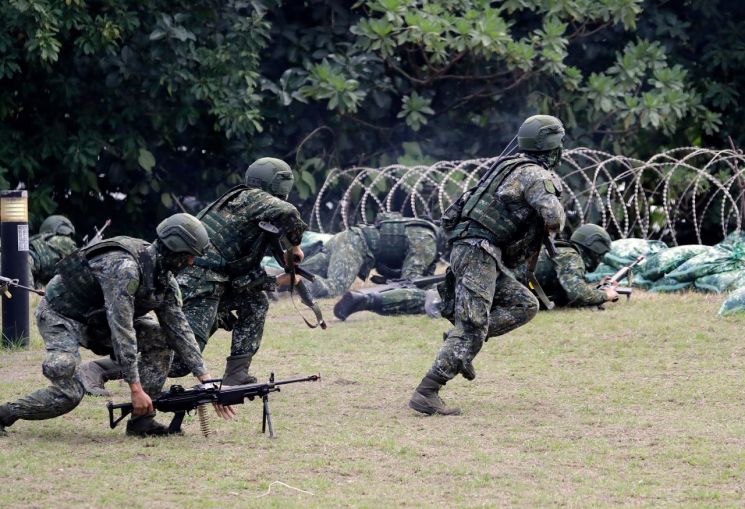 Scenes from the reserve forces training conducted on the 2nd (local time) in Yilan County, northeastern Taiwan. Photo by AP Yonhap News
There is also analysis that China's multiple launch rocket systems pose a significant threat to Taiwan's security. It is believed that Taiwan's planned advanced air defense network, known as the 'T-Dome,' would have great difficulty intercepting these rocket systems.
According to the Taiwanese media outlet China Times, the Chinese military has recently withdrawn short-range ballistic missiles such as the Dongfeng (DF)-15 from the Taiwan Strait area and has instead deployed a large number of multiple launch rocket systems. By deploying these systems, which can deliver massive barrages to targets about 130 kilometers away from the Chinese mainland, China is seen as aiming to paralyze Taiwan's air defense network in the event of a conflict.
Sun Bingzhong, a former colonel in the Taiwanese Army and a military expert, stated, "The multiple launch rocket systems deployed by China in the Taiwan Strait area can fire thousands of rounds in a single salvo, and each rocket costs only about 200,000 yuan (approximately 41.6 million won)." He added, "In contrast, the cost of a single U.S. Patriot missile, the core defensive weapon of Taiwan's T-Dome project, exceeds 3 million dollars (about 4.4 billion won), so if the Chinese military engages in a war of attrition using multiple launch rocket systems, it will be extremely difficult to defend."
Meanwhile, the T-Dome refers to the multi-layered air defense system over Taiwan officially announced by President Lai Ching-te in October. Although the specific weapon configuration and budget have yet to be finalized, it is widely expected that the Taiwanese military will focus on further purchasing U.S. Patriot PAC-3 missiles.
© The Asia Business Daily(www.asiae.co.kr). All rights reserved.
![Clutching a Stolen Dior Bag, Saying "I Hate Being Poor but Real"... The Grotesque Con of a "Human Knockoff" [Slate]](https://cwcontent.asiae.co.kr/asiaresize/183/2026021902243444107_1771435474.jpg)


















