First Scientific Evidence Suggesting the Possibility of Treatment
Evidence has been presented regarding the causes of symptoms such as decreased concentration and memory that occur after COVID-19 infection.
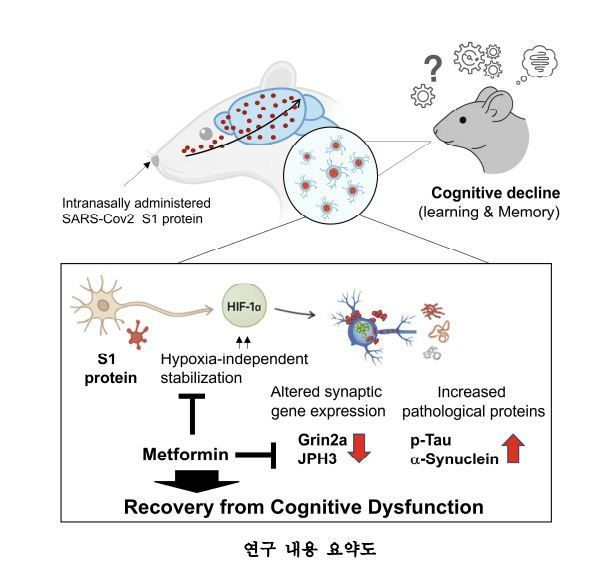 Summary of Research Content. Korea Disease Control and Prevention Agency National Institute of Health
The Korea Disease Control and Prevention Agency National Institute of Health announced on December 9 that it has scientifically identified the causes of cognitive impairment reported after COVID-19 infection through animal experiments.
According to the research, the spike protein (S1) of the COVID-19 virus reaches the brain, interferes with the connectivity between neurons, reduces the expression of NMDA receptor genes crucial for memory formation, and increases the accumulation of toxic proteins associated with dementia and Parkinson's disease.
In the experiment, when the S1 protein was administered nasally to mice, they exhibited decreased learning and memory abilities and increased anxiety behaviors, showing patterns similar to cognitive decline observed after COVID-19 infection. Additionally, six weeks after administration, a decrease in the number of neurons and accumulation of pathological proteins characteristic of degenerative brain diseases were observed in the hippocampus, suggesting the possibility of long-term brain damage.
Meanwhile, it was also observed that 'metformin', a diabetes medication, helped restore neuronal function and reduced the accumulation of toxic proteins. Metformin is already a widely used diabetes treatment.
This study provides the first scientific evidence suggesting the possibility of treating cognitive impairment that appears after COVID-19 infection. Kim Jungyeon, Head of the Clinical Research Division at the National Institute of Infectious Diseases, stated, "Since August 2022, through the 'Chronic COVID-19 Syndrome Survey and Research Project,' we have been conducting studies to identify the clinical features and underlying mechanisms of chronic COVID-19 syndrome in Korea, as well as clinical trials to discover treatments. We will establish scientific evidence for the management of chronic COVID-19 syndrome patients and share it promptly."
Im Seungkwan, Commissioner of the Korea Disease Control and Prevention Agency, said, "Research is needed on patients who experience long-term symptoms even after COVID-19 infection," and added, "We will continue to support research on infectious diseases and brain disorders to establish evidence-based policies."
© The Asia Business Daily(www.asiae.co.kr). All rights reserved.
![Clutching a Stolen Dior Bag, Saying "I Hate Being Poor but Real"... The Grotesque Con of a "Human Knockoff" [Slate]](https://cwcontent.asiae.co.kr/asiaresize/183/2026021902243444107_1771435474.jpg)















